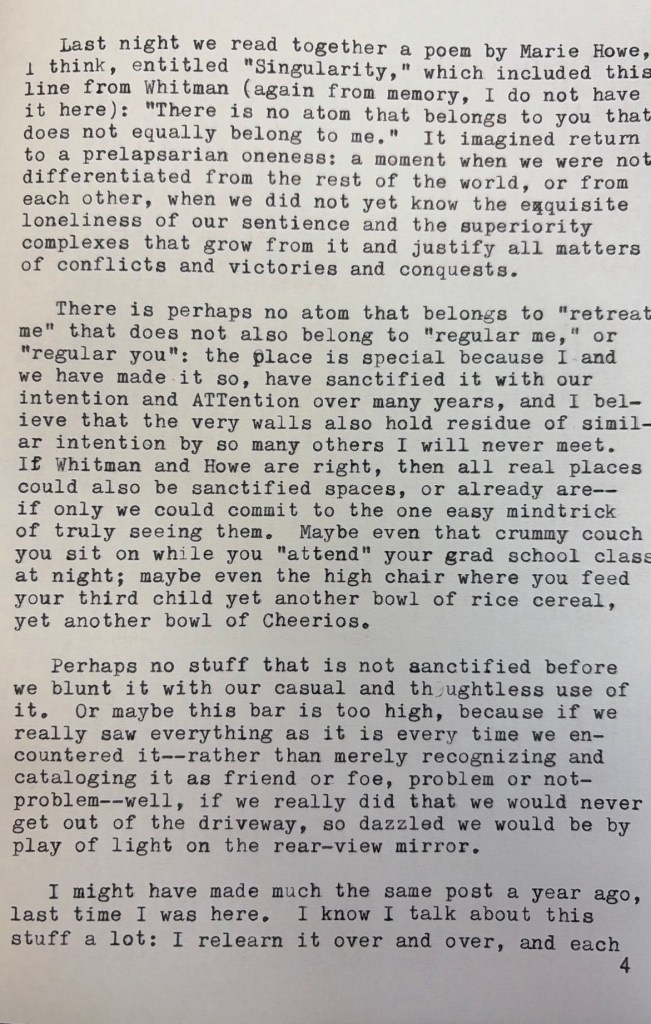
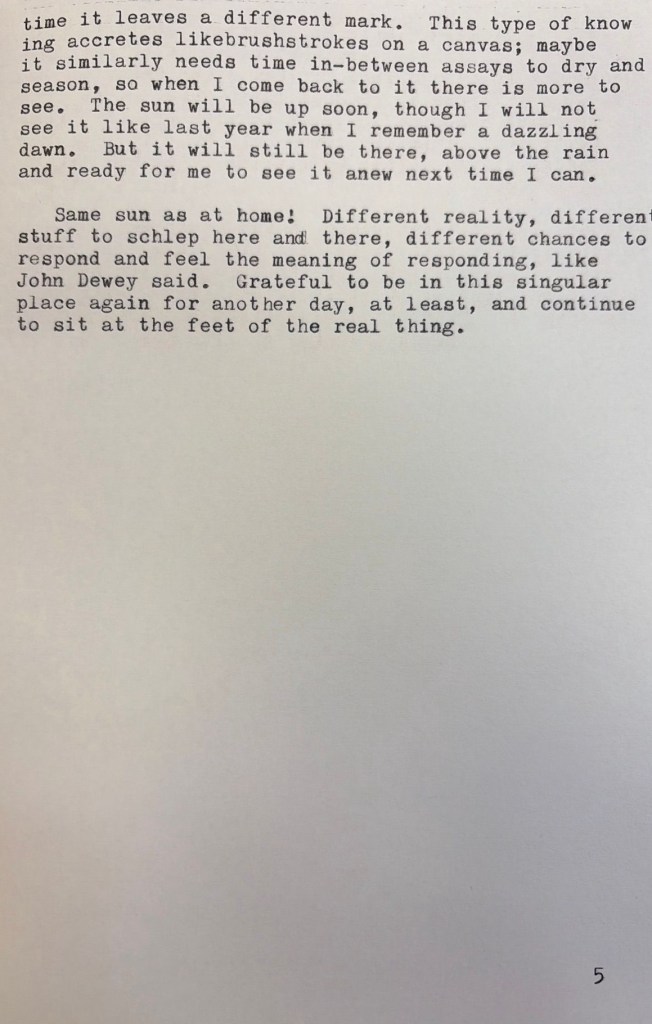
The poem: https://poets.org/poem/singularity
The poem: https://poets.org/poem/singularity
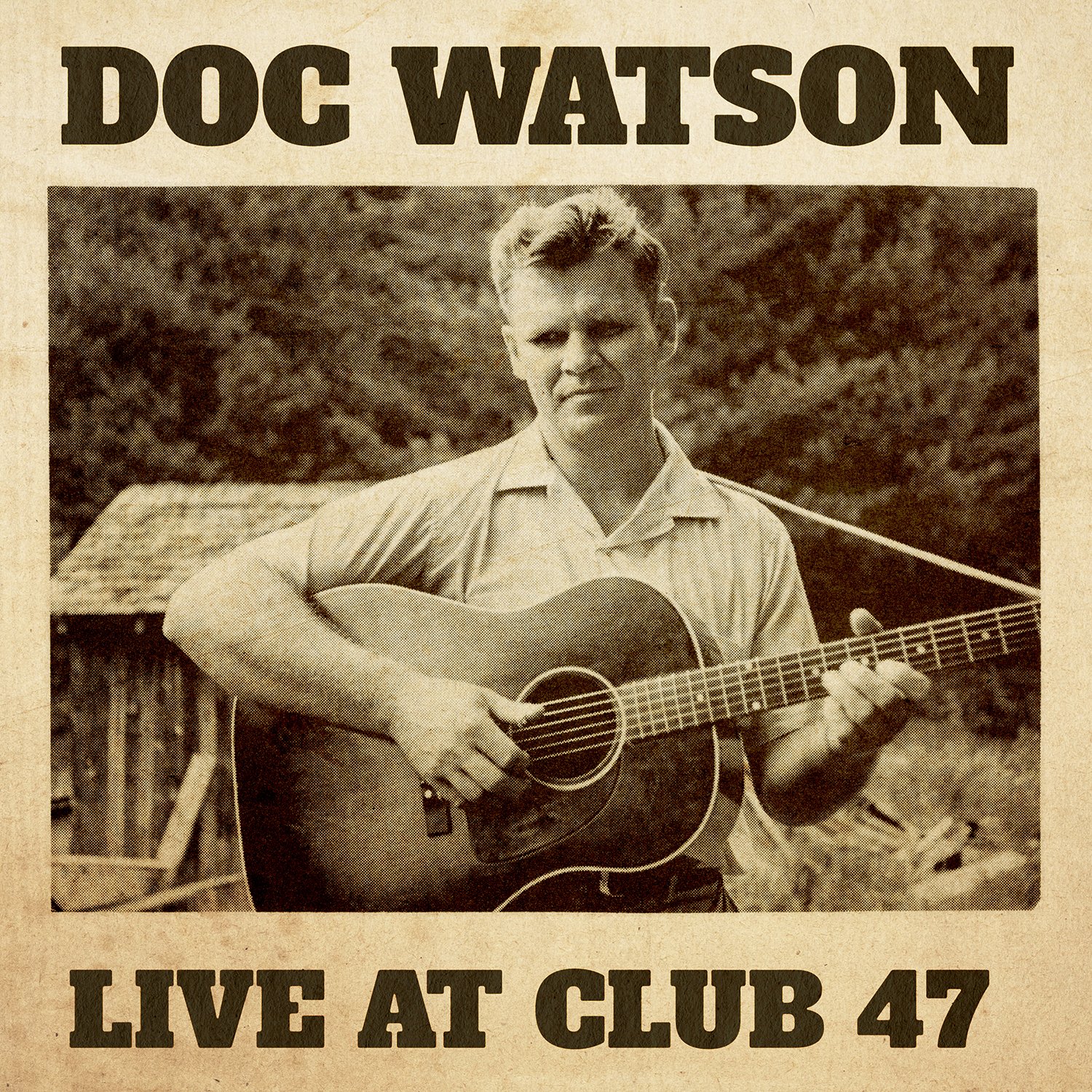
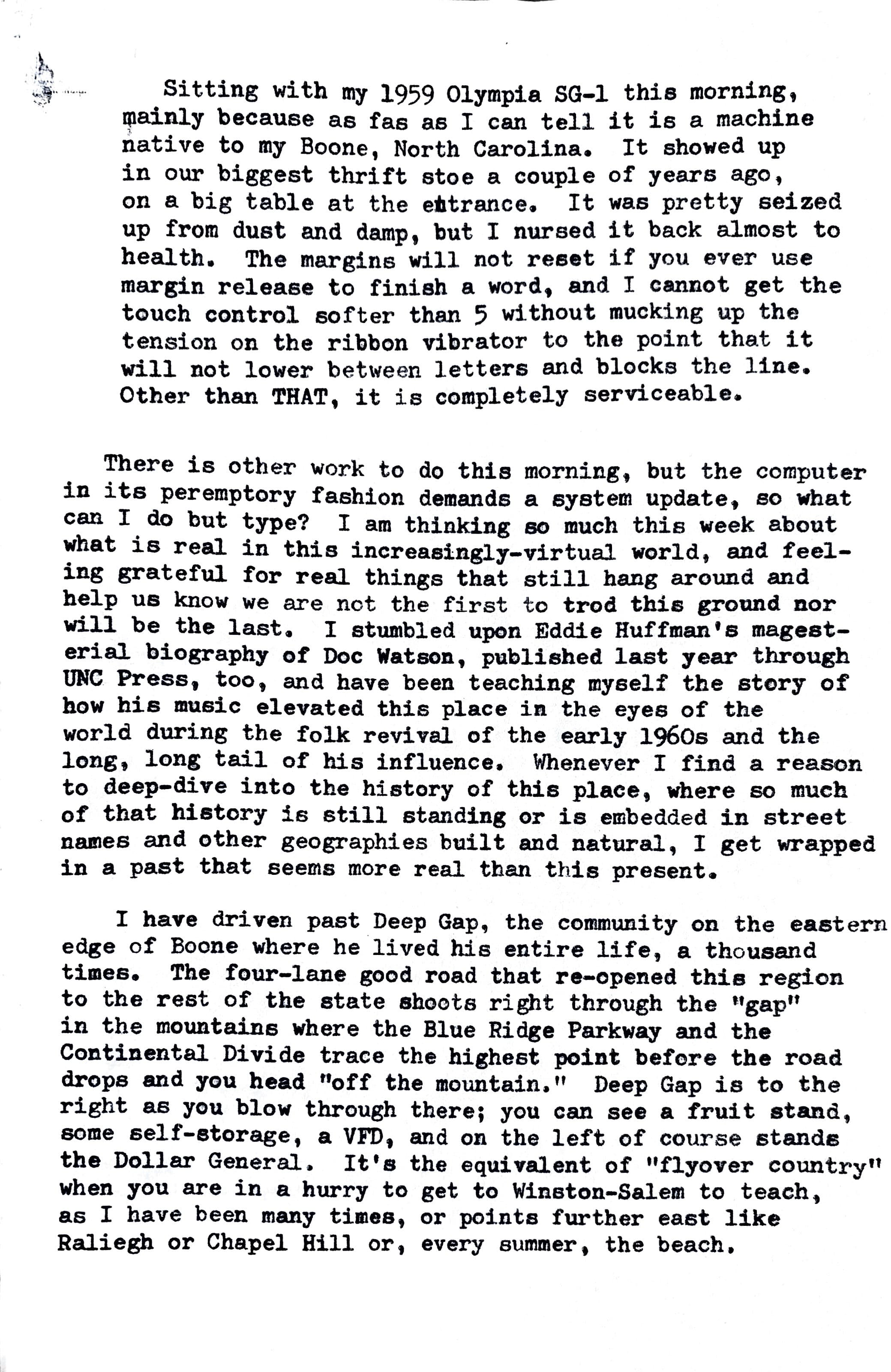
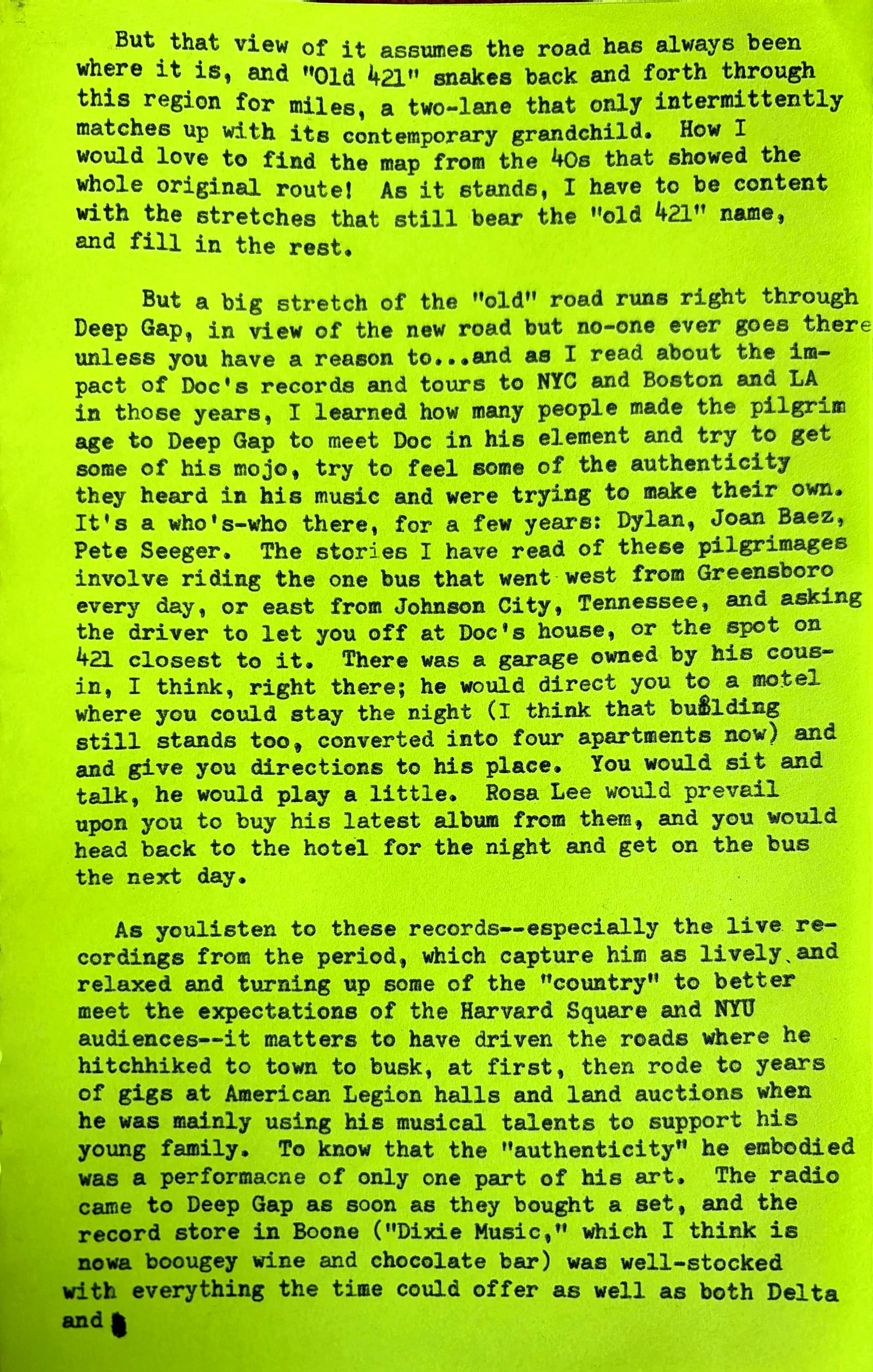
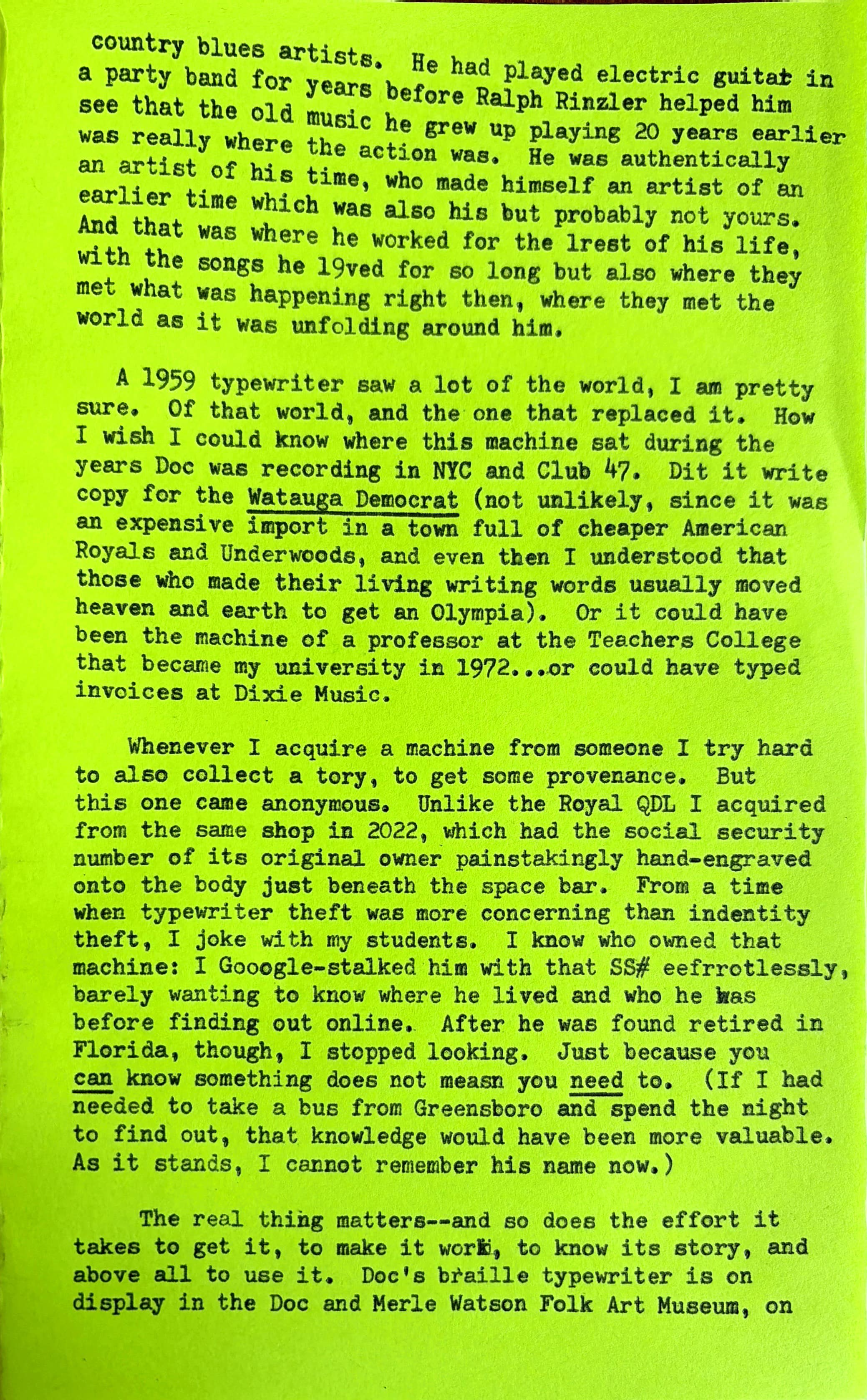
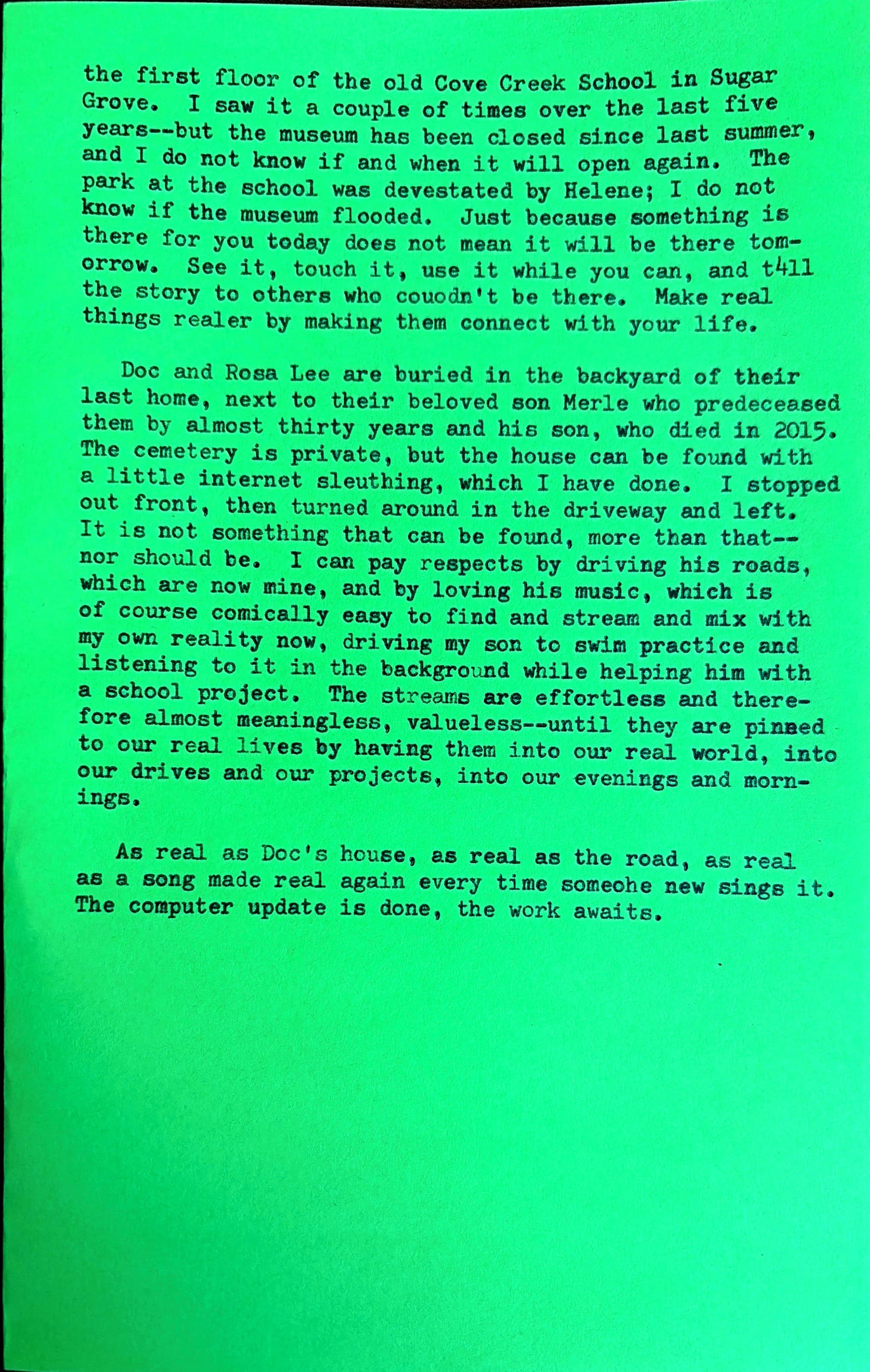
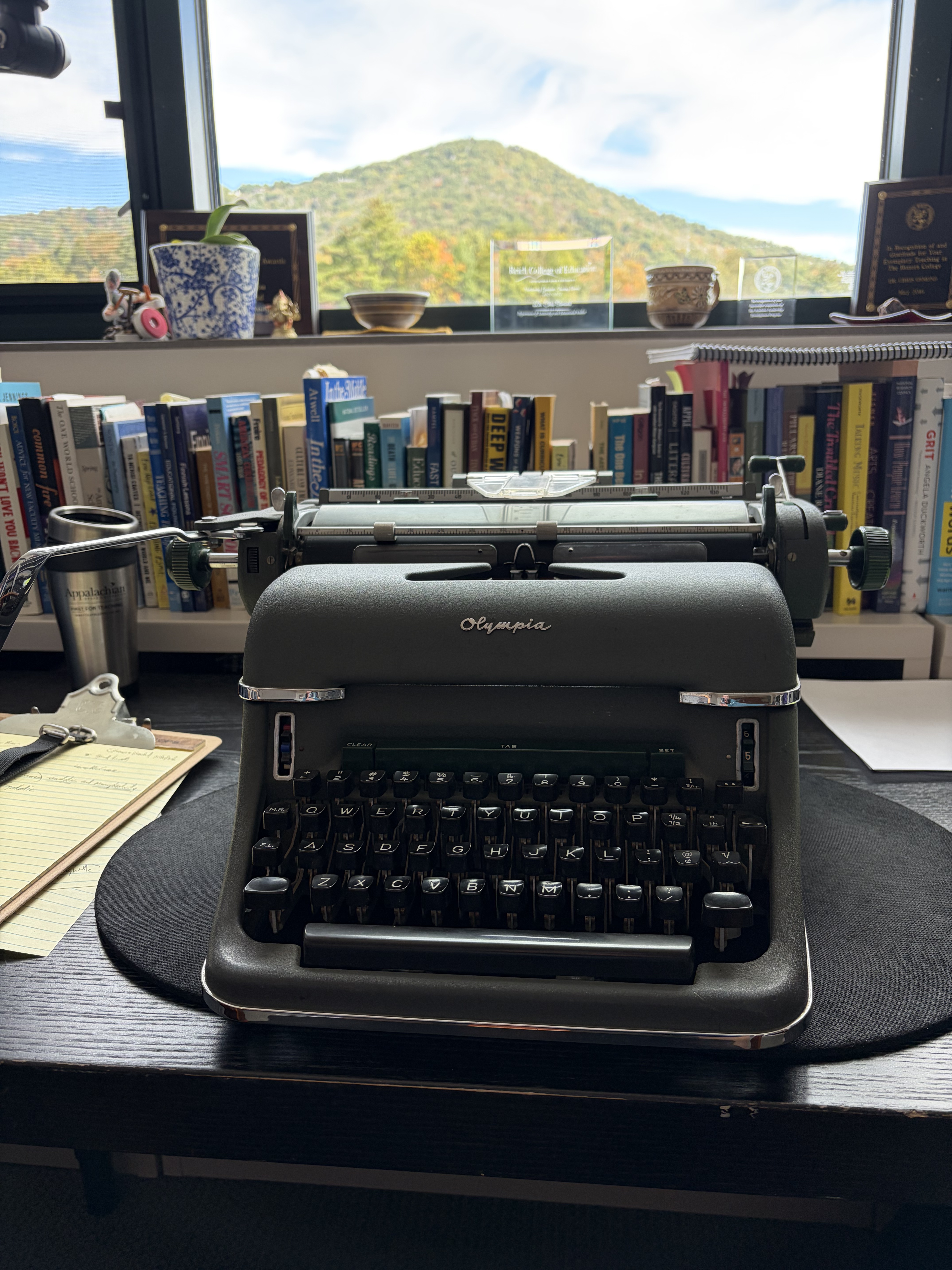
Buy the book! Eddie Huffman, Doc Watson: https://uncpress.org/9781469680354/doc-watson/
Pilgrimage stories, from people of various famousness:
https://www.fretboardjournal.com/features/imposing-doc-watson-hitchhikers-musical-memoir/
https://gardenandgun.com/remembering-doc-watson
The soundtrack: https://docwatson.bandcamp.com/album/live-at-club-47-2

Here are three reality-adjacent (and typewriter-enabled!) flashes of hope: two from this week, and one from way back that’s finally finished its lesson.
September 23rd’s web page featured this headline for a story in The Athletic:
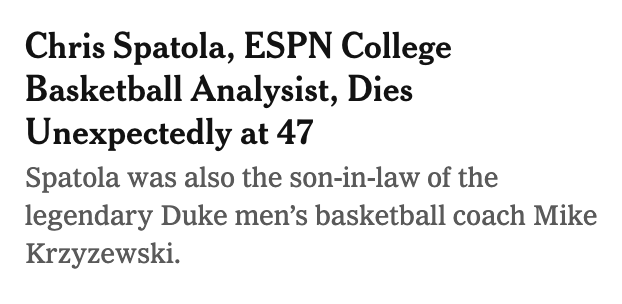
Tragic news, marred by what we still call a “typo.” (You might need to look for it again, unless you are a former English teacher proofreader-type too.)
Frequent and discerning readers of The Gray Lady know that repeated words, misspellings, and false start sentences are not uncommon, even in 2026. They are invariably corrected the next time you think to refresh the page–but they still happen (and some make a cottage industry of noting them).
Whenever I encounter one I treasure it. Because it means there is a real person on the other side of my screen, in Times Square or L.A. or Paris or Baghdad, going hell-for-leather to make deadline. Not an A.I. agent. (Well, not until AI starts putting the right titration of typos into its prose to meet its ends.)
I have held for a few years now that soon actual “typos” will be precious, almost-boutique experiences, like face-to-face schooling. Because they will mean a real person is passing through an experience alongside you, sharing your time and space and making sense of the world too. I think that time is already now.
(And as a waggish friend noted: “I also love that the NYT could misspell ‘analyst’ but spell ‘Krzyzewski’ correctly.”)
2. The Kids Are Alright, and Angry.
I brought Stanford’s AI howler to both my undergrad sections of preservice teachers this week.
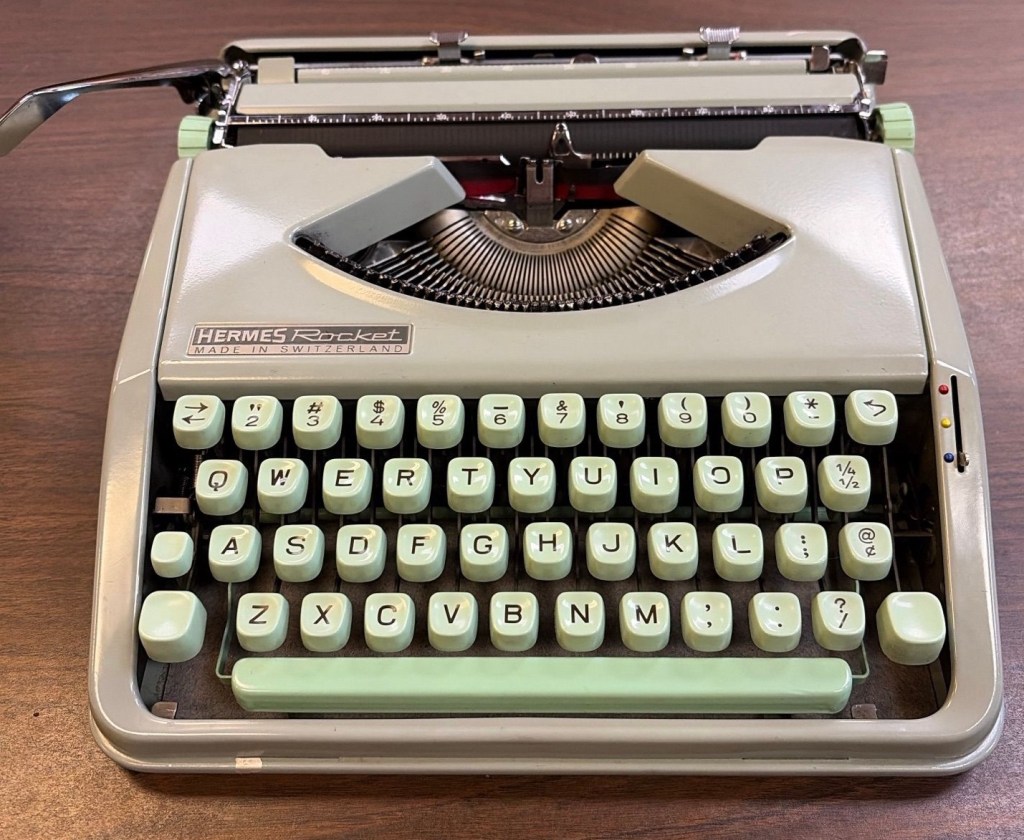
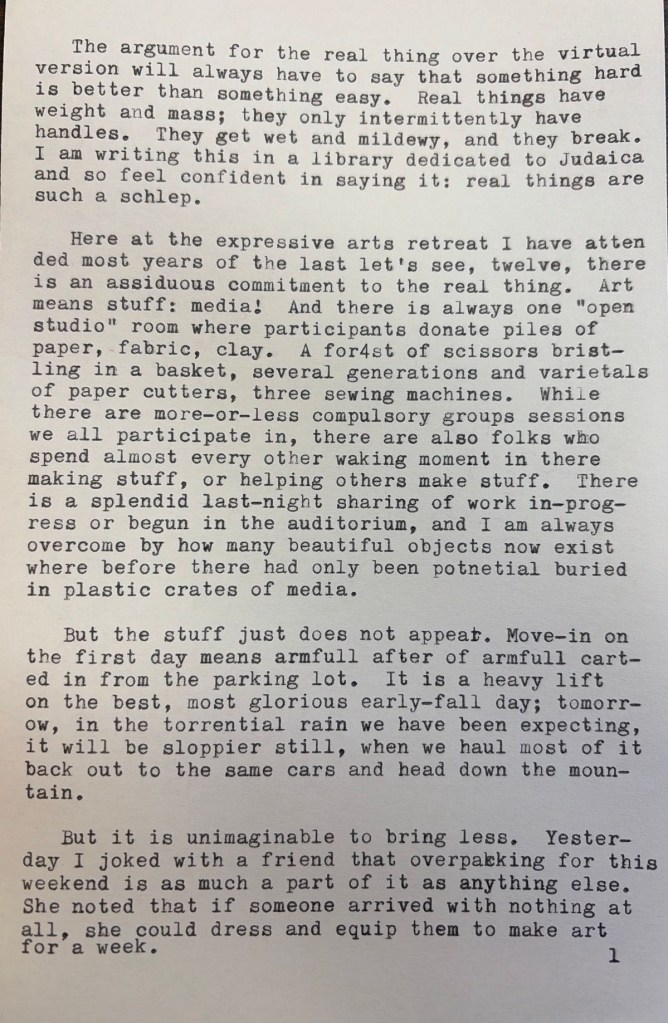
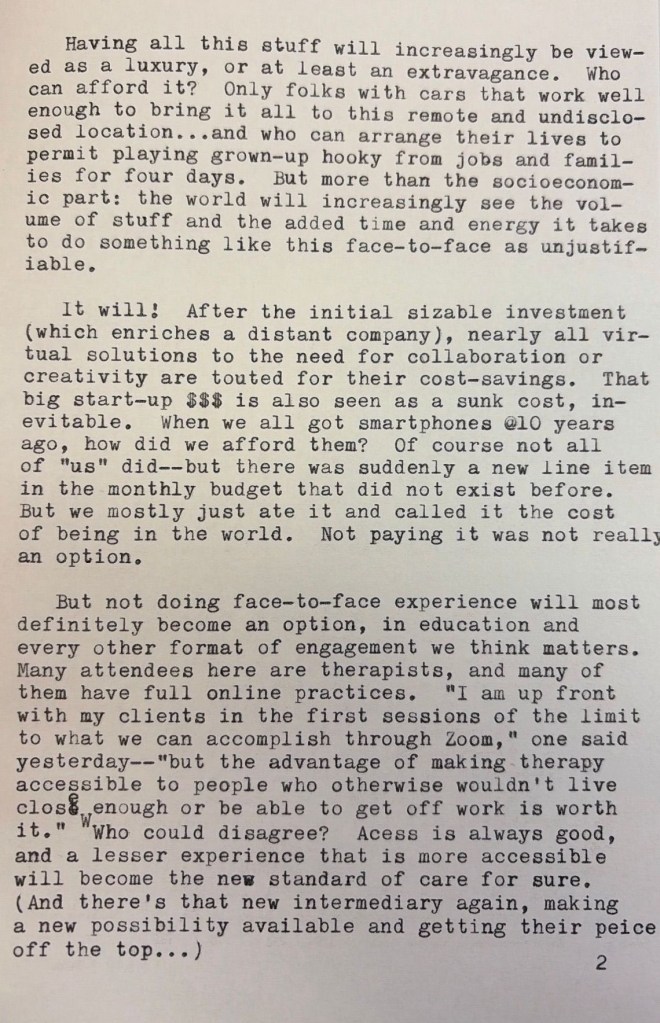
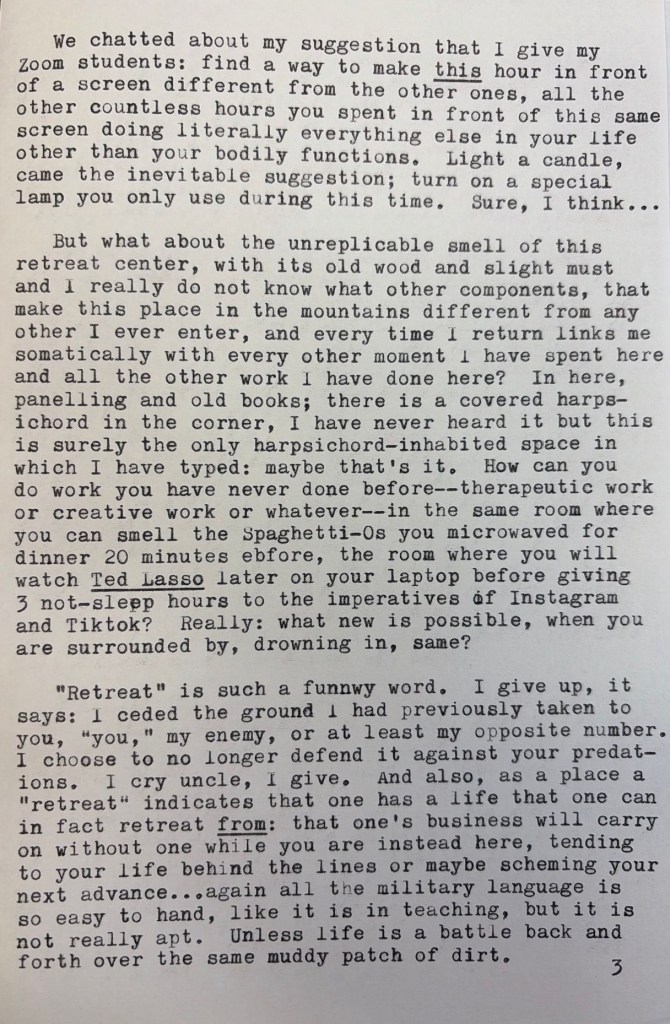
We use my collection of manual typewriters for reflective writing, to find the contemporary themes of historical reading and make connections to experience that transform ideas into learning. Inevitably, work with these beautiful hands-on machines invites excursions into what technology does, can’t do, and might do to and for the yet-hypothetical classroom of their subject and level.
As I never tire of reminding them: my phone distraction / using AI “for brainstorming”/ reality bending teaching problem today is their problem in @ 3 years. What are they going to do about it?
I have to screenshot the image from the NYT story, in case you have somehow missed it. You need to have the same chance to react that they did.

The first photo was snapped of three undergrads at a “Lunar New Year Party in 2024.” I imagine this was a late night dining promotion, like midnight breakfast during exams. The second appeared in online university promotional materials last week.
The student on the right in the original photo, Billy Ramirez, seems remarkably good-humored about the revision, though also unsparing. After all, university students, staff, and faculty of color are used to having their images centered, altered, or removed, as suits the branding need of the moment.
“To see me erased like that so easily was kind of very upsetting,” Mr. Ramirez, who is Hispanic, said in an interview on Tuesday.
Mr. Ramirez, a senior who is majoring in human biology, said there was “a comedic element” to the matter. Nevertheless, he said that he was frustrated by Stanford’s move, which he learned about from a friend.
The other students in the original photo “did not respond to emails on Tuesday.” The student on the right in the altered photo could not be reached for comment, obviously, because she does not exist. (Her AI sister Tilly might be game to offer some word salad, in a language or two, maybe.)
My own undergrads’ response didn’t start with racial / ethnic erasure, though. Instead they zeroed in on the revisions to make the other two students more conventionally attractive.
“They made them hotter,” was the first, dismayed comment in one class. “It’s the dining hall late at night. No one is camera-ready. People are just wearing whatever and trying to get something to eat.”
We went on to talk about that mix of aspiration and self-loathing that powerful advertising sparks inside us. Obvs, they agreed.
But then a student said, “If I see the second photo in an ad, it makes me not want to go to Stanford. No one really looks like that. Where would I fit in?”
In one acid take that student undid a century of marketing campaigns, and decided to let be be finale of seem.
I tried the counterpunch: “But what if you are the UComm employee who has to finish this web page and two more before midnight. You do not have the actual image you think you need! Can you see why maybe, just this once, you could fudge it with AI, and make up people who don’t exist?”
Absolutely not, both groups roared back at me. Not even worthy of response. Authenticity above all. Reality above all, said the room.
“Besides,” came the coup-de-grace: “This same university will bust you for using AI to write a paper.
“How can they turn around and use it themselves?”
3. The Canoe
Twenty years ago I helped start a microschool in the North Carolina piedmont. It did not survive past its first year. The experience taught me gratitude for institutions, for existing infrastructure that doesn’t need to invent a way to get attendance to the front office by 9 AM every day, etc.
But in class this week, another lesson from that time came back to me. One of our organizing team was tech-savvy, and used PhotoShop (oh innocence) to place the name of the school in many becoming photographs that supported its vibe. Our building backed on a lovely river; one photo depicted a Coleman canoe nosing into a sun-dappled autumn stream, with the school name now proudly lettered in gold on the transom.
We are all dazzled, excited by how our nascent website would be zhuzhed up by these gorgeous images. We will have so many prospective students applying!
But one of the teachers contemplated the pictures silently for several moments. Then she asked,
“What do we tell the student who shows up on the first day and says, ‘I want to see the canoe’?”
She was right.
The trust of a young person in the intentions and credibility of a new school comes down to whether or not it is what it says it is.
How can a student know they are safe–know they can relax and trust–know they are free to do the work they are here to do–without that rock-solid confidence?
The photos were forgotten.
The young people are done with appearances and promises.
They just want to see the canoe.
Lead image borrowed from The Happy Adventure, with thanks.

1977: I learn we are moving to upstate New York from our rented home in Clinton, Maryland. Dad will be stationed at Griffiss AFB, and I will come to learn about B-52 bombers. Once when I am mowing the lawn a B-52 comes in so low over our house, blotting out the sun for an instant. You mean New York City, I remember asking? Images of Welcome Back Kotter in my mind, maybe West Side Story; terrifying, filthy, loud. Oh no, Mom assures me: that is hours and hours away. Nothing like that.
1982: We get basic cable, MTV. Life changes immediately for the better as I first see drums being played, and a whole lot more. Package includes WOR-TV; in-between Tom and Jerry episodes I learn of another universe. Carvel ice cream, Crazy Eddie‘s where the prices are in-saaane, something astonishing called Rockaway Beach. Can we go, I wonder. No, we cannot.
1983: Junior high theatre club trip down from Rome to see Cats on Broadway. So much Thruway, gray skies and bouncing in a school bus (no, even better: a charter). We are told to avert our eyes through Times Square, which isn’t Disneyfied yet. We do not. Rum Tum Tugger, flashing eyes on actors running through the aisles in the dark, a proscenium of artful garbage buffed to a high polyurethane sheen, a beautiful Siamese cat dancer languid upstage. Meet and greet with Terrence V. Mann at the stage door; a Red Lobster? I get a burger. Long trip home through cold and dark treasuring up what I had seen, a world so strange, so magical, just over there.
1988: weekend in the big city from college in Connecticut with two dear frosh friends. One’s cousin is a high-roller bridge champion and has an apartment in Battery Park; he’s out of the country at a tournament and we will have the place to ourselves. Innocents abroad–I am, at least; half my friends it seems come from Stuyvesant or somewhere in New Jersey. I am too dazzled by their brilliance to be scared, I just laugh and laugh and try to keep up. Ordering a pizza from way too far away, it arrives cold with a $30 delivery charge. Strolling through SoHo, galleries and street art on a perfect blue spring morning. Eating the peppers you are not supposed to eat in Chinatown, wondering for a few minutes if I will need medical help. Up to the observation deck in the South Tower, maybe a glass floor? But so high, so impossibly and improbably high. I look down because when will I be here ever again, but it feels wrong to be this high. Back to campus in Connecticut weary, thrilled, scared. The world is so, so big.
1995: Visiting my sister and her husband on Long Island, he’s got a gig at SUNY Stonybrook. LIRR all the way into the city, so cold. Letterman theatre, Statue of Liberty I think? I have been inside the crown but cannot remember when or how…or maybe I am confusing it with the Arch in St. Louis. It takes a long time to get places when everybody lives in the same place.
1999: Fellowship interview at Teachers College Columbia University. I am heading to grad school: will it be here? Crashing with another dear college friend, bagels and coffee in the blue cups, you know the ones. TC like a Habitrail for people, all hidden corridors and improbable staircases. I tank the interview–not meant to be. Can’t figure out the mix of swagger and humility that counts around here. Also, where would we live with two dogs?
September 11, 2001: I am teaching middle school in Durham when it happens, and I make some choices I regret. Even though I lived in DC for six years, it is the horror in New York I feel most. Today I feel it all again. So do you. Our city in ruins.
2003-2005: Two or three trips with my curriculum job to NYC. We collaborate with folks at Bank Street and have a contract with city schools. I am so out of my depth but am paddling as fast as I can. I ride the subway and try to play it off cool but am tense and scared. My professor friend takes it all in stride: it’s just her commute. I attend an early AM professional development session in a basement classroom with a set of folks I will always picture, for good or ill, when I hear the neolib argument about unions making dead weight teachers that get pushed around from school to school but never get better. The hotel has free coffee; I drink it until I am glowing. This is the height of sophistication. I take a town car from LaGuardia instead of a cab and get chewed out when I submit my expense report. I go to the Village Vanguard twice, because I know where it is and it makes me feel almost like a local.
2008: Back to NYC for a grant meeting with the School of Medicine. My PI and I meet with another researcher for drinks at The Yale Club. I start to learn what “flex” means. I say something foolish in a big room full of people and feel foolish. If you can make it there…I realize maybe I can’t, and wonder if that’s okay. (It is.)
2017: Two nights in the city with my eldest son on college tour; he is checking out Hamilton and NYU, where he has a friend. Crashing with yet another old college buddy; wow, am I well-friended. The trash trucks run all night. Is it ever quiet here? Another Chinatown dinner, dumplings for days. After, we stumble into a Little Italy street fair, sausage and cannoli, why not, elbow to elbow with a thousand strangers, carried along in a gorgeous daze beneath a thousand twinkling lights. The next day I stomp around the Strand while he interviews. The city continues. The city will always continue.
I wonder at other timelines that might have placed us here. I know that I will never live here, but that it will always also be mine.
I Love New York.
Image of One World Trade Center By Praneeth Thalla – Own work, CC BY-SA 4.0, https://commons.wikimedia.org/w/index.php?curid=149819824.
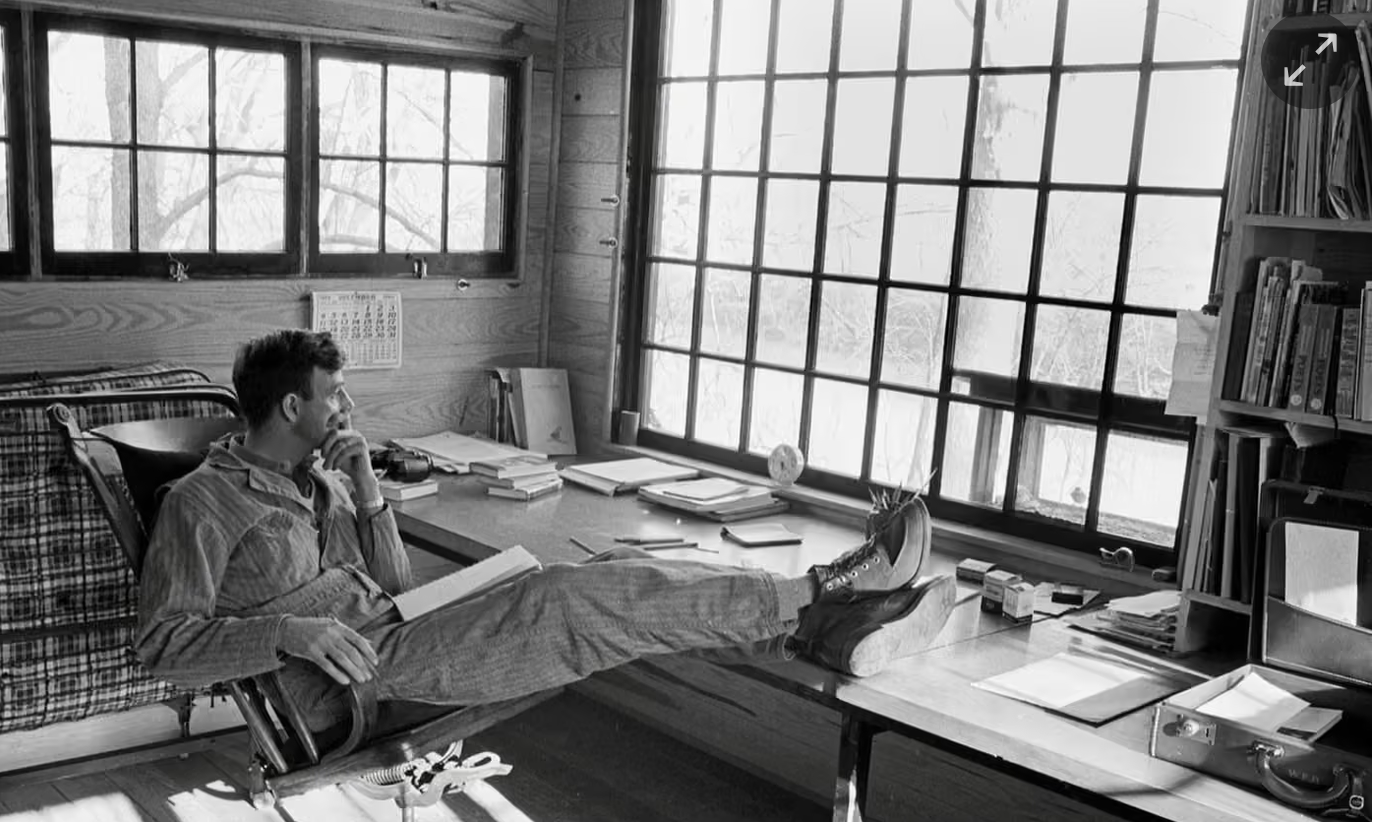
I learned of Wendell Berry’s passing last night, from the New York Times. They had an “advance obituary” on file, “which are prepared for notable people so they can be published quickly upon their deaths.” It is lovely, and benefits from the time taken.
Though I personally think he might have been a bit embarrassed by its excesses. Its opening paragraph noting that he wrote “mostly in pencil and without electric light,” as if that were the most relevant aspect of his work. His description as “lanky and rawboned in middle age, with melancholy eyes, a jutting chin and a widow’s peak reminiscent of Lincoln’s.” A little purple for his taste.
These all might be true statements–but somehow his own capacity for evocation seems misplaced when applied to him. The media takes liberties, of course. It chooses words and images for impact in the moment, whether or not those words and images have integrity, or are contiguous with what is real. They are chosen to sell papers, in his time; to drive clicks and shares and likes, in ours.
This is precisely the problem, I imagine him saying, though better than I just did. How we are harmed, and do harm, through our shortsightedness. Our willingness to go for the quick satisfaction at the cost of truer things. He talked like that.
I do not share the NYT’s foresight, or perspicacity. (Berry loved the perfect word carefully chosen, and here is one to hand.) I do not have any thoughts ready that can squeeze Berry’s impact upon me into a ball and roll it toward you with piercing insight. I can share my gratitude that I found his work when I did, and have lived with it so close to my own mind and heart and teaching for a long time.
And I am no Berry scholar. I have read comparatively little of his extensive output. But what I read, I kept–and more importantly, taught.
Here’s the five-inch shelf of Wendell Berry that has got me this far, and that my students have likewise thanked me for keeping on the syllabus. Especially in the courses I have taught on burnout prevention and sustainable practice, where he’s fundamental to many disciplines’ efforts.
Solving for Pattern (1981). (Opens in PDF.) The first thing of his I encountered, and I cannot remember how or why it came to me. Grad school I hope. An early essay, more about farming methods than deeper theory, though the wisdom is not hard to find. How many times have I read with students about “the solution that causes a ramifying series of new problems”–and stood before them with my arms branching wildly above my head to drive home how things branch out, how unintended consequences overtake one’s plans?
Restraint – for us, now – above all: the ability to accept and live within limits;
to resist changes that are merely novel or fashionable; to resist greed and pride; to resist the temptation to “solve” problems by ignoring them, accepting them as “trade-offs,” or bequeathing them to posterity. A good solution, then, must be in harmony with good character, cultural value, and moral law.
The Hurt Man (2003). (Opens in PDF.) A short story that has been the glowing jewel at the core of any class on the mystery that permeates healing practice. Everything is here: how compassion may bloom from our own suffering, can turn either to empathy or rot. How the need transcends the judgment of who deserves to be needy. And above all, in the breathtaking final paragraph, how love is deeper and older than any of our days’ concerns or preferences or fears. How we who wish to be of use to other peoples’ children are invited to connect to something wise that we can trust, that will last–and can.
It All Turns on Affection (2012). His victory lap, arguably: his center-court NEH Jefferson Lecture. He could have retread what he had already explored. Who would fault him? But instead, his erudition and compassion combined into an accessible and moving treatise on how what we love, we imagine–and how what we imagine, lives.
This teaches so great! With some useful swipes at big data too, for those who persevere.
I will say, from my own belief and experience, that imagination thrives on contact, on tangible connection. For humans to have a responsible relationship to the world, they must imagine their places in it. To have a place, to live and belong in a place, to live from a place without destroying it, we must imagine it. By imagination we see it illuminated by its own unique character and by our love for it. By imagination we recognize with sympathy the fellow members, human and nonhuman, with whom we share our place. By that local experience we see the need to grant a sort of preemptive sympathy to all the fellow members, the neighbors, with whom we share the world. As imagination enables sympathy, sympathy enables affection. And it is in affection that we find the possibility of a neighborly, kind, and conserving economy.
Why I Am Not Going to Buy a Computer (1987). (This appreciative essay links to it in the first sentence.) A minor piece in the big picture, that nonetheless presages our current tech mania by asking what tech improves that isn’t already working fine, and at what cost.
He got heat for acknowledging that his handwritten manuscripts had been prepared for editing and publication on a manual typewriter by his wife for decades, which smacked of exploitation to many. Typical comment: “Wendell Berry provides writers enslaved by the computer with a handy alternative: Wife – a low-tech energy-saving device.”
Berry does not back down. Let’s savor his prose. I’d hate to have him disappointed in me.
I understand that it is impossible to make an adequate public defense of one’s private life, and so I will only point out that there are a number of kinder possibilities that my critics have disdained to imagine: that my wife may do this work because she wants to and likes to; that she may find some use and some meaning in it; that she may not work for nothing. These gentlemen obviously think themselves feminists of the most correct and principled sort, and yet they do not hesitate to stereotype and insult, on the basis of one fact, a woman they do not know. They are audacious and irresponsible gossips.
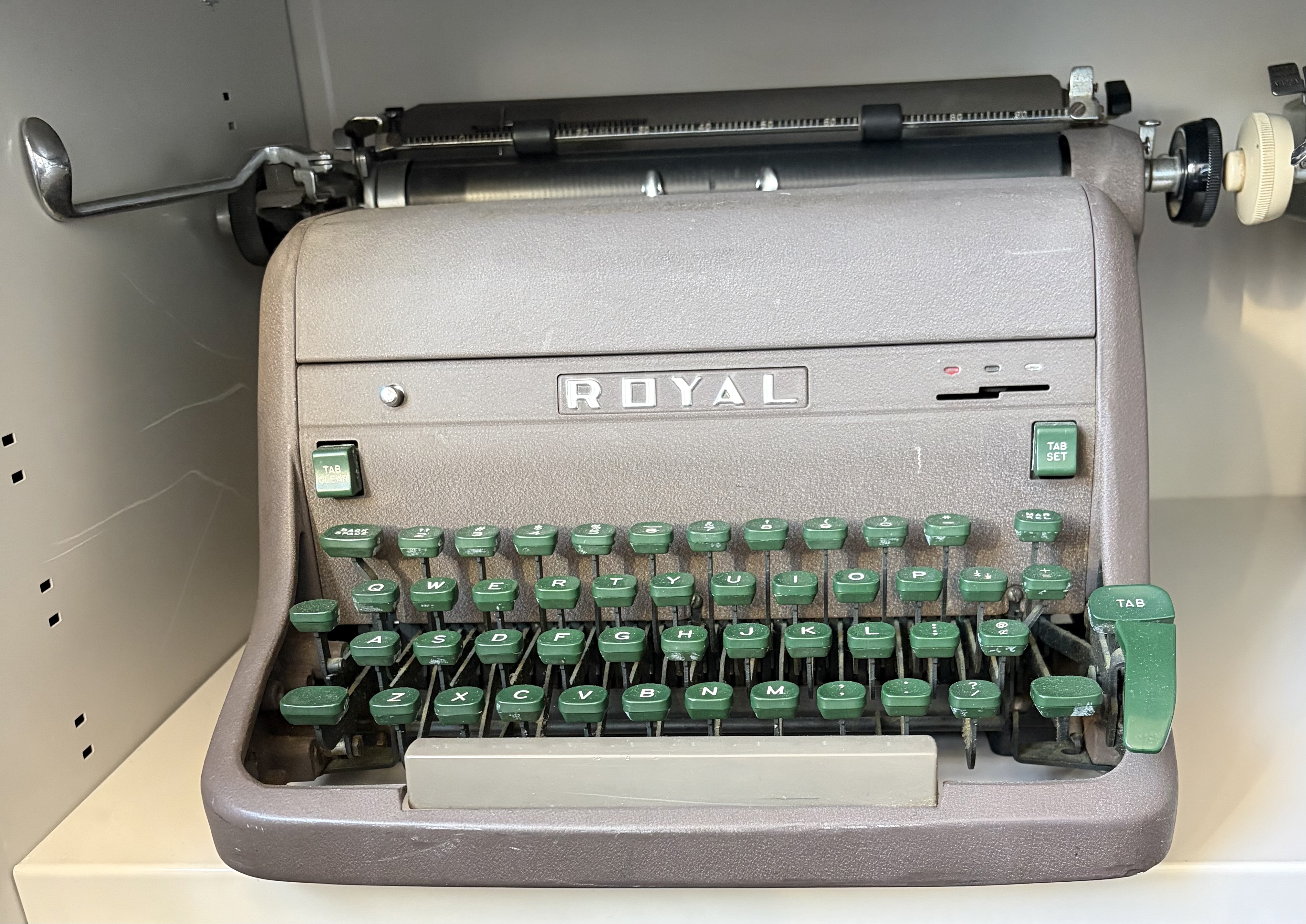
Like so many writers and thinkers I love, Berry defies litmus tests and troubles pieties. He won’t be who you think he is: he’ll be himself, and you can do what you wish with that.
A Poem on Hope (I do not know when he wrote it, but you can find it in Collected Poems 1957-1982). Frequent readers of this blog have seen this one before. I think of it every time I glimpse one of the great blue herons in the New River on my morning run, and wonder at how nature shows us every day how many ways there are for things to be, and still be perfect. I end nearly every class I teach with it, and will give you a bit at the end of this post. You’re welcome.
I am not a perfect acolyte of Mr Berry. Which of us could really walk a path as strait as his? Leave a rising career path to return to one’s home place, and assiduously learn its lessons by farming the same patch of dirt all your life. Maintain your principles utterly, in your work and your daily choices. That path would mean no burgers handed to me through drive-through windows, and no Diet Pepsi, that’s for sure. It’s too much.
But we probably do him, and ourselves, a disservice when we make him so singular. Like most paragons, he has served me more as a source of calming truth than a blueprint for daily living. When my own rhythm gets too chaotic, and I lose the pattern, his work is a source that remains deep and nourishing. It is good-enough, and so am I–and getting better all the time. Enough purity tests: listen harder to what is older and wiser than you today, and do what comes next. That is all.
And my students are emailing me as they see the news. Their own brush with his thought in the classes that we have shared left a mark, they tell me: gave them something to also hold onto when they need it most. This makes me so happy, and hopeful.
It wasn’t until last semester’s class that I realized most of my idols share an ambivalence toward the path that was laid out for them. Most are reluctant members of the higher education culture–or fled it outright, due to that combination of arrogance and insecurity that if you spot it, you got it. (I got it.)
W. Berry. M.C. Richards. Parker Palmer. And my cousin Ed Abbey, who took the same Stegner Fellowship Berry did the following year, and with whom apparently he enjoyed a collegiality of ends if not means. Berry was no monkeywrencher. (Thank heavens for that, probably–we only need a little leaven in the loaf.)
So personally, I thank him for the path he showed that helps me find my own. I’ll read him again this semester with those whose attention I am entrusted to focus profitably. I hope they find what they need in him, or file it away until the need can be felt.
He is gone, but his work remains–as long as we enliven it with our own affection, and gratitude.
Belong to your place by knowledge of the others who are
your neighbors in it: the old man, sick and poor,
who comes like a heron to fish in the creek,
and the fish in the creek, and the heron who manlike
fishes for the fish in the creek, and the birds who sing
in the trees in the silence of the fisherman
and the heron, and the trees that keep the land
they stand upon as we too must keep it, or die.
This knowledge cannot be taken from you by power
or by wealth. It will stop your ears to the powerful
when they ask for your faith, and to the wealthy
when they ask for your land and your work.
Answer with knowledge of the others who are here
and of how to be here with them. By this knowledge
make the sense you need to make. By it stand
in the dignity of good sense, whatever may follow.
Image of young Berry in his writing cabin, looking especially lanky, rawboned, and Lincoln-like, borrowed with thanks from The Guardian.
“Of all the vices, I find books to be the least dangerous…I think it’s possible his landlord might have their priorities misplaced, or might not understand him. If you’re not steeped in his culture, maybe his library does look chaotic. But I’d argue it only looks like a mess. I’ll bet he can tell you where every single book is in his apartment.”
That’s bookseller Israel Mizrahi on Mendel Uminer’s collection of thousands of books, and his resultant eviction from his Upper East Side apartment. Here’s a picture of only some of them.

According to yesterday’s NYT piece, the stated grounds are fire hazard–but, as becomes clear in the article, his true infraction is unseemly eccentricity. Too many books!
We have a word for people whose relationship with their stuff doesn’t track with the sleek, beige, gentrified, laptop-and-tablet-and-phone lifestyle promoted on the socials: “hoarder.”
Like so many words borrowed from clinical psychology, its casual use dishonors the suffering caused by its authentic manifestation. It feels edgy, using words about real pathology to describe behaviors that are a little outside the norm–feels knowing and hip. It’s also kind of stupid, since it blunts an edge that can be so helpful to so many. We should do it less.
But in this case it mostly serves to reveal a high cultural antibody titer…against stuff. The manufactured challenge that so many of us feel: too much stuff in our lives, and not enough room for it.
Why can’t our spaces look as curated and spare as the ones we see in the media, in the ads that sells us the storage and cleaning technologies we “need” to so appear? Uncluttered space=clear mind, we are told to believe, and so we are supposed to discard what doesn’t spark joy. Or, if our nerves fail us, hide it in the garage.
I am maybe a little sensitive about my stuff right now! I am in the middle of an office move, from one end of my College’s massive building to the other. And while it will not involve an elevator or staircase, it is still a physical and emotional heavy lift.
I have been in my present space for eight years. And the vagaries of summer schedules mean I am moved “out” of my present space as of three days ago–but will not be “in” my next space for a couple of weeks, after its present occupant has time to clear it.
This means that all of my stuff, at present, is stashed in two corners of the big seminar room of the Program I have helped run for eight years. It is out of the way, functionally; the truth is we rarely use the space for student events anymore anyway, since the entire Program moved online in 2019.
One wall is stacked with liquor boxes of books and files and papers and pictures and lamps and all the crockery and trophies and such that didn’t fit at home, and so found their way to work.
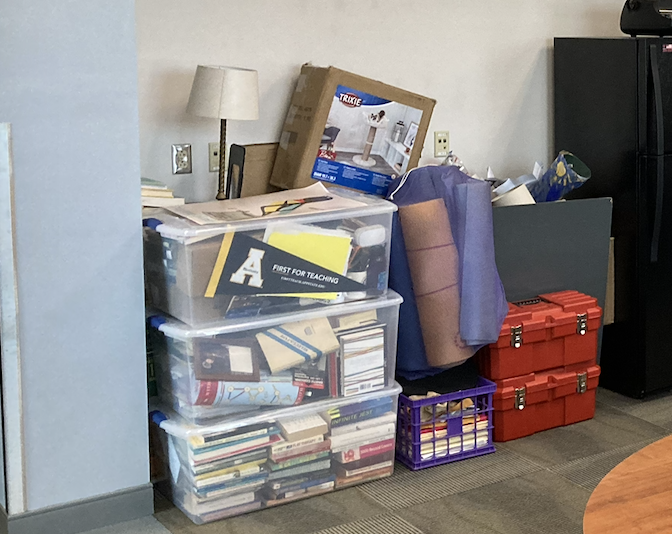
And the opposite corner is stuffed with my working collection of 40 +/- typewriters, and the shelves that have archived them and will again in a couple of weeks.
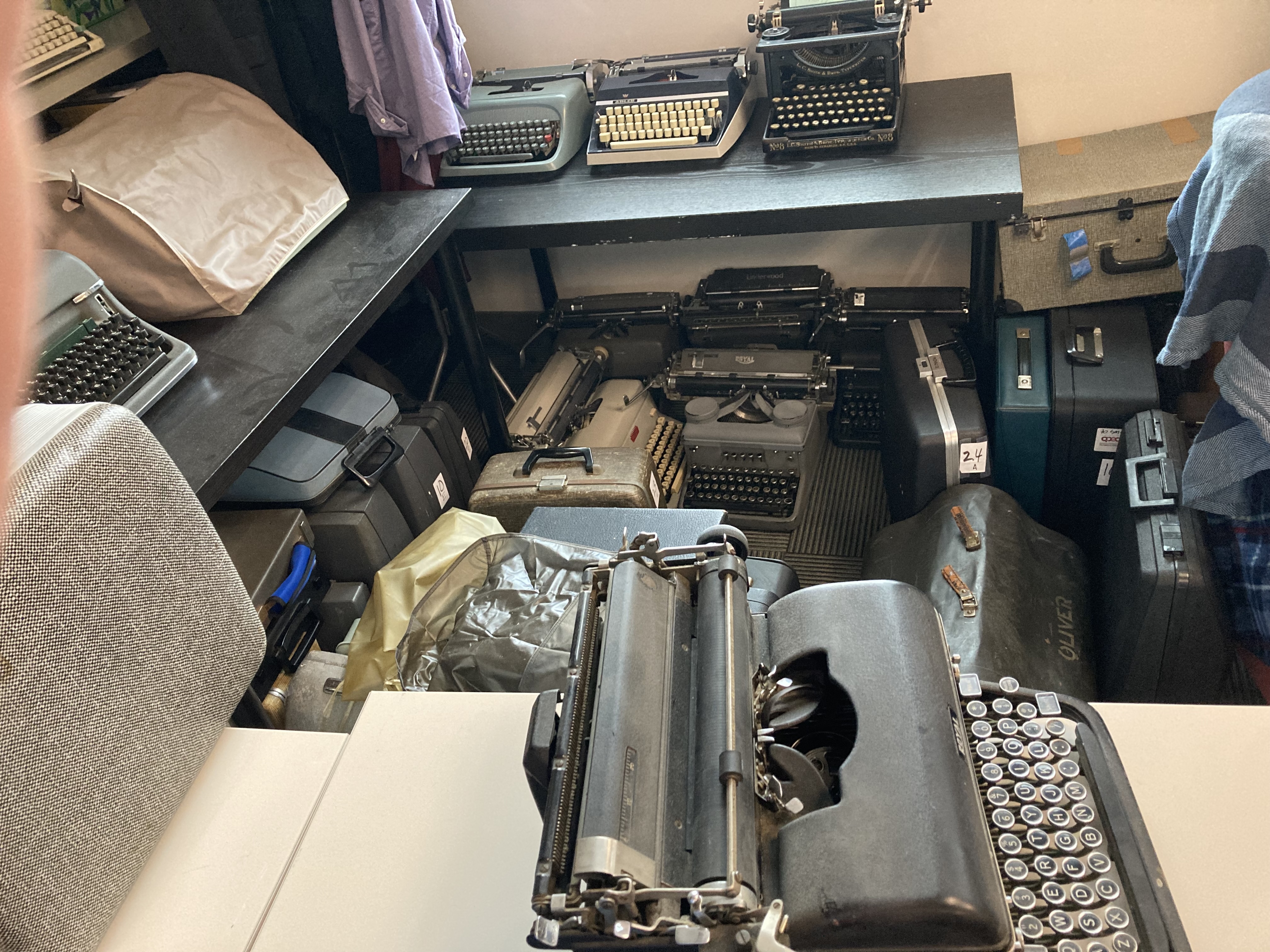
It’s a jumble, it’s a mess. And it invites inevitable feelings of reproach.
Why do I have so much stuff, when of course I can run 95% of my professional life off this laptop?
Why do I have so many books, when so much of their contents is available digitally via the University library?
And dear heavens: what of the typewriters?
Constant readers of this blog will know that my typewriters are in heavy service during the school year. (I wrote a book about it!)
They are the core of my undergraduate teaching, which asks students to retrieve a machine from my office at the start of one class session a week and use it to create a few pages of “human words” in response to a few prompts I provide. The prompts ask for reflection and consolidation of the themes in the readings we are handling that week–but also provoke about medium and technology, about attention and memory. About how the stubborn reality of the anachronistic tech in front of them refuses to let things feel normal, and what that discomfort could allow to happen next for them.
The majority of the machines I use for this teaching are “portable,” in the way that word in the 50s and 60s conveyed a machine with a case and a handle that conceivably could be carried from one writing site to the next.
But “portable,” in 2026, means something a lot lighter than the 20+ lbs of each of these machines. So their weight is a constant topic with my Gen Z students at the start of the semester: how schlepping a typewriter from my office to the classroom and back again isn’t effortless.
And of course, the new office location will require baroque calculations on my part about classroom location, changing floors, timing, frustration tolerance…learning spent with reality is rarely convenient, but the inconvenience is often the point.
Portable-but-heavy, it turns out, is an auspicious combination, if your goal is to invite students to notice stuff they haven’t before. It’s all curriculum.
And it is a nice characterization of the books in the article. Look at them! No one book is too much to manage, but taken together they are quite a phenomenon. There they sit, spines toward you for easy selection and delectation, tumble-bumble on shelves and tables and stacked along walls. Redeemed, somehow, in the opening quote, by the insistence that there is an organization to their stacking: you just don’t understand it. (If there’s a method, it’s not a mess.)
But also behold the boxes of books, so like mine. See their progress as the article unfolds: loaded up, with friends’ help, into almost-carryable batches. Hauled down beautiful but tortuous old stairways. Bunged into open minivans, in the rain of course–and finally stacked ignominiously in his parents’ apartment, in the middle of the floor, awaiting whatever is next, whatever can be allowed.
Somewhere along the line I learned, from a striving realtor probably, that the risk of many books in a home is not primarily fire: it is weight. Books are usually stacked in shelves along the edges of rooms. That concentrated weight at the borders, vs. the much-lighter foot traffic through the middle, over decades will lead to warped floorboards, settling, even foundation issues. Get rid of your books, I remember one realtor telling me. They will hurt your home’s value. Shed the weight.
But books as weighty signifiers of value, of seriousness and taste on the part of those who display them, is also nothing new.
Your books “say something” about you, we are told! You can curate them by the yard, “by color, theme, or size,” for your study decor.
You can place them strategically (or images of them) for your Zoom flex.
You can even dial them up on AI for unfathomable reasons. (No, wait–they’re real. Real fakes. Try to keep up.)
Have books, the big world seems to say, or simulacra of books: just make them tidy and hep. And for heaven’s sake, don’t make them towering ziggurats of Strand cutouts. That is not cute.
What does a wall of typewriters in a faculty office “say”?
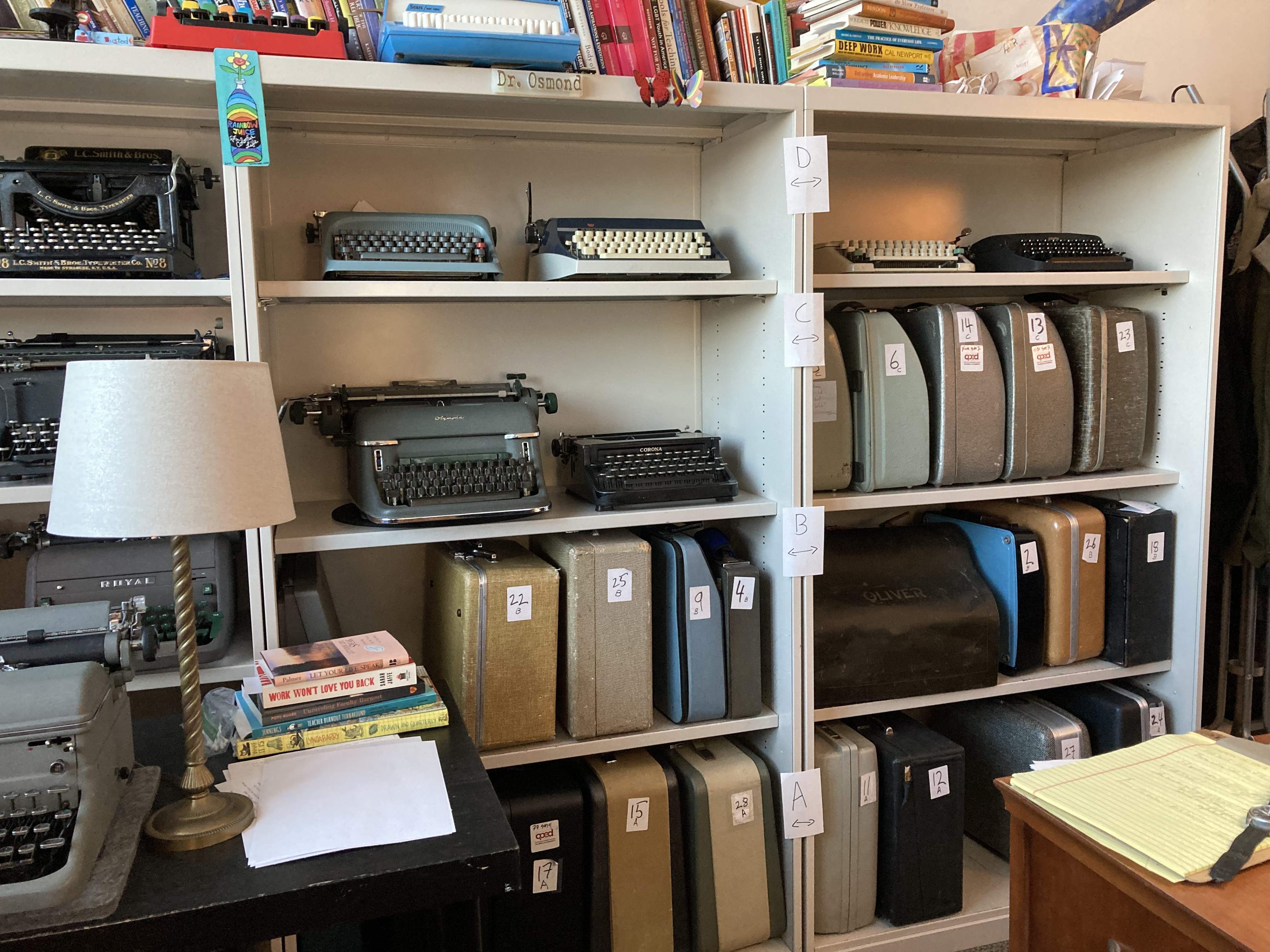
Other than giving one less floor space to maneuver through, and the comforting eau-de-typewriter-ribbon and whiff-of-mold that greets me every morning?
Well, I suppose it also communicates an eccentricity. a willingness to commit to something unusual and unwieldy, for reasons that will soon become clear if you can stay with me long enough to find out what it is.
I think teaching with typewriters is just a physical manifestation of an emotional dynamic that pervades every classroom:
-the teacher is convinced that something new should be attended to;
-the students are not so sure;
-the teacher’s first job is to make the case that a new enthusiasm is warranted;
-the teacher lends their own enthusiasm, generously, until the students’ own can be unearthed and engaged.
And a reliable way to concentrate that enthusiasm and pique that interest is to present a puzzle, an artifact, a curiosity, a weirdness. Any provocation that heightens engagement, and therefore attention, just enough for what students actually care about to run parallel to what the curriculum hopes they will start to care about. Just long enough to catch fire, like a fresh match set alongside a lit one.
Typewriters are great for that, whatever else they become over fifteen weeks of living with one.
And my wall of typewriters also gives a sense of history: a heightened sense of being in this moment by acknowledging that other moments have happened too.
This is surely a core reason why I am comforted by antique stores, especially the ones that are more rummage sale than curated display. These things all mattered once, those places say, for people who are not here anymore but were, just as you and I are here. We will eventually matter probably no more than they did, but certainly no less. Our now can be imbued with meaning by the artifacts of their now. Whether or not we take any of their stuff home, hanging out for a spell with their stuff makes our stuff–and our lives–more real.
I cannot tell you where every single book is in my boxes right now. (I also doubt Mendel can, and don’t need him to in order to have them.) I will not pretend otherwise.
But: I am definitely keeping it all. All the books, all the files, and definitely all the typewriters. (Most of the crockery.) It is all going into the new room at such time that the new room is available. I will not be culling the stacks much more than I already have, though I will probably continue to insist I intend to.
Because here’s the thing: an empty room is exciting, inspiring, bracing in its possibility. Isn’t it?

As I have worked in my now-empty office for the last couple of days, I have wondered: why do I not keep my office this empty all the time? So much space and aether; so little to hook onto from the past when I cast my eyes around it looking for the next sentence to write.
But empty rooms aren’t the ones we live in.
And they sure aren’t the ones we learn in.
And they aren’t the ones we stash the tokens and memories of the things we do that matter to us in.
You know, surgical suites are nearly-empty rooms. So are those interfaith chapels you can still find in airports. No specific tokens there to comfort or enrage; bring your own, or do without, for your devotions. Passing-through places are usually empty places.
But empty is not good for dwelling–except in someone else’s Instagram pic of how you should dwell.
Empty is not good for living–except according to someone else’s rules about how you should live.
We real humans live with our stuff: with our books, with our stacks, with our typewriters, with our ephemera that becomes less ephemeral the longer we keep it around. And sure, we can become prisoners of our stuff–but before things go that far, consider who we become when we let ourselves be owned by our stuff.
“It makes sense to me that Mendel, a Brooklyn yeshiva kid, would come to the Upper East Side and make this world for himself here, only to get rejected from it…There’s a New York now, keyed into professionalism and uniformity, that sees a guy like him and thinks something must be wrong. There’s an element to the city now that’s hostile to the life of the mind, to the eccentricity that might produce it.”
I hope you can find your own personal way to push back today against the forces of uniformity. The hostility to living one’s own life that is sure to come at you, in ways great and small, every time you ask the monoculture for input on how you should live.
After all, we are way harder to market to when we don’t like the things we are supposed to.
We are way harder to control when we don’t share our every word and image with the algorithms.
We are way harder to pathologize and shame into buying stuff we don’t need if we won’t be who we are told to be.
So blow up your TV, like John Prine told us fifty-five years ago. Delete your account, we would say now.
And go buy a used book, or an antique typewriter, and put it right in the middle of the table, right where it doesn’t belong.
Then get another one. And another.
Top image by James Estrin, from Alex Vadukul’s linked NYT story and reproduced here with thanks. All other images my own.
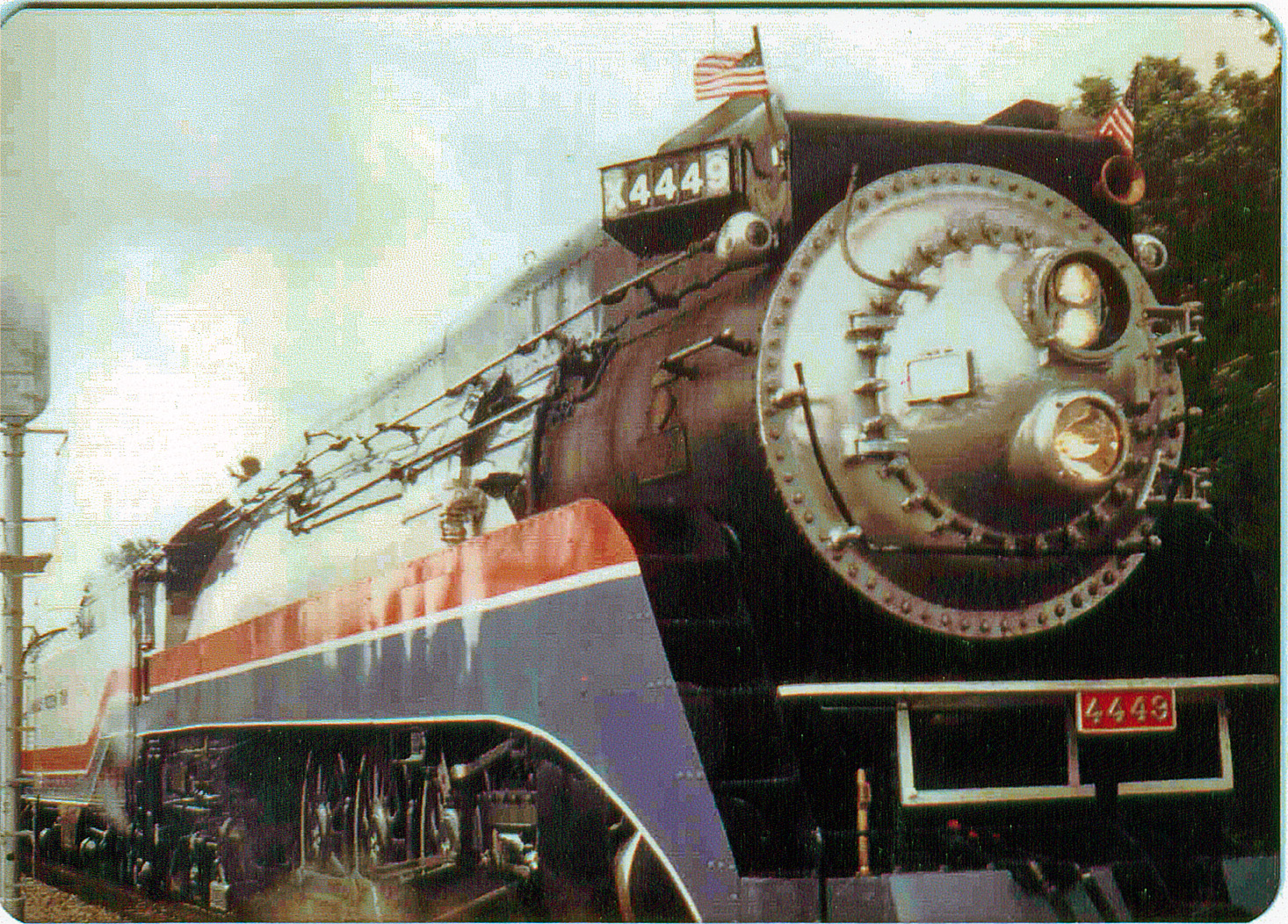
Here’s an image of the bicentennial Freedom Train at a stop in Georgia, 1976.
What a happening the Freedom Train was! An eighteen-month tour of the rails across the contiguous 48 states. A rolling collection of +/- 500 artifacts that represented America in all its post-Watergate malaise.
Touted by pardoner-in-chief Gerald Ford as exemplifying “the spirit of free enterprise at its best.”
My passion for all things physical, objects in the real world, is piqued upon remembering this rolling exhibition! There’s abundance of online records about the train itself and its itinerary (train people being even more obsessive than typewriter people)–but an exhaustive catalog of exactly which artifacts made the cut was tough to find.
This Troy University page is the best I came up with, which takes us to BhamWiki (“an ever-growing encyclopedic resource for anyone curious about Birmingham, Alabama and the region around it“). And we are happy to find a Remington No. 1 typewriter on the roster, as part of the “Innovations” car, in august company. ‘Merican ingenuity FTW!

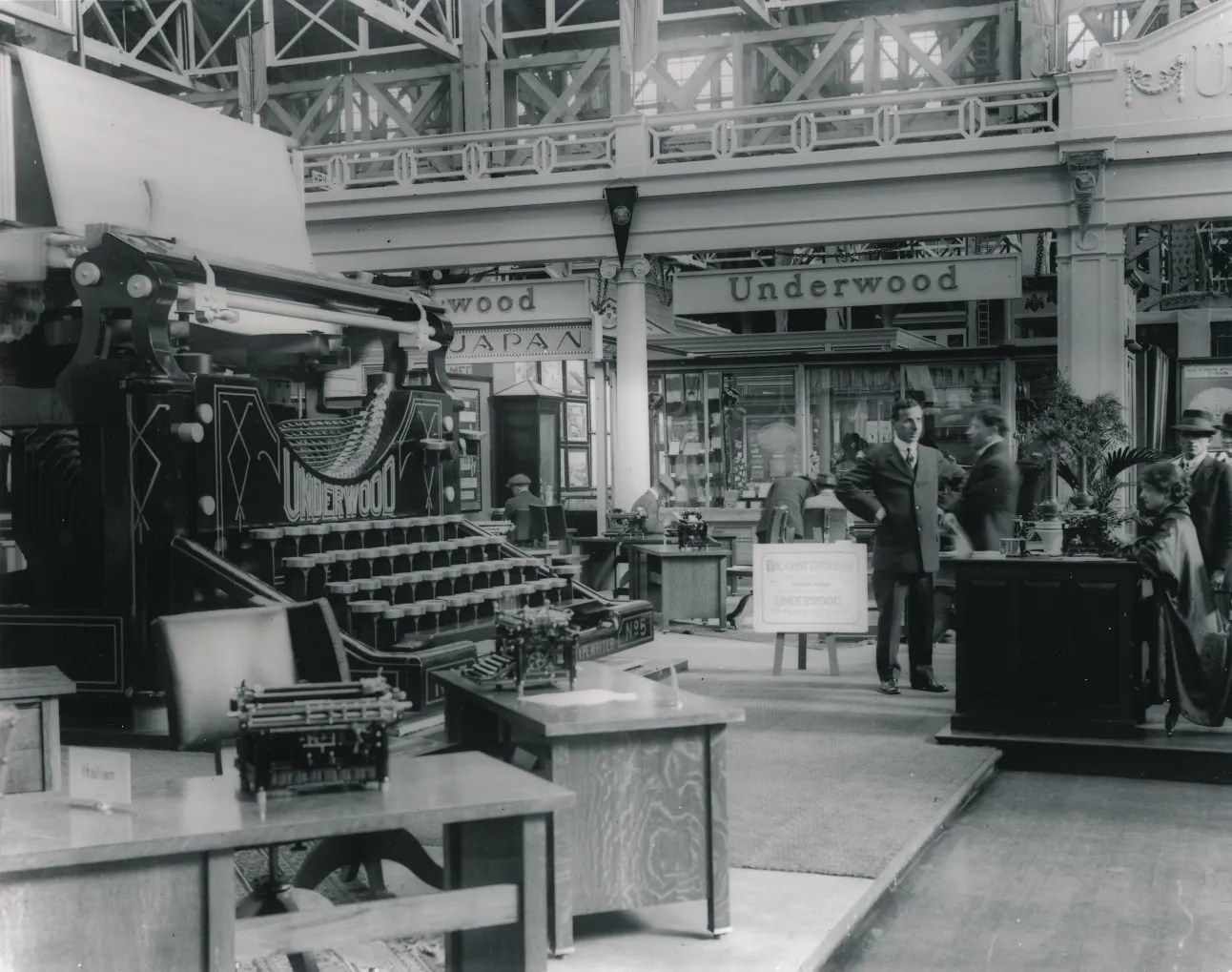
(NB: This is not a Remington No. 1, but IS an image of the 14-ton Underwood No. 5 typewriter created for the Panama-Pacific International Exposition in 1915, then refurbished for the 1939 NYC World’s Fair, and I will take any opportunity to post it. Check out Mary Ech’s terrific post for more about it. Can such things be?)
I have a gauzy, madeleine-like association cascade of the Freedom Train steaming across my seven year-old consciousness. How did seven year-olds come to know such things were happening, in the mid-70s? How did anyone?
I suspect it was featured in the Weekly Reader that year, which I probably had access to in 1975-1976 in my super-groovy, open floor plan, carpet-squares-and filmstrip-viewer, mixed first-and-second grade classroom at Cunningham year-round Elementary School, Aurora, Colorado.
The Internet Archive shows Weekly Reader coverage of the 1947-1949 Freedom Train (which was its whole own huggermugger, full of citizenship paeans and racial tension):
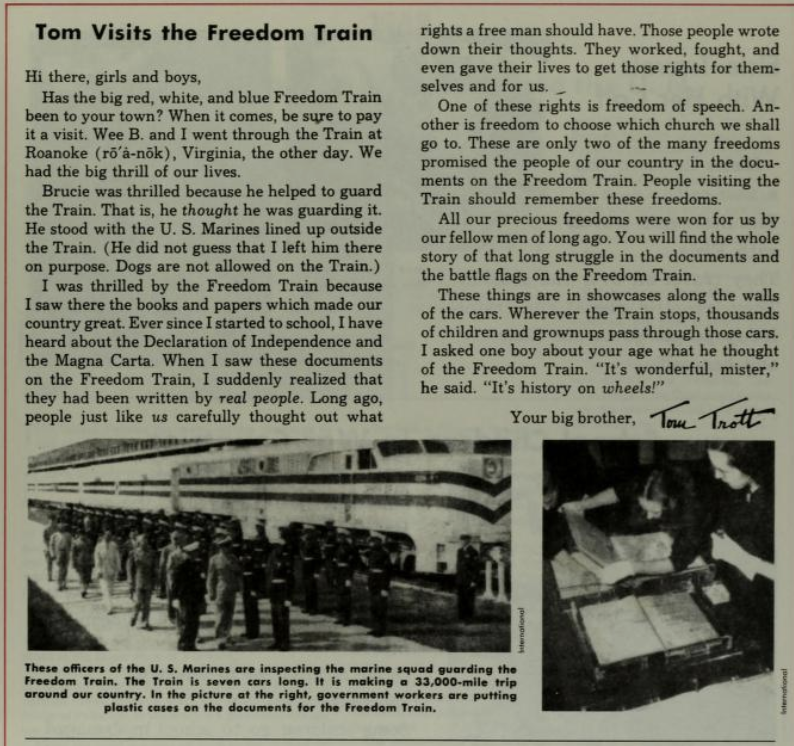
…but it is silent on the ’76 one. And I didn’t have a National Geographic World subscription yet either…so how did I know about it? Dad was still active-duty Air Force, so maybe he brought home news of it.
I did not finally see the train, in the actual event, that I can remember. But I wanted to!
I remember the longing to see it. The promised thrill of Important Things being brought to us, in all their irreducible actuality, all the way out here in the provinces. Left over from the previous era of whistlestop tours and medicine shows and itinerant entertainers, maybe, when the only way to experience something was in the flesh and folks would pay what they could to have it.
(I did see the King Tut exhibit later that year at the National Gallery, though! That deserves its own post, someday.)
It is no surprise that early efforts to revive the Freedom Train for the 250th came to naught, or at least much-reduced form: “on April 15, 2026, Reading No. 2100’s excursion as the 2026 Freedom Train was canceled, citing “a lack of financial backing from corporate sponsors, difficulty negotiating access with major freight railroads, and tight timelines leading up to the 2026 semiquincentennial celebration.” Trains are on the outs. And it’s a big loss.
Trains aside, there is not much real stuff to touch this July 4th, especially in DC. The State-Fair atrocity on the Mall is full of VR and other simulacra. The permanent built environment of the nation’s capital city is fenced off in the name of security, but also to hide the shame of a monstrous fixer at being unable to fix everything.
I lived in DC twice, once for a year between the summer of ’76 and ’77, and again for six years after college. I still consider it “my city,” though of course I know it has been changed and Chipotle-homogenized like everywhere. (What did Joan Didion say about knowing even in the moment that it would never be quite the same again? Like that.)
(And can you believe they closed The Biograph? It’s a CVS now.)
I remember how frustrated little me was that we got to DC in summer of ’76 after the Bicentennial fireworks. Though I still remember seeing them splendid in ’77 over the Washington Monument, from a distance and a rise somehow.
And both that year, and when I returned as an adult, I gloried in how accessible everything was. In ’77, Dad would circle the National Mall on Saturdays until street parking opened up on Constitution Ave. and we could walk over and see the Wright brothers plane, the moon landing capsule, the Spirit of St. Louis. (When I grew up I discovered there were also other museums in the SI–but to this seven year-old, it was Air and Space, ride or die.)
And during my 90s term in office, I helped coach my first school’s cross-country team. The Dupont Circle location of its first campus precluded any actual sports facilities, so we ran and ran. We had several loops mapped through the city and Rock Creek Park. We would fly down Connecticut Ave, somehow get over along the Potomac, and run under the overhang of the Kennedy Center.
I lived in Arlington, in a crummy group house at Court House metro. You could park at the Iwo Jima memorial and run across Memorial Bridge and back, waving to Lincoln at the turnaround. Or even blast up the steps Rocky-style and salute him personally, if it was early on a weekend AM and you could juke across the traffic. Turn around and stand where MLK did and behold the reflecting pool, not caring what color it was.
The country I love is a place of unlimited access and invisible barriers, both. As today’s gorgeous NYT piece on the colossus in New York Harbor asks, “Is Liberty peaceable or vengeful? A nurturing presence, greeting all who come, or an unstoppable revolutionary?” I have found it to be all of these things–but most of all, when it is at its best, it is real, not pretend.
No Freedom Train for you to go see today, probably. And if you are in DC, I hope you don’t endure the metal detectors and military presence to see the definitely-not-for-kids late-night fireworks.
I hope instead you spend some quality time with something real that means liberty and possibility to you, and maybe take a moment to consider what this place has opened in your own reality. (A manual typewriter is a promising option, supra.)
And, of course, how to pay it forward and make opportunities for others. The most American of values, as Learned Hand reminded us in 1944. Here’s Bret Stephens’ masterful reflection on his address last week:
…the judge said, the spirit of liberty lay in a combination of humility, curiosity, generosity and restraint. It was “the spirit which is not too sure that it is right,” the one that “seeks to understand the mind of other men and women” and “weighs their interests alongside its own without bias.” It was an elusive spirit, one that could exist only “as the conscience and courage of Americans create it.”
Fugitive virtues this year–but still ones we can each seek in our own hearts and choices. Which also burn in Woody Guthrie’s last verses of his unofficial national anthem–the ones we never get around to singing–
As I went walking I saw a sign there,
And on the sign it said “No Trespassing.”
But on the other side it didn’t say nothing.
That side was made for you and me.
In the shadow of the steeple I saw my people,
By the relief office I seen my people;
As they stood there hungry, I stood there asking
Is this land made for you and me?
Nobody living can ever stop me,
As I go walking that freedom highway;
Nobody living can ever make me turn back
This land was made for you and me.
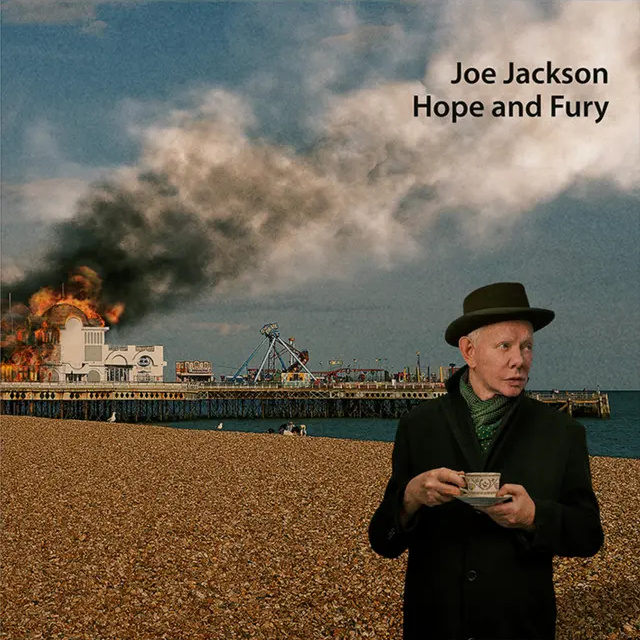
How to be a great adult rock star? Rock and roll being primarily an art of and for the young. Just showing up at all as a grown-up with any credibility seems like it’s most of the battle.
What to wear? Youth and volume + leather and swagger are the the original classic thing, from Elvis to The Ramones to Bono to The Strokes. But that gets tougher to pull off as you either soften or get stringy. If you somehow manage to survive your 27th birthday, and fail to die before you get old, what will you wear to your 50th birthday party, or your 60th, or 70th–or beyond?
You could retread the Johnny Depp pirate look you invented, like Keith Richards. Or go for jumpsuited Devo-core, like D. Byrne. Basic black with good kicks works for Jack White more often than not.
Or will you look sharp?
And holy cow: what to play?
Reanimated roots rock is always respectable (with or without AI de-aging, like the Stones in their new video). So is furthering the genre you invented, like David Byrne again, with sidepeople and stage crew not yet born when you made your bones. Or like Jack White, you can remain the daemon you have always been, and slay with another surprise record of noise and edge coming out this summer.
Or you can push on into…something quite else.
Hello cruel world, I’m not going away
So I might as well have my say
For all the damns that I never gave
And for every damn whale that I failed to save
For every little fad I didn’t chase
And every little fool who just didn’t like my face
I know that you like it
I know that you want it
I know that you need it
Leave it alone because I’m not gonna say it
I’m not sorry
I’m not sorry at all
I found Joe Jackson’s new album Hope and Fury almost unlistenable the first time through. Then I read the words and listened again, and again. I learned from it how to hear it.
And now it is my favorite release of the year. It is a sign of life in a dead time: a blast of grownup-ness in an age of deliberate puerility, especially from our supposed betters. And it is therefore more precious than ever.
You remember Joe Jackson, if only casually, o Gen X American former radio listener. You do! The angry young man who got signed in the wake of Elvis Costello’s late 70s fame, and broke through on the radio with smartypants songs like “Is She Really Going Out With Him” and “Sunday Papers” from his first album.
His second record I’m the Man was rushed out within the year, same formula; the title track was joyfully covered by Silversun Pickups in the season three opener of The Lincoln Lawyer, which cover put him back on my own personal screen. The song there does the work his early music always does: cue intelligent mania, cue passionate people who put the stick in their own spokes. He’s the patron saint on these records of the guy who yearns and hustles and is denied but gets back up again.
Then wow, do things get interesting: he makes two records that mostly amuse himself, one full of British reggae dub (featuring bassist-for-life Graham Maby) and one of Louis Jordan jump blues stuff–but not much attention results. He repairs to NYC in the early 80s and soaks in the Latin vibe of the street music he finds there, metabolizing it with the composition training he had gained at the Royal Academy of Music. And the resulting album, Night and Day, gives him his biggest hit (thanks to nascent MTV, which spins it heavy in the absence of much else on offer).
He is among the masters of English songwriting that yearn for connection, from the juvenalia of “Happy Loving Couples” through the early-midlife trainwreck of “My House” and “Stranger Than Fiction.”
And no-one since Eddie Palmieri understands better the sting of a lit montuno (well, guajeo, strictly, I think). Those piano figures burn through his fiercest work, from Night and Day’s “Cancer” to Body and Soul‘s “Cha Cha Loco” to Hope and Fury’s acid cancel-diss “I’m Not Sorry.”
He could be done, is my point. After so much music, he has certainly earned it. He is 71 years old. Those who love him have plenty to keep loving.
But he isn’t done. So here’s Hope and Fury.
Maybe he needed a reason to get back to touring. He has been a tireless road warrior throughout, and that’s the only place for any musician to really earn in the age of essentially-free streaming. These songs seem like they took time–at least one references Covid–but who can tell? Someone this prolific must have another hundred tunes shored up for future releases.
Though he is not superhuman, and admits to a multi-year creative block after the commercial underperformance of 1991’s impeccable Laughter and Lust, which still seems to perplex him. He worked so hard on it, even did market research with the new tunes live to see what the kids liked…and it wails, even now, thirty-five years on. But it didn’t sell. Heartbreaking.
Hope and Fury is an album about efforts and plans going wrong, sure. But the scars are sublimated, so familiar they are not mentioned so much as whiffed ambiently as the songs hurtle by.
JJ songs have always taught tough lessons–even as they didn’t care whether or not you learned them–about the ease and impossibility of connection between and among the sexes especially. His didactic bent is funny and sad in his first decade. “It’s Different For Girls” is a swirling gender studies disquisition ten years before we start laboring through Judith Butler in grad school.
But “Made God Laugh” isn’t about a lesson learned, so much as a reporting of the reality of the weather in your head when your head has been pushing you to succeed your whole life. If you don’t already know that you “made God laugh when you told him your plans,” you are not going to learn it here. But if life has taught you that truest truth, well, here’s your affirmation, and company for the daily commute to the latest site where it’s happening to you.
It’s also a record about coming home after fleeing home for most of your life. JJ is an ambivalent Englishman, and says as much. He started as a pub rocker, but his long time in NYC softened both his accent and his tolerance for the gray and the old. This record is about how he both hates and loves it back home. Now he leans into the Portsmouth accent sometimes, for effect–but he lives in Berlin now, mostly.
And I think the offputting chorus of distorted growling groaning voices that appears intermittently on the record is Britannia, that mother, that minx. It performs an important libretto role on the album as the voice of tradition, both the stuffy and terrifying bits and the comforting bits. His most complex feelings are given to it: the monster-rap opener, about how hideous and beautiful “Burning-by-Sea” is; the self-doubt and self-criticism in “The Face”; the chorus of “The End of the Pier” turns into a comforting pub singalong.
What’s more grown-up than accepting you’ll always feel some kind of way about your origins, and letting all the conflicting feelings stay conflicted?
“Fabulous People” slyly returns to the distinctive glockenspiel voicings of his biggest hit, 1982’s “Stepping Out” (pun intended) for a complicated take on queer identity. It’s a bracing Pride month listen, for sure. He weaves a tale of a shlubby straight guy who has tried “being himself, but no one cared.” And so decides to embrace the “fabulous” LGBTQ ways promised by the “rainbow” he sees everywhere: on “the shopping mall / city hall / glitter ball.”
Turns out it’s not for him. He is going to have to find his own way to be “always fun, and never scared”…which of course no one can ever be.
So much cascades through this song! It makes me remember the dryest New Yorker cartoon ever, about how Pride is supposed to invite all ways to be while honoring mostly one. This June has had more than its share of thinkpieces about queer identity in a season of erasure and violence. In this moment, the song lands as an insistence on complexity and iconoclasm, even now, forever.
(Remember he gave us “Real Men” in 1982 as well, a song in the darkest days of AIDS that swung for more than even that pathos. In any decade, his message is clear: you are going to have to go your own way.)
You know what a grown-up rock star does? He delivers exactly what he has to give, as blunt and abrasive and contradictory as it may be. He’s not here to settle your hash about who he is–or much less, who you are.
He’s not demo-ing new songs anymore to see if you like them. He’s putting out what he’s got, and if you don’t like it, then sod off.
He’s straining for some notes; the cracks in his voice are part of the landscape now, and why would he fix them in post?
And he’s got a grown-up band too, it goes without saying. Doug Yowell’s supple feel on “After All This Time” is nearly everything I hope my drums sound like, Keith Carlock without the metronome. And trading fours on piano with Teddy Kumpel’s guitar on “The Face” is just enough to remind you he’s got the chops…but he doesn’t need to impress you anymore, so back to the bridge he goes. The song’s the thing.
His tour plays Charlotte tomorrow night. I feel too old and tired to make the two-hour drive down the mountain that late, frankly–a sentiment I fancy he would support.
But I hope my small celebration here sends him the sentiment I have always wished him. Gratitude for his wicked craft, and fellow-feeling for his insistence on being utterly himself.
Don’t listen to the dopey critics, who begrudge him growing up. Just listen to the record.
Then came the smoke, then came the flames
And no more jokes, no video games
Who’s left to cry, who’s left to cheer
For the end of the pier
I don’t speak Latin. I am putting on airs. But this phrase has been rattling in my mind since I first read it.
Not in its original source, Rudolf Otto apparently–but in Parker Palmer’s sublime Let Your Life Speak, a little book on finding your purpose in life and letting yourself be exactly who you are on the journey. And also 20 years ago, when I was a goat among sheep at a school of medicine, when Rachel Naomi Remen checked it in an essay about what might lie beyond the edge of our understanding of healing.
Funny how I am doing the defensive academic flex: citing how other people have already thought about this thing so I get to think about it too. It is the simplest idea in the world, really, and it doesn’t need a pedigree.
It is just acknowledging the “awe-inspiring and fascinating mystery” that lies around and within the stuff that matters most to us.
I have long been drawn to thinkers and writers and teachers who work to make the case for the irreducible reality and precious value of mystery. Especially in a world that only values certainty and deductive proof more each day. I collect them–these fellow travelers–like marbles in my pocket. Look, here’s someone who thinks so too. Here’s someone else.
We who love the mystery need a posse. We do! It’s a lonely place to live, in the mystery. Lonelier and lonelier.
Lonely–because of the rampant conviction that competent people doing life-impacting work like education and healing need to eliminate the mystery. Need to get down to what is always true. What always happens when you do this or that.
Because it’s important work, right? Being rigorous about finding out and tracking what always works is how we get “best practices,” and we love to be told by scientific types what the right answer is. It makes us feel like serious people.
Not goofing around anymore, not us. “Best practices” tell us THAT our work can be serious–because “best practices” say, “this can be science,” and the people with the science are the most serious people. Serious people do the “best” things, the most important things. (They are the sheep, not the goats…)
God, I love it when someone refers to “serious people.” I love how immediately everyone at the table sits up a little straighter. Whatever else happens, let’s NOT be mistaken for unserious people. I sit up straighter too.
But I also suddenly want to spill Kool-Aid on everyone’s papers. Serious people? LOL.
Because what if the most serious people working on important stuff like education and healing were also brave enough to acknowledge that they DON’T know everything?
That they don’t know what will happen THIS time when they try something out?
Would your doctor, or your teacher, admitting that they don’t know the best answer to a mystery yet–but they want to keep finding out, so much–make you feel more secure with them, or less?
More secure, for me, by a country mile.
One of the most impactful ideas I learned in education school was that most of the stuff we most care about in life is more like art than like science. Not because it is beautiful, or gives us pleasure, though it sometimes does.
But because most of what we care most about doing is a mystery while we are doing it. And surprises us with what it ends up being, when we decide it is done.
You can do a paint-by-numbers painting, or a jigsaw puzzle, or make a cake from a box for that matter. Those endeavors are entertaining, and they are great for relaxing and passing the time (or getting a task done quick, with the cake mix).
But no one would say jigsaw-puzzle-assembling is the same as artmaking…because you have the picture it will end up looking like right there, on the box.
Real artmaking is real because you never know exactly what you will end up with when you start. You might have an idea, a destination–or even better, an intention. “I want to paint this day lily.” And it helps to have an intention when you get started, sometimes. It gets you to put brush to paint to canvas. To do it instead of merely intending it.
But the painting will unfold before you, brushstroke by brushstroke. And–unless you are completing an art class assignment to “paint a day lily”–if your accumulating brushstrokes end up looking more like a Studebaker than a day lily, maybe you decide mid-course that you are actually painting a Studebaker.
You discover what you are painting WHILE you are painting it. And BECAUSE you are painting at all.
Have you ever heard the idea that a sculptor’s task is simply to take away everything that is NOT the statue? That the work is already in there, and they just need to let it out?
Maybe! That’s a kind of mystery to consider too. What if what you find in that block of clay isn’t what you thought it would be? Wouldn’t it be great if blocks of clay came labelled with what was inside them?
No, that would be a nightmare. That would take all the fun out of it. That would eliminate the mystery.
Here’s a humdinger: Where’s the mystery in the thing you care about most? In the thing you have spent the longest time doing? Painting, or running, or gardening…or teaching?
Does the mystery get solved, the longer you spend caring about it and doing it?
Or does the mystery change and shift? If you are doing the same thing now that you did at the beginning of your career, are you trying to understand the same mysteries, or different ones?
Or is it a combination of solved and not-so-solved–always depending on the day, the light, what you had for breakfast, what was in the paper this morning?
These are the questions of serious people! Of people who love the world and the magnificent mysteries in it, exactly on their own terms and exactly as they present themselves to those of us who try to pay attention.
I have been serious about playing drums longer than I have been serious about nearly anything. It’s true! Longer than I have been a father or a husband, longer than I have been a teacher…even longer than I have owned a drum set.
I listened this morning on the way in to work to one of the first records that made me fall in love with playing drums. One of the first records that told me, you have to do this in your life, with your life. This is for you.
How differently I hear that record than I did when I was thirteen! I am working on different mysteries now than I was forty-plus years ago.
And how completely the same mystery of that drummer’s feel and time, that drummer’s sense of what could be in this song, in this take, is waiting there as well.
Some mysteries solved and transcended on the way to others: I know full well what to do with this foot and hand, this stick and this cymbal.
And some: as mysterious as ever. Even more so, knowing what I know now.
I almost had to pull over to collect myself, meeting that mystery again today. To reintroduce myself to an old, astonishing, tantalizing friend, and wipe my eyes, and listen again, and then again, and again. As seriously as I can.
God save us from a world where the serious people know everything they know for sure, and are no longer baffled, mesmerized, by what is bigger and older and wiser than they are.
Long live the awe-inspiring and fascinating mysteries–in our eyes and ears, in our work, in our hearts. In our classrooms. What a privilege to spend our lives with them.
However serious we may become: may we never pretend to have them solved.
Image borrowed gratefully from this retrospective on the album art of Hugh Syme, and if you know you know. Retconned to represent confrontation with awe-inspiring and fascinating mystery! We have assumed control!

Today marks thirty years since the publication of David Foster Wallace’s failed entertainment, Infinite Jest. Click away if you must–but I hope you will stay.
The anniversary snuck up on me. In my defense, I have also been consumed with the publication of my own personal big book (more about that in a minute), and managing both a few winter storms and the world’s first four-thousand day-long January. There’s been a lot going on.
But since the book had such an impact on my own personal life and work, I have got to have something to say about it. So, provoked by Hermione Hoby’s excellent reassessment this week at The New Yorker, I’ll try.
This book landed smack in my sweet spot: right at the end of that part of my life when my sweet spot was still accepting applications, wide-eyed and willing.
I have read it multiple times, alone and with others (especially with others). I have read it in hardback first edition, in trade paperback, upon a Kindle, once in its entirety upon the tiny screen of an iPhone (!). I have taught it to two Honors College seminars, and would do still if the English dept hadn’t gotten wind of my efforts and wondered mildly if I had the bona fides to do so (no, but try me).
I own an autographed first edition, which he signed in the middle of the tour when I saw him read at Politics & Prose just a few days before he met David Lipsky. He read about Lyle, and the woman who said she’d come, I think.
I have even read much of the the terrific scholarship emerging around it, and made some small CV bones of it.
I have not pressed the book on many people. (Except my ninth grade English students in 1996, whom I subjected to period-long readings from the book that spring. Apologies?) Recommending a book is always a big risk, and even bigger when the book is massively long (it is) and infamously difficult (not really) and a bit of a cultural taser (ymmv).
But I have lived with it myself for thirty years, through many of my own changes and shifts. It was present at my creation as an adult as surely I was present at its. So it is my ur-text: the book against which I measure the ambition, the impact, and the faults of nearly anything else I read. Respect must be paid.
Hoby does the honors, so well. Born in 1985, she is sixteen years younger than me (and three years younger than those ninth graders). Her take is well-programmed. We suppose we can know what this book meant to folks like me who hoovered it up in our twenties, and what it means now in our fifties, if anyone cares. But what does it mean now, to the youngs?
Well, she writes directly to the heart of IJ’s maintenance in the cultural consciousness (mostly by those who have not read it) as a red flag for self-involvement, for “performative reading,” for male toxicity. And plaintively wonders:
The occasion is a moment to ask how a novel that mourns addiction and venerates humility and patience became a glib cultural punch line…At a thousand and seventy-nine pages, Infinite Jest has become a one-liner.
Amen, sister. It’s not right that a book that works so hard to make a case for simple connection between people, and depicts so vividly the horrorshows that nonetheless keep us apart, would be reduced thus.
Part of it is conflation of book and flawed author, who of course is not around to speak to our evolving takes on the work for good or ill–or evolve himself, like so many fathers, Shakespearean and other. He is gone and the book remains. If we still want to read it, we are on our own to explore why.
I bought my first edition of Infinite Jest at a chain book store in Dupont Circle, selecting my copy carefully from a teetering ziggurat of blue-sky-with-white-clouds covers that dominated the entrance. It was expensive–thirty bucks, on a beginning teacher’s salary!—but I dropped the coin.
I did so at the urging and in the company of my best friend at the time, a fellow teacher at my first school. He was nine years older than me (still is, strangely), and had already become a sort of pace horse for me in the three years I had known him.
He showed me a way of being an adult that I had never seen up close, and didn’t really know was possible. He was deadly serious about the things I was beginning to care about more than air and water: music, stories, teaching, beauty where you found it. He had taught at this place right out of college, like me, then left to go to a really good law school and become a big deal lawyer.
And then he had dramatically quit the law and come back to teaching—because he had come to realize that some ways of spending your life deadened your soul, and some ways expanded it. This made an abiding impression on me. When you figure out what matters, perhaps you should immediately begin devoting all your energy to it, hang the cost.
This relationship matters most here because it points to a type of experience that IJ catalyzed for me. It could have NOT been a big hard smartypants book that my friend and I had in common. It could have been working on our cars on the weekend, or playing in a band together (actually, we did that too), or playing D&D or rock climbing or building houses. Youngish people have lots of salubrious things they find to get into together.
But it wasn’t: it was reading a hard book that was heady and inane, hilarious and heartbreaking, in turns—sometimes on the same page. Reading alone to ourselves (like we all do, if elementary school works), and then talking about what we had read.
That spring, we mostly kept in step with each other, not spoiling events coming up if one of us pulled ahead by a few pages. We tried out theories about whether this character or plot point contributed to the whole huggermugger or would be a red herring; we reminded each other of what someone who sounded suspiciously like this character actually said in a group conversation a hundred pages back.
Put another way: we made an asynchronous individual experience into a time-wedded shared one. If the way to make friends is in fact going through stuff with people—well, we went through it together, for months. We remain close friends despite distance and decades, with the book remaining a touchstone of our shared formative time even as other experiences have followed for each of us.
(Do the youngs still have these experiences? Do the young men? That’s another post. The double bind especially young men find themselves in when they run the risk of being tarred “LitBros” for caring inordinately about something that speaks to them.)
I think that the best of these relationships happen around actual made-by-human texts, not engine blocks or soccer pitches. Texts that are too big to be held in your own head alone. Texts that insist on stopping time for you until you find someone else to help you make it real. Those texts can be films, too, I know–or videogames, I hear. (My son chats “on the phone” online with a friend while they build and explore Minecraft realms together. That sure sounds like kind of the same thing.)
But caveat: the shared text has to be too much to be managed alone.
And that is why it has to be human-made.
Because tech can give you too much, too–but why would you care to spend time with its excesses, when there is no too-much human behind the scenes to try to know?
My strongest memory of meeting Wallace in DC was looking at his head and wondering: this all came out of that? What structured it and contained it? What, even after 1079 pp, has not yet been said? How unfathomably broad the backfields inside each of our skulls* really are, bandanna-wrapped or not.
Making sense of that landscape is usually beyond us. As I read the early critical responses to IJ, I notice again and again how Wallace is taken to task for his “excess”. Again, Wikipedia:
Some early reviews, such as Michiko Kakutani‘s in The New York Times, were mixed, recognizing the inventiveness of the writing but criticizing the length and plot. She called the novel “a vast, encyclopedic compendium of whatever seems to have crossed Wallace’s mind.” In the London Review of Books, Dale Peck wrote of the novel, “… it is, in a word, terrible. Other words I might use include bloated, boring, gratuitous, and—perhaps especially—uncontrolled.”[ Harold Bloom, Sterling Professor of Humanities at Yale University, called it “just awful” and written with “no discernible talent” (in the novel, Bloom’s own work is called “turgid”). In a review of Wallace’s work up to the year 2000, A. O. Scott wrote of Infinite Jest, “[T]he novel’s Pynchonesque elements…feel rather willed and secondhand. They are impressive in the manner of a precocious child’s performance at a dinner party, and, in the same way, ultimately irritating: they seem motivated, mostly, by a desire to show off.”
A.O., my man! Simmer down!
Many of these opinions became revised with time. Criticism of course usually happens on deadline, when even an advance copy only comes a couple of weeks before an assessment is due. A big work, one that overflows convention and expectation, must be resented on some level–must be punished for overflowing, maybe. As Joe Jackson says, on a near-perfect and almost-entirely-forgotten album:
And when I die and go to pure pop heaven
The angels will gather around
And ask me for my whole life story
And for that fabulous sound
But I know they’re gonna stop me
As I start going through every line
And say please–not the whole damn album
Nobody has that much time.
Just the hit single.
I needed every month of the last thirty years to make sense of this book, deeply and gratefully. Its excess is its economy: messy, overbearing, too much. Human, at our very best.
My own book could only happen once I gave myself two permissions:
To say exactly what I meant, for exactly the reader I wanted to hear it, however it came out on the page.
And to feel and speak the anger I felt–and still feel–toward every mechanistic, logical, algorithmic attempt to rationalize and make more manageable our real human experiences in the name of efficiency, economy, and “accountability” that rarely brings us any returns.
To be against such things is inevitably to be for excess, for mess, for reality exactly as it is.
And I can see that, at this point, IJ’s lasting legacy for me has been permission to do my own thing as fulsomely as Wallace did his.
I’m not Wallace, and neither are you…but my words can find the reader who needs them, too, as surely as his did. And as surely as yours can.
I don’t remember if I thanked him in the acknowledgments, but if not I thank him here.**
And I hope you find your own DFW too. Your own permission; your own cage that liberates and sustains both.
*Permit me but one footnote, ’tis but a wafer thin: skulls are structures that contain what is precious so that it can thrive. What happens to us without the right structures–and what can happen, if we find and commit to them– is one of my favorite concatenating themes in the Sierpiński Triangle of the book. Without skulls, without frameworks, without principles, without cages, we are lost, or at least seriously compromised. Do not draw to yourself weight that exceeds your own weight. Find your cage.
** Yeah, I did.
Image approximating cover of first printing borrowed from Mental Floss, with thanks.

