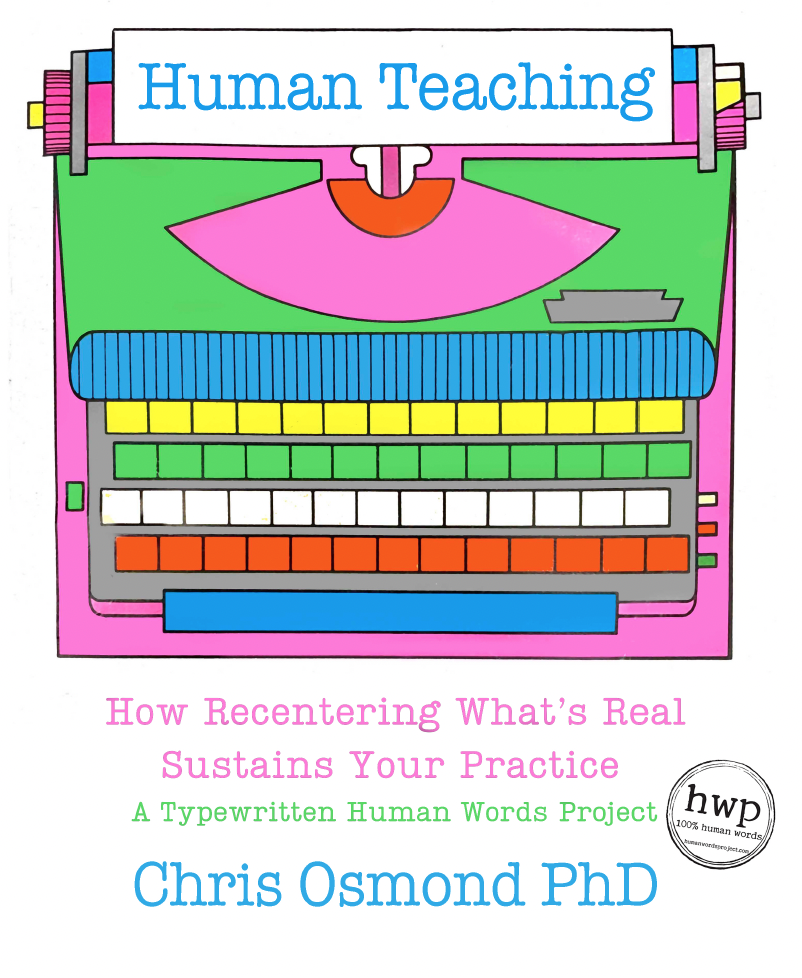
Human Teaching: How Recentering What’s Real Sustains Your Practice is now available, in paperback only (no digital download!).
Get it at Lulu, or get it at Amazon!
In Human Teaching, I use a combination of word-processed, typewritten, and hybrid pages to explore the relationship between seeking out unmediated reality and thriving in your teaching practice.
As our lives become more and more virtual–more and more invaded by screens and algorithms, and the billion-dollar efforts behind them that compete to extract our attention–I am more and more convinced that the way forward has always been beneath our feet, before our eyes, and right under our fingertips.
Maybe this moment, despite it all, is the first moment in which we can truly see reality for the endless source of sustaining power that it has always been. If we choose to stop fleeing from it in the name of speed, convenience, and ease, we may find that friction is our friend.
We may regain our living, breathing teaching selves by losing the stories we’ve been told we have to believe.
The core of the book is the “Five Spot”: a scheme for understanding the research-based principles of sustainable teaching practice that have infused my burnout prevention work with preservice and practicing educators for years.
What’s the “Five Spot”? Here’s an excerpt from the introduction:
- While the themes that underlie educator burnout are complex and interwoven, I think we can engage the most urgent ones in five moves. Five is a manageable number! It is counting on your fingers; it is the days in a school week. It is how many periods I taught each day, when I was a middle and high school teacher from 1993 to 1999. It’s a handful—and it’s just enough.
- At the school where I began my career, a “five spot” was what they paid you to sub for an absent colleague’s class. If someone called out sick, and you had planning period during one of their classes, you could volunteer in morning meeting to cover for them. Sometimes they would leave a plan; usually it was study hall. But when you were done, you would go to student accounts, and the woman who ran the shop would hand you a five-dollar bill out of the cash box. And now you had money for an extra value meal at McDonald’s up the road (at 90s prices), which you could just make in a lunch period if you really boogied. Maybe these moves are like that “five spot”: do a little extra, extend yourself a bit—and immediately start to see something better in your day, something sustaining and lovely, that wasn’t there when you got up that morning.
- Jazz fans will have thought of the third thing first. The Five Spot Café was a storied club in Greenwich Village from 1956-1967, where some of the most innovative musicians of the period played residencies, sat in, and cut records. Thelonious Monk had two long stands there; Ornette Coleman made his east coast debut there with his avant-garde improvisations. It was an unpretentious, inclusive, and adventurous place, where food and drinks were cheap and all were welcome. Being part of the new thing was everybody’s business, not just a select few. I hope the same sense of freedom, openness, and possibility comes through in these pages.
Get the book, and let me know what you think! And thanks so much for reading.

