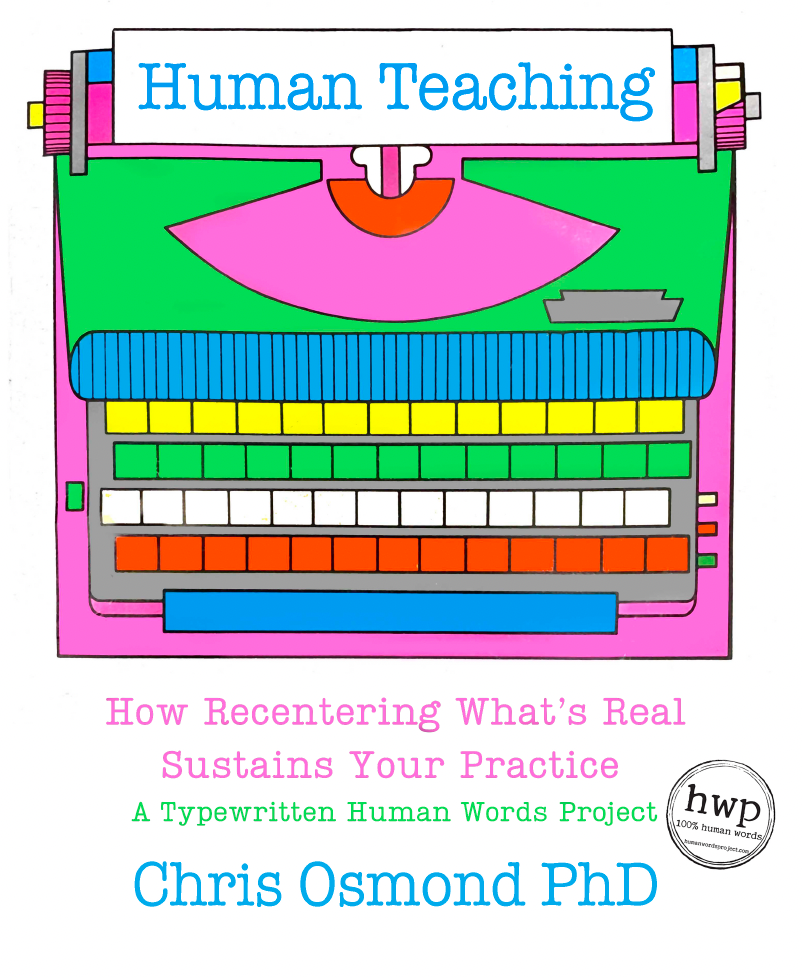
Human Teaching: How Recentering What’s Real Sustains Your Practice is now available, in paperback only (no digital download!) at this link.
I am pricing it at near-cost through the end of February–because I am so excited to get these ideas out into the world, and continue the conversation that started in these pages. I hope you’ll order yours today!
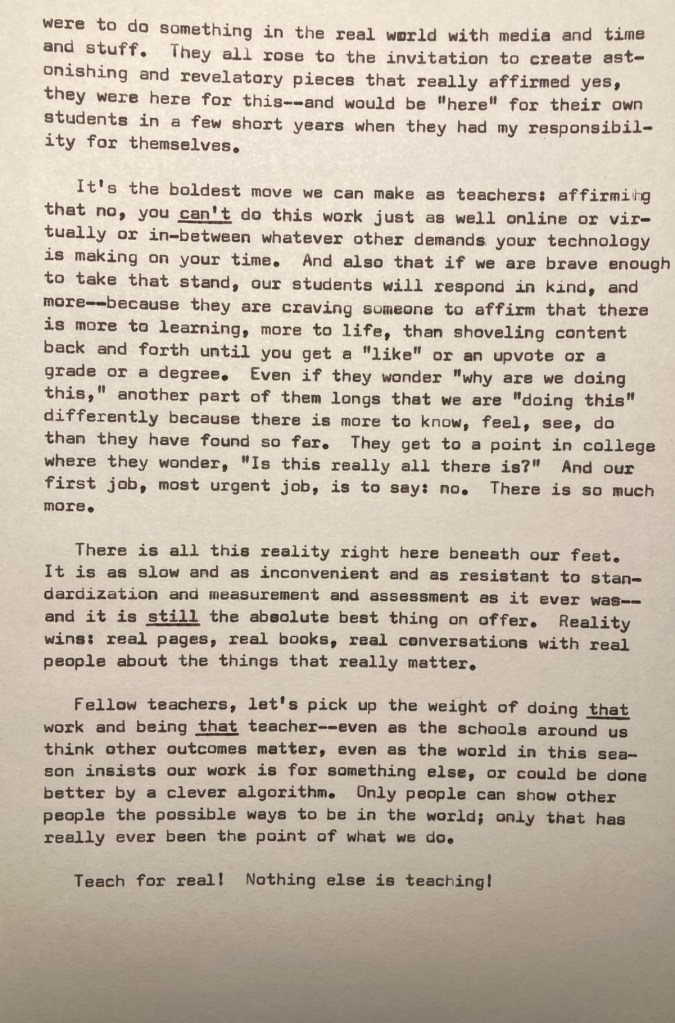
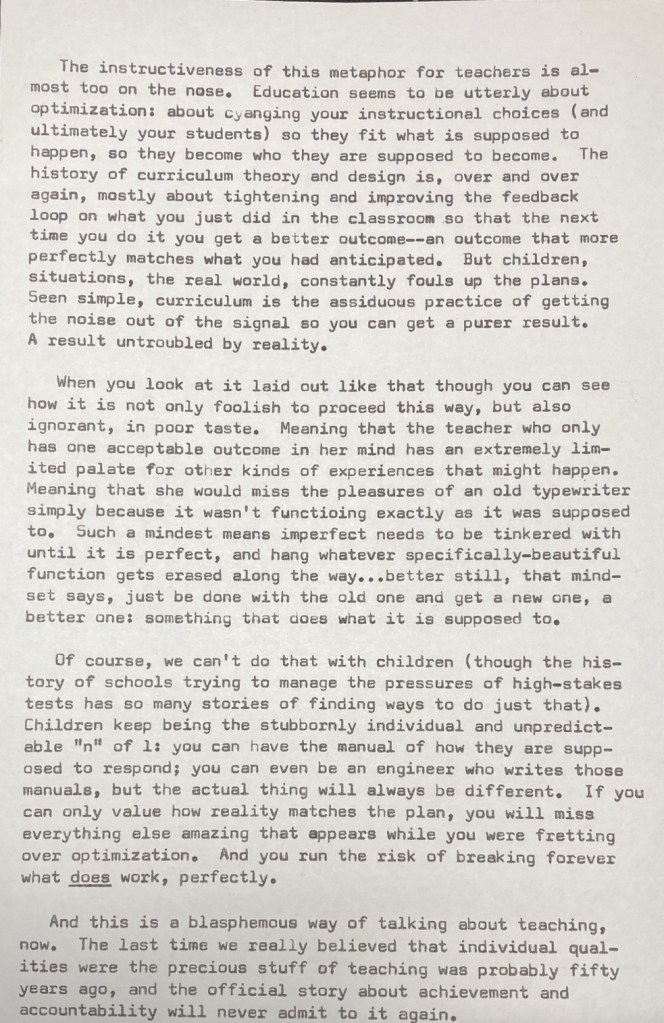
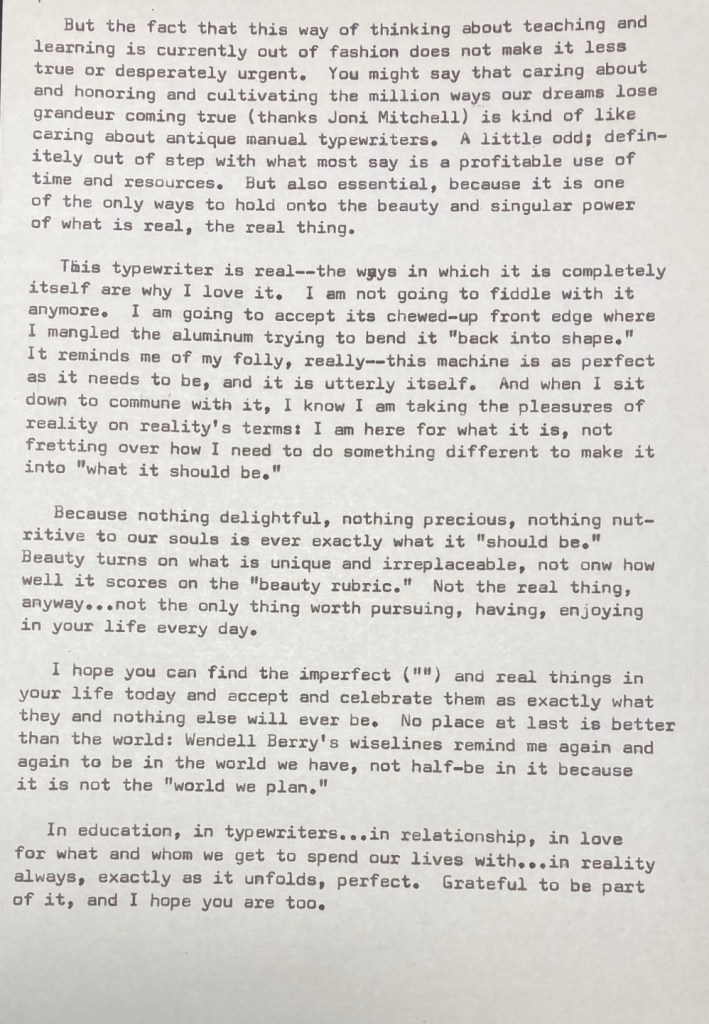
In Human Teaching, I use a combination of word-processed, typewritten, and hybrid pages to explore the relationship between seeking out unmediated reality and thriving in your teaching practice.
As our lives become more and more virtual–more and more invaded by screens and algorithms, and the billion-dollar efforts behind them that compete to extract our attention–I am more and more convinced that the way forward has always been beneath our feet, before our eyes, and right under our fingertips.
Maybe this moment, despite it all, is the first moment in which we can truly see reality for the endless source of sustaining power that it has always been. If we choose to stop fleeing from it in the name of speed, convenience, and ease, we may find that friction is our friend.
We may regain our living, breathing teaching selves by losing the stories we’ve been told we have to believe.
The core of the book is the “Five Spot”: a scheme for understanding the research-based principles of sustainable teaching practice that have infused my burnout prevention work with preservice and practicing educators for years.
What’s the “Five Spot”? Here’s an excerpt from the introduction:
While the themes that underlie educator burnout are complex and interwoven, I think we can engage the most urgent ones in five moves. Five is a manageable number! It is counting on your fingers; it is the days in a school week. It is how many periods I taught each day, when I was a middle and high school teacher from 1993 to 1999. It’s a handful—and it’s just enough.
At the school where I began my career, a “five spot” was what they paid you to sub for an absent colleague’s class. If someone called out sick, and you had planning period during one of their classes, you could volunteer in morning meeting to cover for them. Sometimes they would leave a plan; usually it was study hall. But when you were done, you would go to student accounts, and the woman who ran the shop would hand you a five-dollar bill out of the cash box. And now you had money for an extra value meal at McDonald’s up the road (at 90s prices), which you could just make in a lunch period if you really boogied. Maybe these moves are like that “five spot”: do a little extra, extend yourself a bit—and immediately start to see something better in your day, something sustaining and lovely, that wasn’t there when you got up that morning.
Jazz fans will have thought of the third thing first. The Five Spot Café was a storied club in Greenwich Village from 1956-1967, where some of the most innovative musicians of the period played residencies, sat in, and cut records. Thelonious Monk had two long stands there; Ornette Coleman made his east coast debut there with his avant-garde improvisations. It was an unpretentious, inclusive, and adventurous place, where food and drinks were cheap and all were welcome. Being part of the new thing was everybody’s business, not just a select few. I hope the same sense of freedom, openness, and possibility comes through in these pages.
I will blog a bit about each of the elements of the “Five Spot” in the coming weeks, so keep reading to find out more!
My sincere thanks to Dr Richard Polt, curator of The Classic Typewriter Page and editor of Loose Dog Press, for his unflagging enthusiasm for this project since I proposed it to him eleven months ago.
When I began this journey with real-world words in the depths of covid-dark December 2021, his was the first page of the “Typosphere” I found. His terrific book The Typewriter Revolution is required reading for anyone who wants to make manual typewriters part of their lives in a digital world.
I wanted so badly to publish this work with someone for whom the typewritten bits were a feature, not a bug. And boy howdy: did I ever choose wisely!
So get the book, and let me know what you think! And thanks so much for reading.
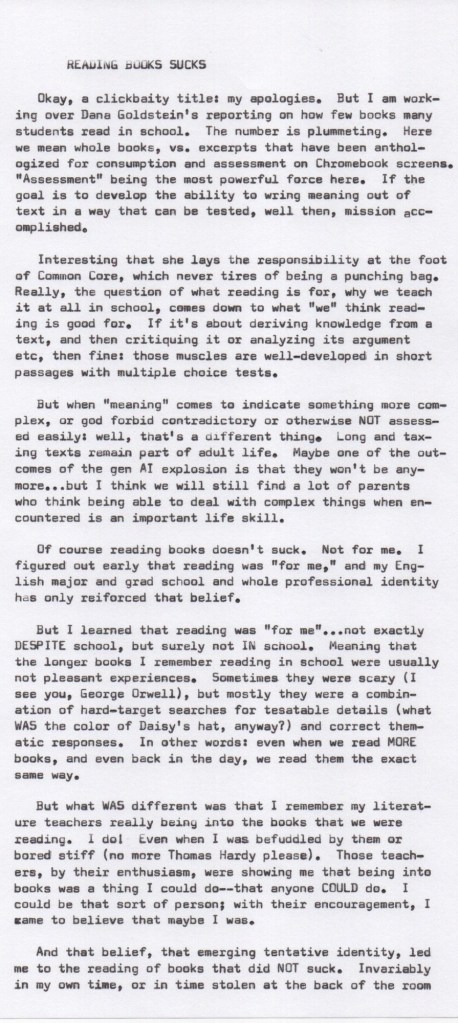
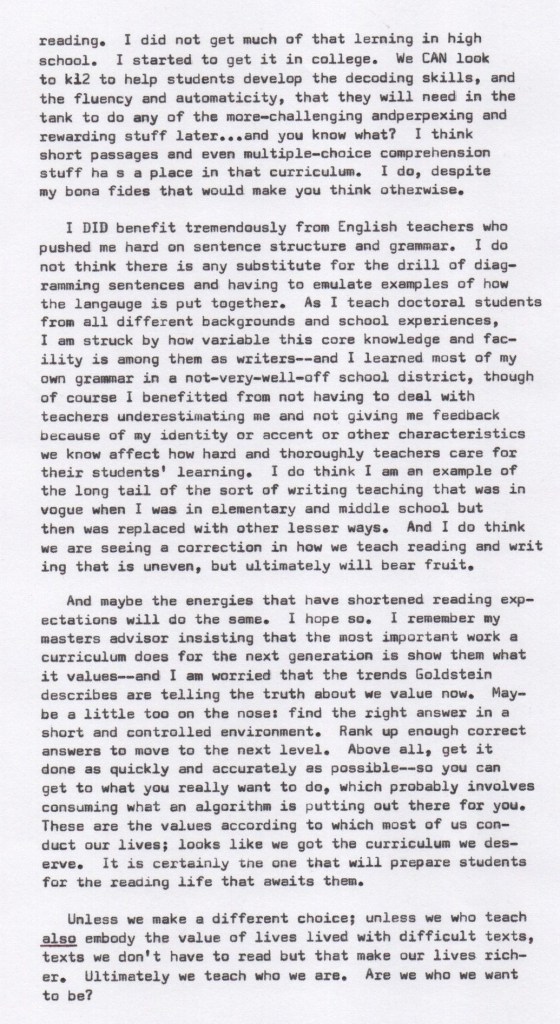
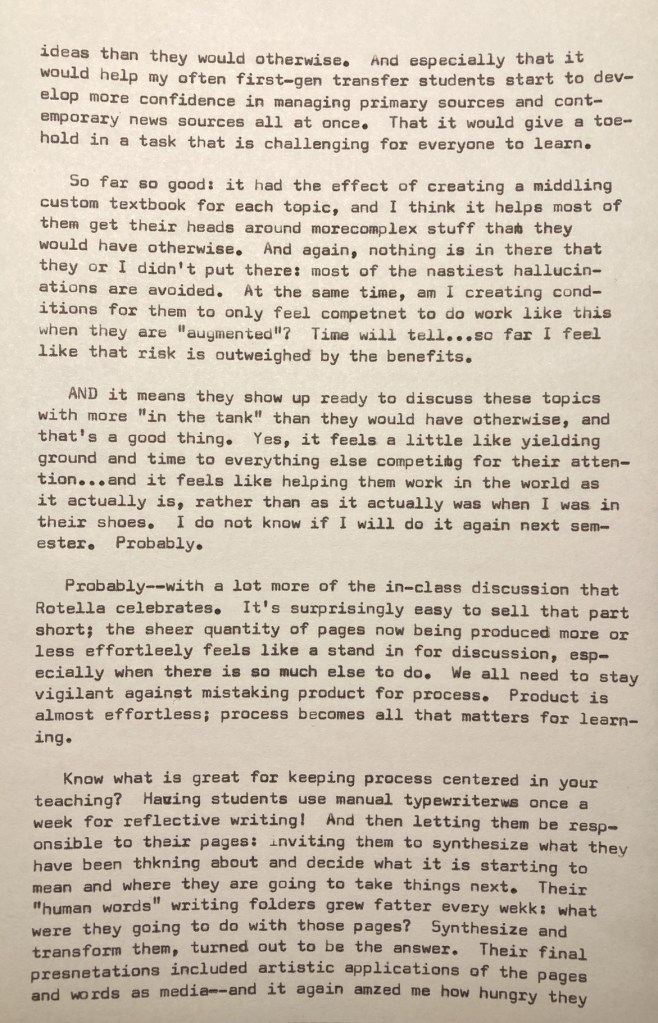
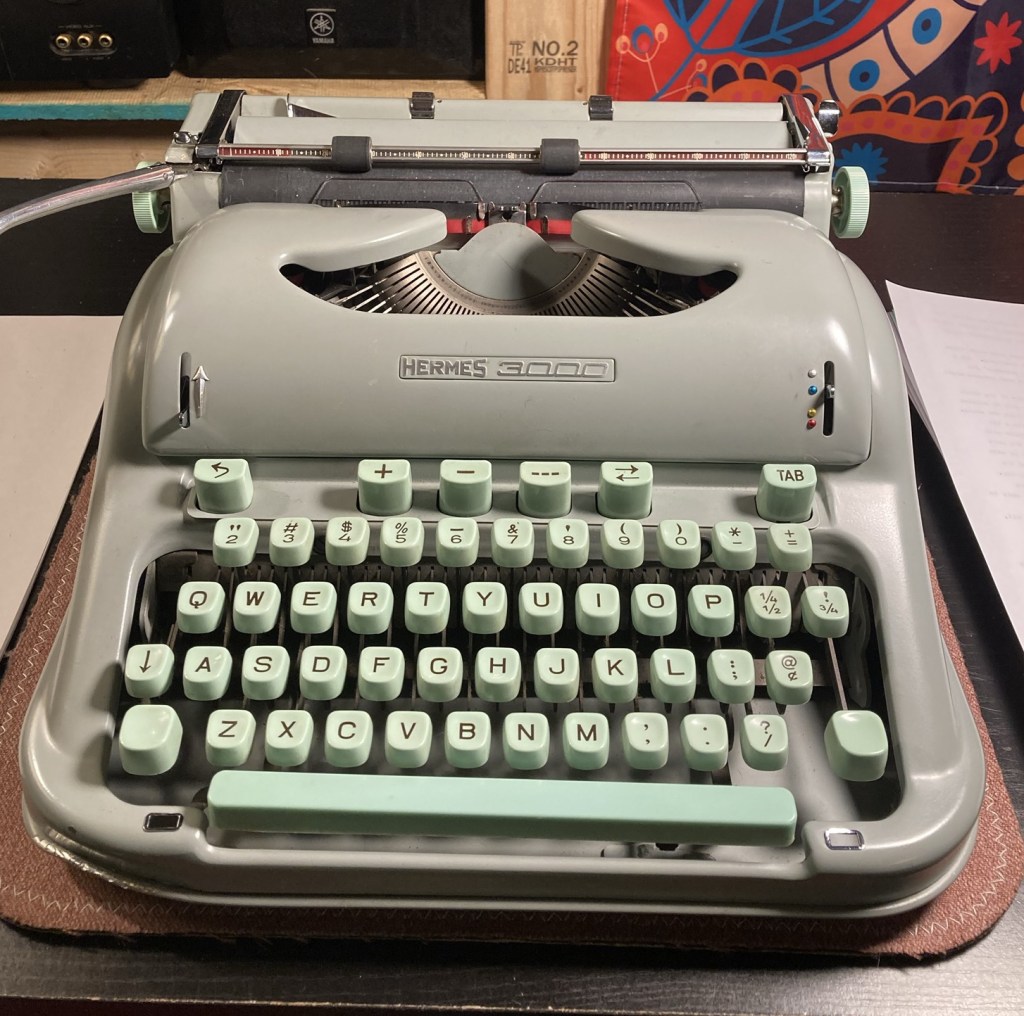
Excited to try a new scanning process to make my typed human words more legible and accessible! I am still with the charming ’63 Hermes 3000. We’re developing a serious long-term relationship. It really gets me…
I have no rights to the B&B image, which is the cover of an out-of-print anthology, but hope Mike Judge would consider it fair use. FWIW, you can buy it here.
First I have to share a note the great jazz pianist Bill Evans wrote to his composition teacher, Gretchen Magee, at Southeastern Louisiana University.
I have always admired your teaching as that rare and amazing combination – exceptional knowledge combined with the ability to bring that same knowledge, that lies deep within the student, to life. You were certainly my biggest inspiration in college, and the seeds of the insights that you have sown, have in practice borne fruit many times over.
That is probably the only French I will attempt here—though it is hard to resist, mais oui.
Because for the last two nights I have been submerged in Richard Linklater’s new film Nouvelle Vague, which tells a story about the making of Jean-Luc Godard’s 1960 French New Wave classic Breathless. I want to think about their typewriters, and the texts they purportedly yield.
I have watched / rewatched them both, Kanopy open in one tab and Netflix in the other. Fighting Richard Brody’s urge to make of the latter film “a nitpicker’s delight…any viewer who knows anything about Godard’s story can find contrivances, departures from the historical record. I won’t bother; if I want the details, I’ll read a book” (perhaps his).
I won’t say I really know anything about the “historical record” of Breathless. I shotgunned it only once a couple of years ago–in the name of cultural literacy, really, when my son came home from college raving about it. He was gobsmacked by his distinguished professor’s thoughts on Bicycle Thieves, and The 400 Blows, and this film, so I tried to catch up. A film autodidact at best, I do know what I like. And I liked these pictures.
In the 1959 milieu of Nouvelle Vague, typewriters are ubiquitous and unremarked. After all, Godard and his partners are the critics of Cahiers du Cinéma before they become filmmakers, so there is (supposedly) a lot of writing happening.
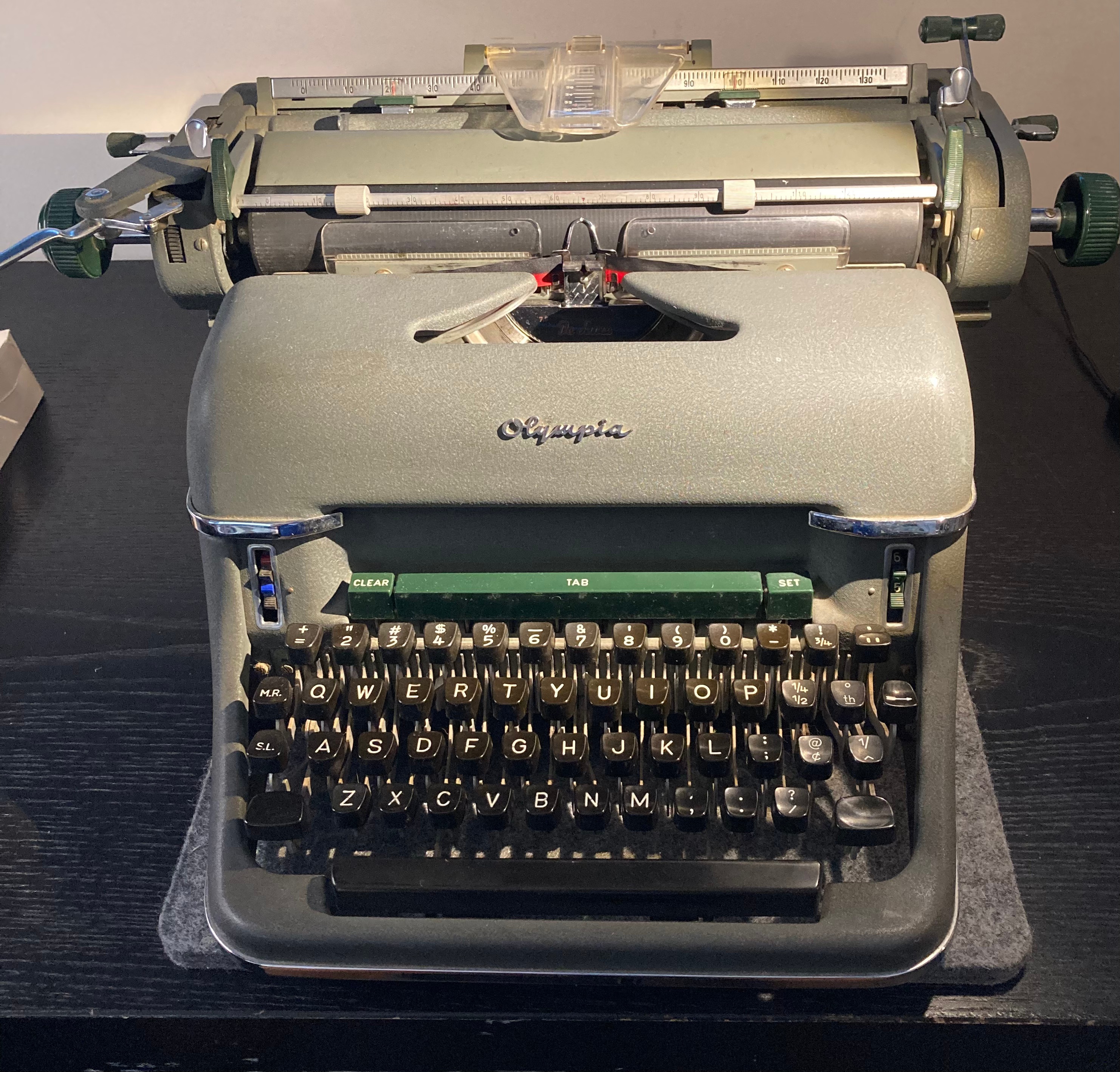
The offices of that magazine are imagined here as a large dining table with three high-end standard machines atop it on three sides. Two are easily identifiable as Olympia SG-1s, apparently brand new and perhaps purchased together for office use. The studio standard machine for people who write for a living, they are completely plausible presences here. First manufactured in 1953, they dominated the European and American markets. Mine is from 1960 and hulks on the table behind me right now.
The third is harder for me to make; it looks plastic and sloping, not exactly the Olivetti 82 but pretty close. We barely see it in the establishing shot of Godard, François Truffaut, and Jacques Rivette typing, and in a later shot of a brief speech by Roberto Rossellini to his assembled acolytes it is missing altogether. Perhaps it belonged to Rivette and he took it home? Pretty big machine–not for commuting! But it would make sense: another serious machine for forging a new age of film.
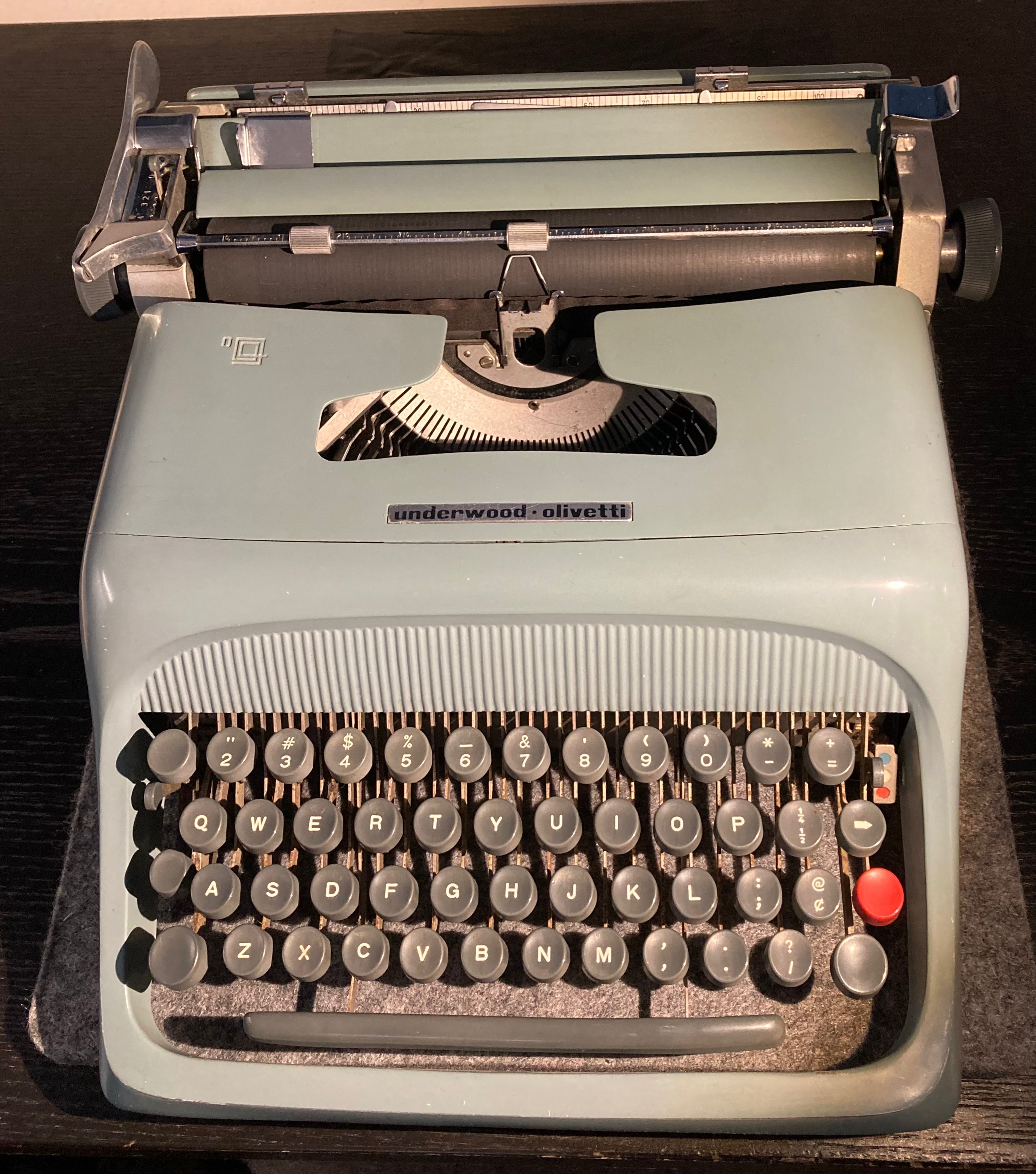
There’s also a lovely Olivetti Studio 44 in the presumed offices of the Breathless shoot itself, tucked into a corner behind Godard’s desk. I have one too, from 1961–though it began production in 1952.
He never touches it, or even acknowledges it is there; the light looks bad for serious typing on it, to me. The machine was style-forward in every conceivable way. Entirely reasonable that it would be the choice of one as presentation-conscious as Godard, so eager to make his mark in the vanguard.
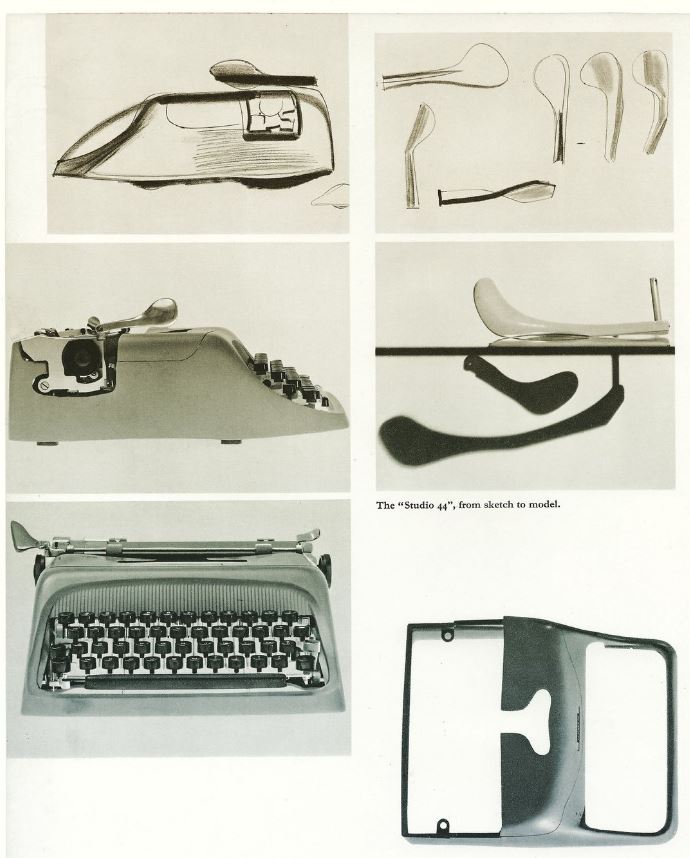
Marcello Nizzoli’s sketches for the Studio 44. Cribbed gratefully from Oz Typewriter.
Whether he ever types anything on it is unclear–and improbable, as we shall see.
But the third typewriter scene is the most interesting to me. In Breathless‘s extended afternoon almost-tryst that Patricia and Michel enjoy in the tiniest hotel room in Paris, we glimpse a portable typewriter on a cluttered desk by the bed. It is Patricia’s, because this is her hotel room. We know she is aspires to be a journalist, despite mostly just selling the Herald-Tribune rather than writing for it, and she also notes that she will have to enroll at the Sorbonne in order to keep her financial support flowing from home in the United States. (From where in the US is unclear to me–though Jean Seberg was born in Iowa, as her flatly-accented French reveals whenever she opens her mouth.) These are all good reasons to have a neglected typewriter on your premises.
And the typewriter is the least interesting thing on that desk in the original film. There is paper in it, but it mostly serves as a flat surface for a hat to rest upon. Later it supports a radio that plays “music to work to”–and is promptly switched off, since its strident tones interrupt the afternoon-delight reverie each is enjoying on different terms.
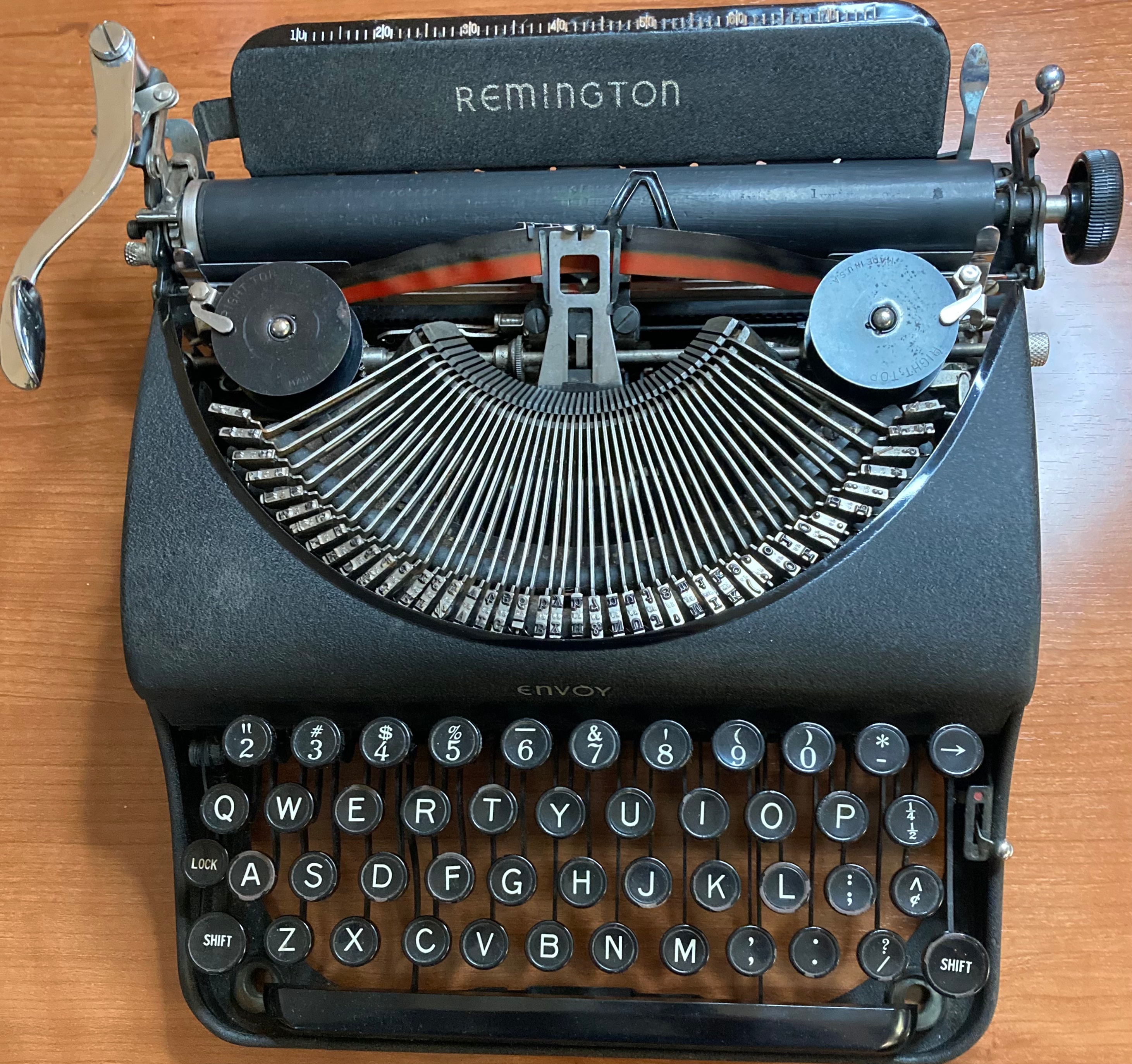
I would guess it is a Remington, by its round keys and distinctively-hooked carriage return lever. It could be an Envoy Type 2 like the beautiful one I own. Manufactured in 1941-42, and indestructible as a cockroach, it is a sensible machine for a budget-conscious gamine to be carting to Paris seventeen years later. So far so good.
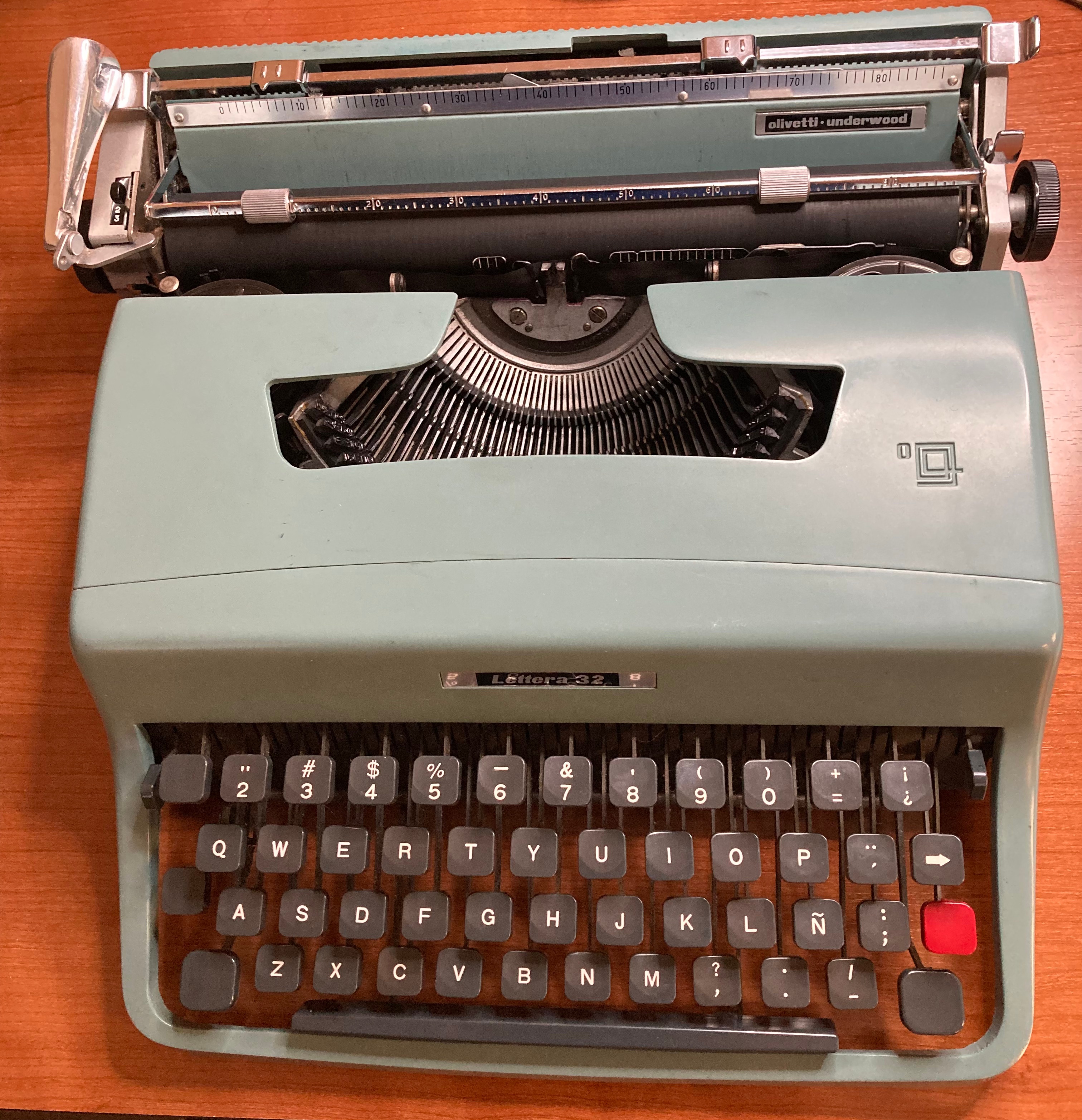
BUT: in the otherwise-fastidious recreation of that hotel room in Nouvelle Vague, the probably-Remington has unmistakably become…an Olivetti-Underwood Lettera 32. An anachronism, since Olivetti first made this machine in 1963—and the distinctive faceplate identifies it furthermore as a later iteration, probably from the late 60s. Catastrophe!
This machine is coded completely differently! Italian vs. American, stylish and sexy vs. boring and reliable. She might have even bought it in Paris.
Who even is Patricia, if this is her typewriter? Other than a time traveler?
Pour quoi?
In a lovingly-detailed recreation and invocation of a very specific time and place…why would Linklater get the typewriter wrong?
Well, maybe he missed it. As a cineaste friend of mine noted, “if I found out you knew more about mid-century typewriter manufacturing than Linklater’s production design team, I wouldn’t be shocked, exactly.”
But isn’t it more interesting if he didn’t? If it is on purpose? Consider.
Nouvelle Vague presents Godard as someone with a complicated relationship to writing. At best. A running theme of the story is that Breathless has no script. In pursuit of a purity of experience, a spontaneity, never before seen, he shot without one. The film used a camera that was too loud to allow synchronized sound, but did permit unique still-camera film that, spliced into long rolls, could capture natural light in extraordinary ways. That meant all the audio was dubbed later, and Godard could and did feed lines to the cast while filming…lines that he would read from scribbles in a series of Moleskin notebooks where he claimed to have the whole film plotted.
Which does not mean the Godard of Nouvelle Vague fears text: he begins each day at a cafe with a pile of paper upon which he makes notes in what Seberg calls “beautiful handwriting,” and sometimes communicates important info by passing those notes to those they concern.
What this Godard fears is committing to a text: to typing it up and saying, this is what it will be. The script manager helplessly flips a single page back and forth on her clipboard. The producer fumes at how this same spontaneous relationship to text extends to the relationship with time and budget: Godard won’t shoot if he is uninspired. Nothing on any of his private pages dictates how and when to make the film: they are just gaps of indeterminacy, as Wolfgang Iser says, that will lead to new possibilities yet unimagined.
The fungibility of printed text in the film also boggles the digital-era, backup-savvy viewer. Presumably, the treatments we do see bandied about are bare stacks of paper, without bindings or apparent copies. (Le mimeo is glimpsed once in the background of the office: it sits silent.) A single copy of the story itself is handed back and forth between Truffaut and Godard on a metro bench; the first assistant director carries a fistful of paper through a bar, responding to Godard’s insistence that he “show it to no one” by shoving the pages briefly into the face of an innocent customer with a smirk.
Where is the text? It is scribbled here, it is handed around there…it is none of these places.
There is no text for Breathless: the film is the text, and the film only seeks to capture the untrained and unplanned interactions that result from Godard’s willingness to commit fully to their pursuit.
At one point, Godard is frustrated with his two leads planning what they are about to do when camera rolls (Allez!)
“What are you filming?” asks a passer-by. (He is shooting on the street, with real people unknowingly serving as extras.)
In frustration, he snaps back, “A documentary about Jean-Paul Belmondo and Jean Seberg acting out a fiction.”
Everything he didn’t want: people planning to do things, which means they will not actually be doing things. (“Though a documentary would have sync sound,” Seberg grumbles.)
That is what Godard wanted, and got. Live action!
And that is what he inspired in those who followed, including Linklater: to seek out reality as best they can contrive to. Linklater, who played with time itself in Boyhood and the Before trilogy–synchronically daring, insisting on time shaping what appeared and what went on the film.
Because the text isn’t in the script, and it isn’t in the typewriter.
And if it isn’t in the typewriter…maybe it isn’t in the choice of typewriters, either.
Typewriters make dead fictions to be acted out, this out-of-time machine seems to say.
This is alive.
Even in this recreation, homage, impression, of what might have happened seventy-six years ago in the process of committing life to film…the choice seems to say: this is alive, too.
Allez!
*I wish I could figure out how to share screenshots from Kanopy and Netflix, but that stuff is locked down. Check out the films themselves! Get Kanopy from your library!
**I had pretensions of using some Roland Barthes in here somewhere but it’s probably in everybody’s best interest that I didn’t.
***The Olivetti Studio 44, by the way, also graces Susie Myerson’s office desk in The Marvelous Mrs. Maisel–which is incongruous, being way more of a home machine. Until you consider that the office is being operated on a shoestring mainly to book Midge: she must have loaned it from home.
“We can’t stand a work of architecture until we go the mat not to lose it.”
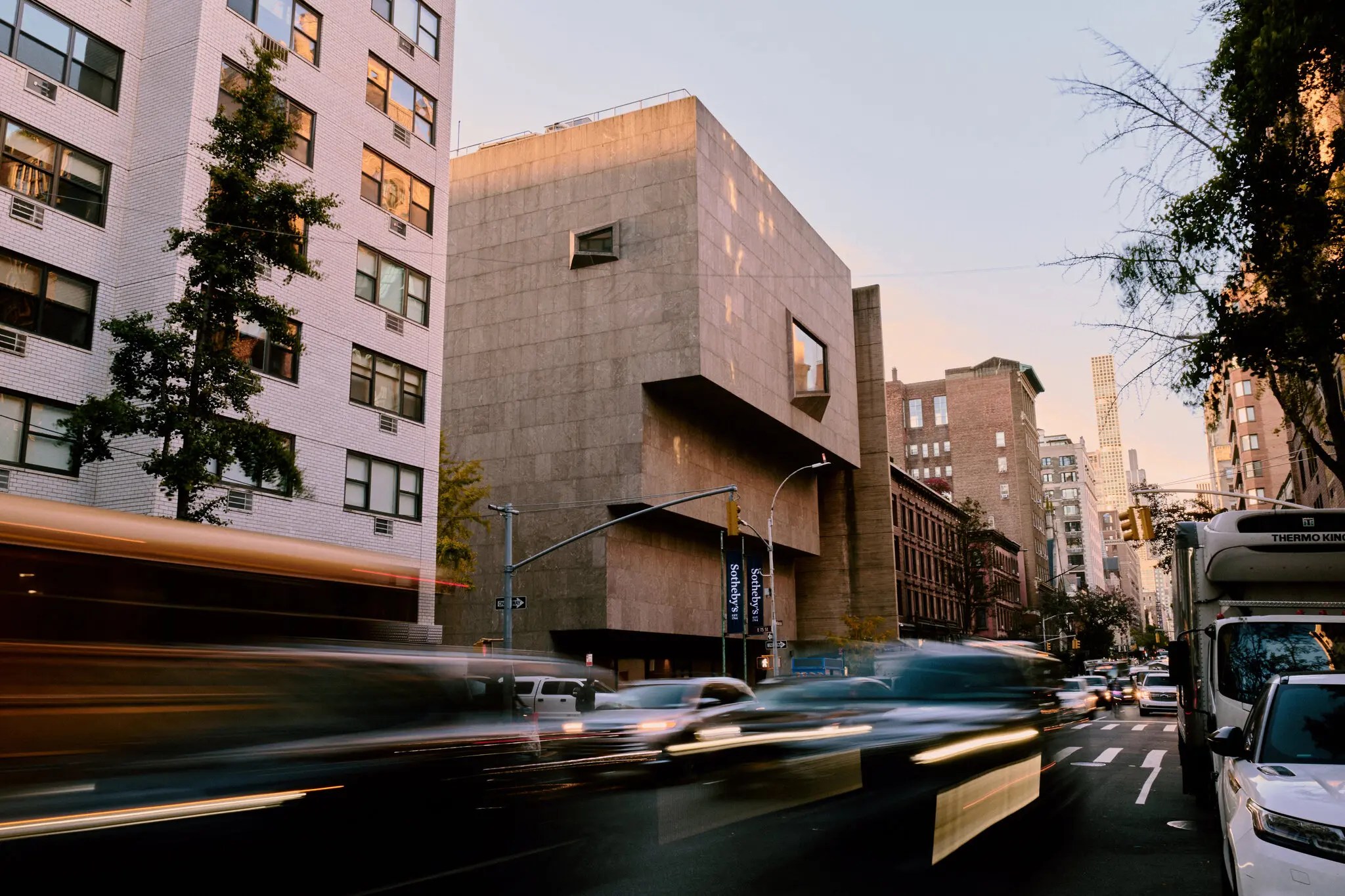
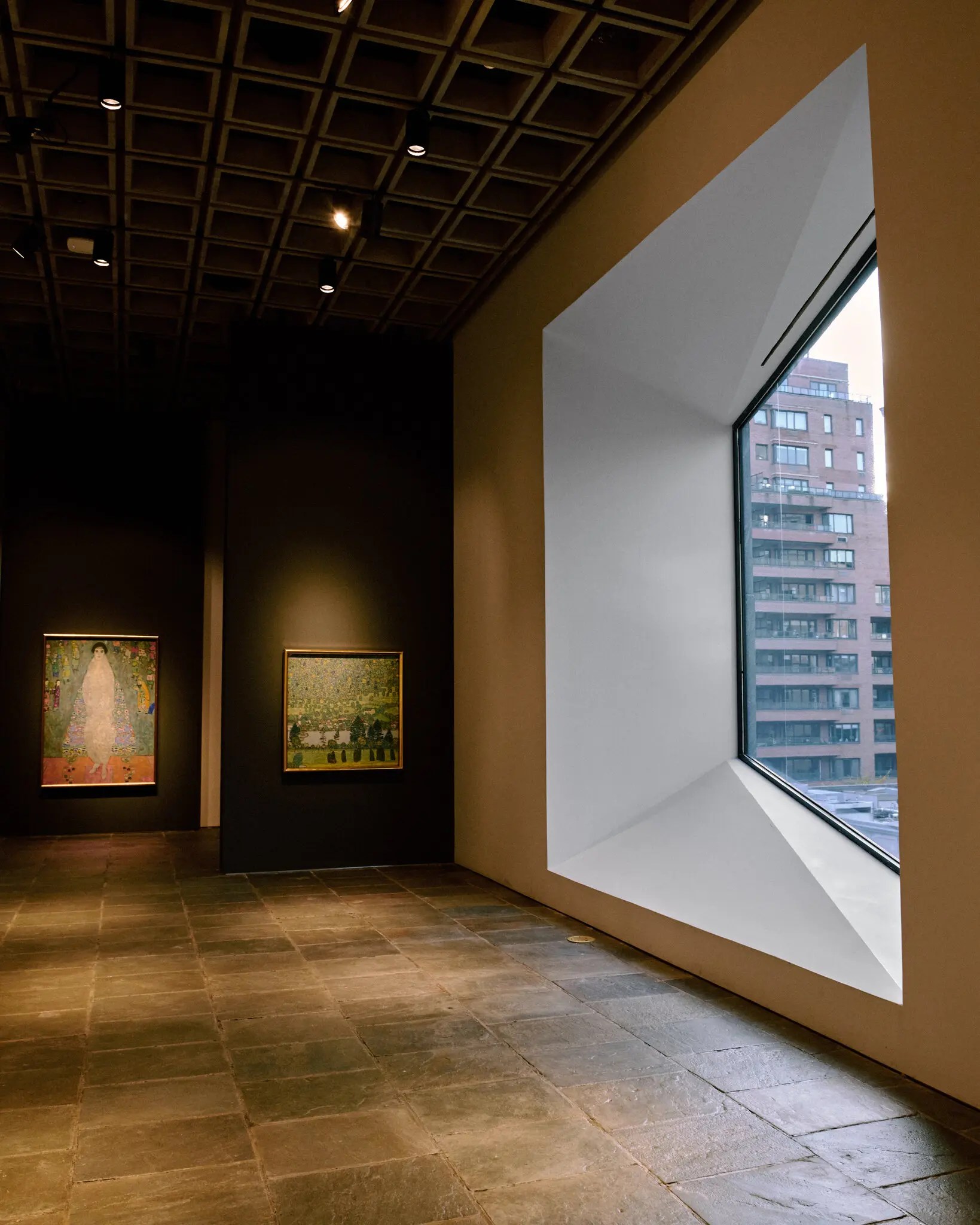
That’s the last line of the admiring account in the NYT today of the restoration of a 1966 “Brutalist behemoth“: the former Whitney Museum, designed by Marcel Breuer. It looks like a humdinger! Regarded as unpleasant when it was first presented; with time, its virtues became apparent; now, it is precious.
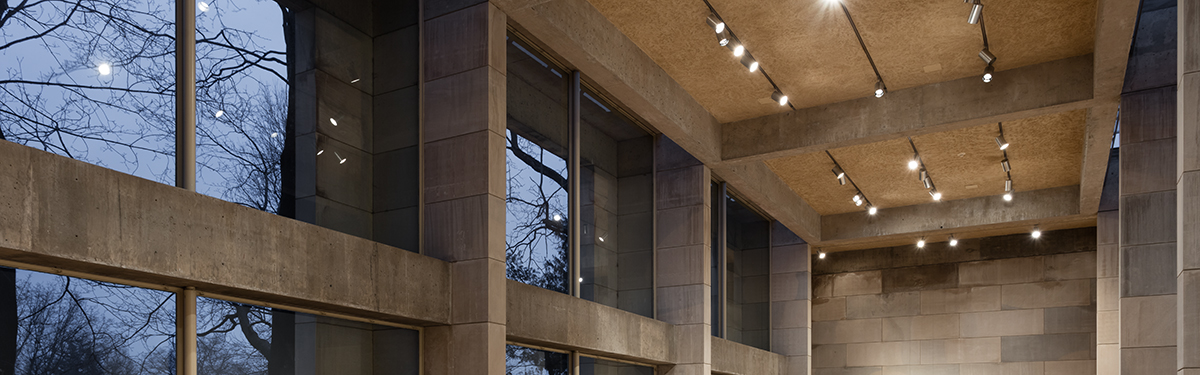
I don’t know from architecture. But I do know how it feels to be inside a building that makes its presence known, and I have a special feeling for Brutalist spaces. Buildings that are not pretending they are not buildings. Buildings that show you what they are made of, and that they intend to do something to you.
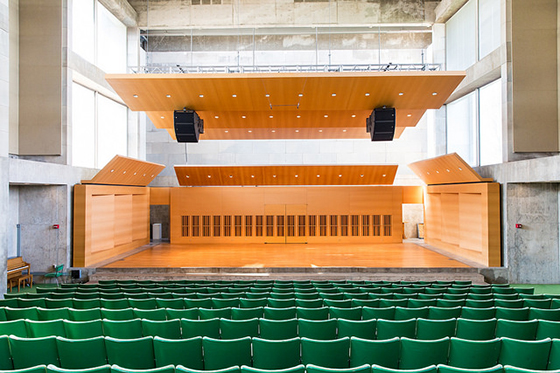
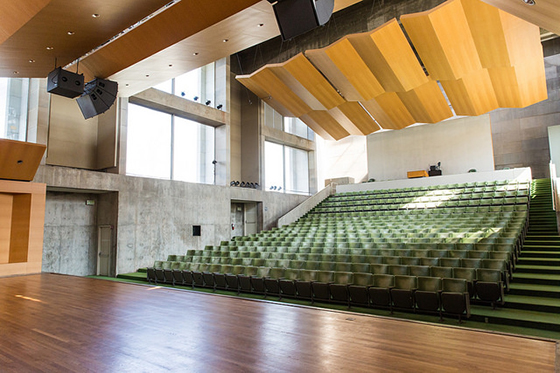
I think I learned to love this aesthetic in my first year of college. Late in that first fall I auditioned for the annual musical review, which was staged inside the campus’s concert hall. The fine arts complex at Wesleyan was appended to the original brownstone row in the early 70s, a deliberate interruption of the “ived walls and storied halls” feel of the place before then. It was a bold flex of the university’s standing as an incubator for innovators and wayfinders.
It still makes an impact now. Crossing Wyllys Avenue is jumping a century into a recent past, an incongruity so intentional it makes you stop and wonder what it is trying to teach you.
I spent more time inside that limestone and poured cement pile than I did just about anywhere else that first semester, besides the then-reviled, now-mourned flying saucer dining hall. (I did not see Joni Mitchell there, but I did perform on that stage!)
I can see now what I couldn’t then: this was a place for students to get used to working, exhibiting, and thriving in galleries. To get used to being seen and heard. To understand that they had something to make and share, and in order for them to make it, spaces like these were going to be theirs. They should get comfy in them.
But I was not comfy back then in spaces like these. Then, they were just weird. “Modeled on Lenin’s tomb,” a smartass friend of mine would joke. “Will make great ruins someday.”
But when I re-entered that building at my son’s frosh orientation, it didn’t feel like a tomb. It felt alive. Because cement and limestone buildings breathe, is the thing. You smell the stone and feel the damp coming off all that exposed expanse. It is like a greenhouse, but for rock, not dirt. (And for people, maybe.) Brutalist buildings are elemental places where things get broken down and maybe regrow into other things.
The sensory charge took me right back to those first weeks, like smell and damp will. The weeks when college was in the process of blowing my damn mind. That was where I became convinced that college should smart a bit. You should wonder if you are in the right place, then find a way through to make it the right place for you.
Wesleyan was the first place this highly-desirable discomfort was committed against me. The first place I had to realize that there were a lot more kinds of people in the world than the ones I had met so far in Mormon churches and Air Force base towns and southern suburbs.
This is where I met real “city kids.” Kids who played speed chess and lacrosse and ultimate Frisbee very seriously; kids who were used to taking charge of what was going to happen when they walked into a room. Kids from places like Stuyvesant and Spence, where leadership was a birthright conveyed as comfortably as a pair of L.L. Bean boots. When I came to the first rehearsal of that show I looked around for the director–the grown-up that was going to validate this thing and make it good. There was none. Like so much that happens at Wes, the students were the directors, designers, and choreographers, as well as the actors. This is what we were here to do, after all. Let’s do it.
I continue to think that college should be hard: that you should be properly dumbfounded and discomfited at first by at least some of what you find there. Not abused, of course; always respected, always seen and honored. But I still believe that student evaluations of instructors are foolish for many reasons–and not only for their well-documented bias in support of white, male, cis, people like me and against women, queer folks, and people of color.
The first reason is that students, by their very nature, do not know what they are there to learn. They do not know what experience is the one they need. Why would we ask them if they think they got what they should have?
I learned that at Wesleyan. My professors would sometimes really step us through a passage, or explain in those pre-Wikipedia days where a text or a painting fit into the historical sweep I barely understood. Sometimes they would slow down and make it easy. Thank God for those folks. But a lot of the time, that amazing faculty just gave us the full blast of their erudition, and it was on us to keep up. (Maybe Stuyvesant and Spence were keeping up better than me. I don’t know.)
A lot of the time, I believe now, the overwhelm was the point. Exactly: you are uncomfortable. Exactly: who you were when you came in is not up to the demands being made upon you. So grow and change. Let it smart a little along the way.
I couldn’t handle some of how my mind was being blown at Wesleyan that first year. Several tearful calls back home from the payphone at the end of the hall in Foss 7. (Oh the payphone call home!) Several intense moments of wondering if this had been a terrible mistake.
In those first weeks I stepped on a rusty pipe in front of the decommissioned frat house that held the Romance Languages department. It gave me a gash in the bare top of my foot (yes, I was wearing Top-Siders without socks) that hurt and bled, and left a scar I still can still see.
A little on the nose, but I need it simple sometimes. School can mark us. Sometimes, it should.
I am so grateful for how Wesleyan marked me. So grateful for how it blew my mind, and how it didn’t slow down for me. Grateful that the point was for me to find a way to keep up.
Like a bold building that once made us uncomfortable, but now we revere, maybe. At the time, maybe we couldn’t see what it was trying to do to us and for us, and we sure weren’t grateful enough for it. And now we are.
Thanks alma mater, for the sometimes brutal love I actually needed.
Class starts in thirty minutes. Time to pay it forward.
(No typewriters in this post! Apologies / you’re welcome. I will note that in 1987 I brought a Brother electric typewriter along with me for my frosh year. It could remember a whole paragraph, and let you proofread it excruciatingly on a tiny LCD screen above the keyboard. Then you hit “Enter” and the whole thing clattered out on the page at once, like ChatGPT if it ran on acorns and elves. I took a long leave after that year; when I returned in Jan 1991, everyone had little beige Macintoshes.)
I am just back from the annual professional meeting of folks around the country who run programs like mine.
Like nearly all academic meetings, it took place in a big city, in a hotel that is also a conference center. The action went down in one big ballroom and an assortment of smaller meeting rooms spread around wide central spaces, where coffee and food intermittently appeared and then was cleared away.
It was furnished to be “nice” twenty years ago but, like all such spaces, showed the constant wear and tear of hosting one such event after another. A spot of ripped upholstery here, a missing light switch fixture there, the scuffs on the walls that inscribe a story of people constantly coming and going, presenters moving chairs and tables in an effort to make their session more collaborative, or less.
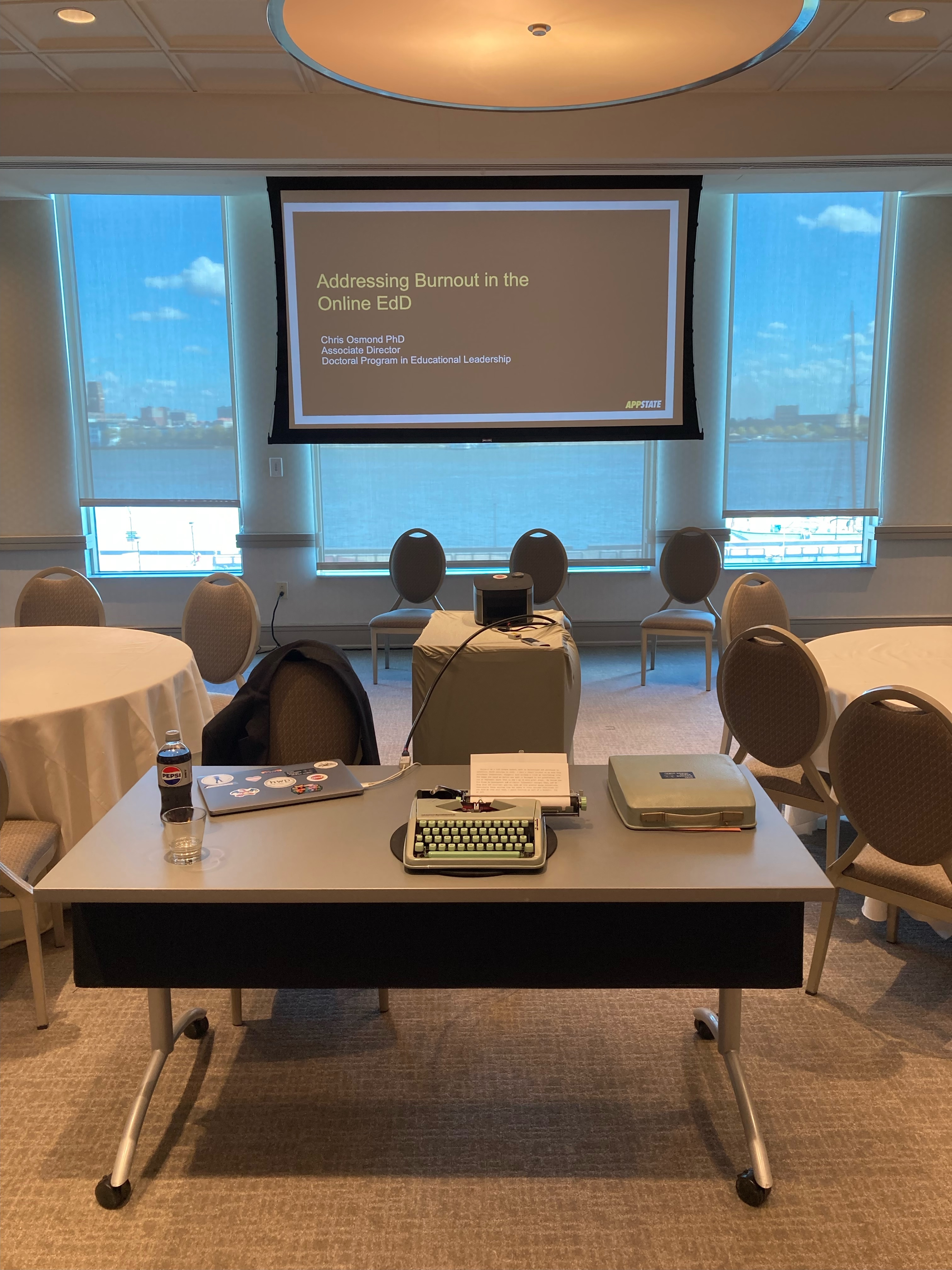
I brought a typewriter with me, as above: my bulletproof 1965 Hermes Rocket, which has traveled with me to Hawaii and Ireland and many places in-between. My session was on manual typewriters in 2025 as an interpretive lens to understand the nature of educator burnout and find new ways through it. (Also the topic of the book I have coming out very soon with Loose Dog Press: watch this space!)
So I got to bring the Rocket with me, and invite participants to take it for a spin. Maybe one of the latent powers of a manual typewriter in 2025 is that it is always exactly what it is, where it is. After all, it is the only object in this photo of my session that is really its own, singular thing: the tables and chairs are anonymous, and even the “slides” aren’t real.
In every session we found ourselves sitting with strangers at a round wedding-reception-type table covered by two massive industrial tablecloths and were asked to interact, to break ice, to discuss, to synthesize, to report out, above all to network. The incongruity of the importance of the work we are striving to do at these meetings, juxtaposed with its trade show surroundings, always jars me and creates an anomie in my soul so consistent I have learned to brace for it.
I remember attending my industry’s biggest meeting twenty years ago in San Francisco and standing on one of those terrible banquet chairs to see one of my mentors receive the organization’s highest honor, a lifetime achievement award. A deeply moving moment, thousands of lives changed for the better, world-shifting impact on education—taking place in a corner of the Moscone Center that would probably feature a refrigerator display in two days.
My local district in opening a new elementary school on Monday, years after accepting the fact that the historic WPA-constructed building was too close to a flood-prone river to possibly be reclaimed, Hurricane Helene displaced the kids from it anyway; they have been meeting for a year in donated halls, and so having a home at last is a major achievement. But of course, as one of my sons (a former student of the school) commented upon viewing an online video tour, it looks like a Hampton Inn inside.
I have not seen the video but do not need to. I know what educational “nice” looks like. I know exactly what he means. Indestructible carpet with fierce patterns overlaying neutral texture that will hide stains and wear for two decades. Ranks of plastic tables and chairs that can be rolled around and reconfigured, but never really fit together. Indirect lighting that will still make everything cold and sallow.
(I also read that the university building where I was so splendidly taught by that grad school mentor just re-opened after a comprehensive refresh. In the photos, I see the Hampton Inn aesthetic, filtered through a lot more money.)
I am grateful to the designers and the builders and everyone for a new building, don’t get me wrong. I just want to note that any public institutional space has to meet its contemporary demands to look “nice,” to accommodate hundreds, and to last for fifty years.
Spaces that tick all those boxes will never be humane spaces. They will never build in the evidence of human existence that so many of us find comforting in older, lived-in educational spaces. Worn spots on terrazzo floors where three generations of chairs have been scraped. Formica tabletops with the edges worn from students leaning over books, then laptops, late into the night. Chalkboards from the 60s peeking out around the edges of whiteboards from the 90s that were mounted right on top of them, to not leave divots in the drywall.
My favorite educational meeting has always happened in the same physical place, and has since the late 70s. It’s a Catholic retreat center near Dayton. I am not Catholic, but I read in its low-slung brick and monastic rooms and stained-glass chapel a strong presence of the liberation theology of fifty years ago. Ecumenical, peacenik, a little woozy, earth-tone woodcuts of venerated elders and saints painted on burlap. The rooms redolent of thousands of urns of coffee and the adequate but unpretentious on-site dining service. Brick and coffee and just a little warm damp: a terrarium, nearly, for people who seek to care for other people.
Overwhelmingly human and cozy, Feels like home to me, anyway, who is old enough to remember Air Force Base chapels built in the same vibe. Feels like room to sit and rest, room to hole up and read, room to make a new friend. The meeting itself the historic home of the last educational moment, IMHO, when we took seriously the interpersonal, the autobiographical, the human becoming of our work. The last moments before Reagan and measure-to-manage became commonsensical, before the ground opened and swallowed it all up in a conflagration of accountability that now feels like the only way to do school. (But isn’t.)
Of course, the real kicker is that every educational space that feels humane now was just “nice” when it opened, according to whatever “nice” meant at the time. The modernist / Brutalist cement and chrome piles I remember fondly from undergrad were built in the 60s as interruptions of the previous century’s brownstones. They only feel human to me because I was a human in them. (Oh look, one of those just got torn down and replaced too.)
Maybe the real point of this reverie on human living in inhumane spaces is that only by living in them do cold spaces warm up. Places where we do sacred work become sanctified. Churches and schools. Why does an empty classroom feel different than an empty hospital ward, than an empty prison cell? Exactly.
Maybe one of my deepest disquiets about online Zoom classes is that Zoom will never feel lived-in. A Zoom meeting is always the same, because a Zoom meeting is not a place. Evening class in Zoom can never feel different than every other meeting you have had in Zoom that day. It is the same not-space, and unless we who teach there make a real effort to make it otherwise, what is conveyed therein will just be more content to be consumed and optimized and turned into deliverables and accountabilities.
(And easily 1/3 of the sessions at my meeting were about incorporating AI into the teaching, writing, and mentoring work we do: another irreality that is changing the scope of what we can imagine doing with our students. For another day.)
We need real places to feel ourselves as real people undertaking real experiences. A sentence even John Dewey, that Lorax of experience, could not have imagined uttering in his day.
Don’t know how to end this. Maybe with the suggestion that we all notice and value what the real spaces we live in do for us. Whether welcoming and accommodating or brutal and indifferent, we make ourselves and each other as we share those spaces and work toward our shared intentions.
What do we want them to feel like? What can we do to make them more so?
Whatever they start out as, they end up…ours.
This whole blog SHOULD be about my amazing encounter this week with Bryan Kravitz of Philly Typewriter. What a shop, what a project! Typewriter Valhalla! More to come!
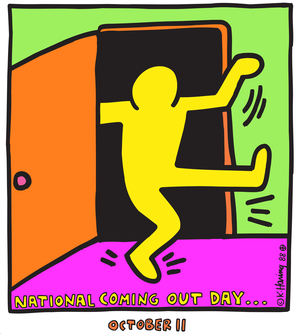
Happy National Coming Out Day! It was yesterday, Oct 11. But I will be observing today: by coming out as a heterosexual and cisgendered ally of my LGBTQ+ students, colleagues, friends, family, and readers.
I do not mean to make light of the occasion by shifting its meaning like this. I understand its gravity, and honor its creation in the dark days of the AIDS epidemic.
But at least around here, people like me seem to have backed away from using the unique protections that our positionality provides us to work for our more vulnerable fellow citizens.
And I want to say to my straight brothers and sisters: where the hell did you go?
My fellow educators, five minutes with the appalling data on the increased risks of suicide, self-harm, and interpersonal violence for LBGTQ+ young people should make up your mind that creating actively inclusive spaces is part of your responsibility.
If you are not actively interrupting the homophobic and transphobic culture of school—the hallway and locker room talk, not just the classroom talk—you are part of the problem.
This truth does not not have to change your faith, your heritage, or your heart. It DOES have to change your practice to an active, change-making daily approach, not a ¯_(ツ)_/¯ and pretend-not-to-hear approach.
How will you know what to do? Especially if you live in a purple-to-red state like mine?
Well, from one straight person (teacher) to another, this is what I do, and what I humbly suggest.
First: think on the LGBTQ+ people you have taught, known, and loved in your life, and presently do. There have been hundreds, both those who told you about this part of themselves and those who didn’t.
Second: make the list, maybe actually write it down. See their faces in your mind.
Third: thank them, in your heart (or maybe even IRL, if you never have). Thank them for trusting you with their truth–especially if their truth proceeded to ruin your capacity to pretend that their issues are not yours.
And once you have done that—well, act accordingly, on both their behalf and the behalf of those additional hundreds you have not yet met, nor yet had the responsibility to serve.
And what does THAT mean? “Act accordingly?” Well, I can’t know for sure. But you can figure it out!
Here’s a thought: maybe go to the Pride March next June! A friend thanked me at ours for marching, “especially as a straight person.” Why? It is literally the least I can do, and you too. To stand with and for.
You don’t have to carry a flag or holler alternate lyrics to “Hot to Go” (though that was super fun).
You do have to stand up and be counted, and swell the numbers, and put your safe and nearly-invisible body between those whose bodies aren’t and those who might do them harm.
Mark it, show it, name it! And I am not perfect at this. This week I finally took the unity flag out of my work email signature. Maybe I am a coward. But we got another email from legal reminding us of the old-and-new rules governing “political activities and employees,” and for the first time it linked to the “email signature guidelines” provided by our ever-vigilant Comms team, which I quote in full:
Don’t promote a personal agenda, including politcal [SIC—nice] messages. If it isn’t connected to your professional life, it doesn’t fit in your signature.
This is loathsome, as I argue to my students: identity is not a political message. Solidarity and safety and peace and love are not political messages. These are humane messages. These are “the world I want to live in ” messages. Aren’t they? As we let identity become politicized—as we let what we know so clearly about bias and its deadly impact become politicized—we diminish in our humanity.
But in this moment, in a system that claims “institutional neutrality” and a news cycle that is keeping the body count of fired professors, a message from legal carries different weight, and I intend to keep this job. So I made the change. I kept my pronouns in there; they are not illegal yet. And I still wear the unity button I have every day since the election. We will see what’s next.
Is this the right thing to do? Is this the best thing to do? I don’t know. I am figuring this out as I go.
But I am still working on it.
And my dear fellow straight folks, hey:
Are you working on it? If not–where have you gone?
Yes, you might think I am virtue signaling. Whatever. (Kind of a charming throwback, that, in 2025.)
And yes, there are multiple identities being punished and erased and traumatized right now, and they all matter. Black Lives Matter. Immigrant lives matter. Womens’ lives matter, as we lose generations of change in their self-determination and autonomy and safety. I admit the zone is flooded, and I am not working for it all the same way. (This week I did get added to the translator list for the Immigrant Justice Coalition, so maybe that can change too.)
But this corner of the vineyard feels like mine—and I see a way through to do something about it—and I am going to keep working on it.
Het/cis friends: Will you?
If not, why not? What changed?
The times, yes; the climate, the laws, the workplace feel, yes, they have all changed.
But has what is right changed? No. Has your love for those friends you conjured up a minute ago changed? No.
Have YOU changed, fellow person who could just keep your head down and ride this out in your ill-fitting khakis, and who could blame you? Maybe?
Well, don’t! We can’t change. Please don’t change.
Our LGBTQ+ dear ones need us not to. Our nation needs us not to.






 Chris Osmond PhD