Excited to try a new scanning process to make my typed human words more legible and accessible! I am still with the charming ’63 Hermes 3000. We’re developing a serious long-term relationship. It really gets me…
I have no rights to the B&B image, which is the cover of an out-of-print anthology, but hope Mike Judge would consider it fair use. FWIW, you can buy it here.
That is probably the only French I will attempt here—though it is hard to resist, mais oui.
Because for the last two nights I have been submerged in Richard Linklater’s new film Nouvelle Vague, which tells a story about the making of Jean-Luc Godard’s 1960 French New Wave classic Breathless. I want to think about their typewriters, and the texts they purportedly yield.
I have watched / rewatched them both, Kanopy open in one tab and Netflix in the other. Fighting Richard Brody’s urge to make of the latter film “a nitpicker’s delight…any viewer who knows anything about Godard’s story can find contrivances, departures from the historical record. I won’t bother; if I want the details, I’ll read a book” (perhaps his).
I won’t say I really know anything about the “historical record” of Breathless. I shotgunned it only once a couple of years ago–in the name of cultural literacy, really, when my son came home from college raving about it. He was gobsmacked by his distinguished professor’s thoughts on Bicycle Thieves, and The 400 Blows, and this film, so I tried to catch up. A film autodidact at best, I do know what I like. And I liked these pictures.
In the 1959 milieu of Nouvelle Vague, typewriters are ubiquitous and unremarked. After all, Godard and his partners are the critics of Cahiers du Cinéma before they become filmmakers, so there is (supposedly) a lot of writing happening.
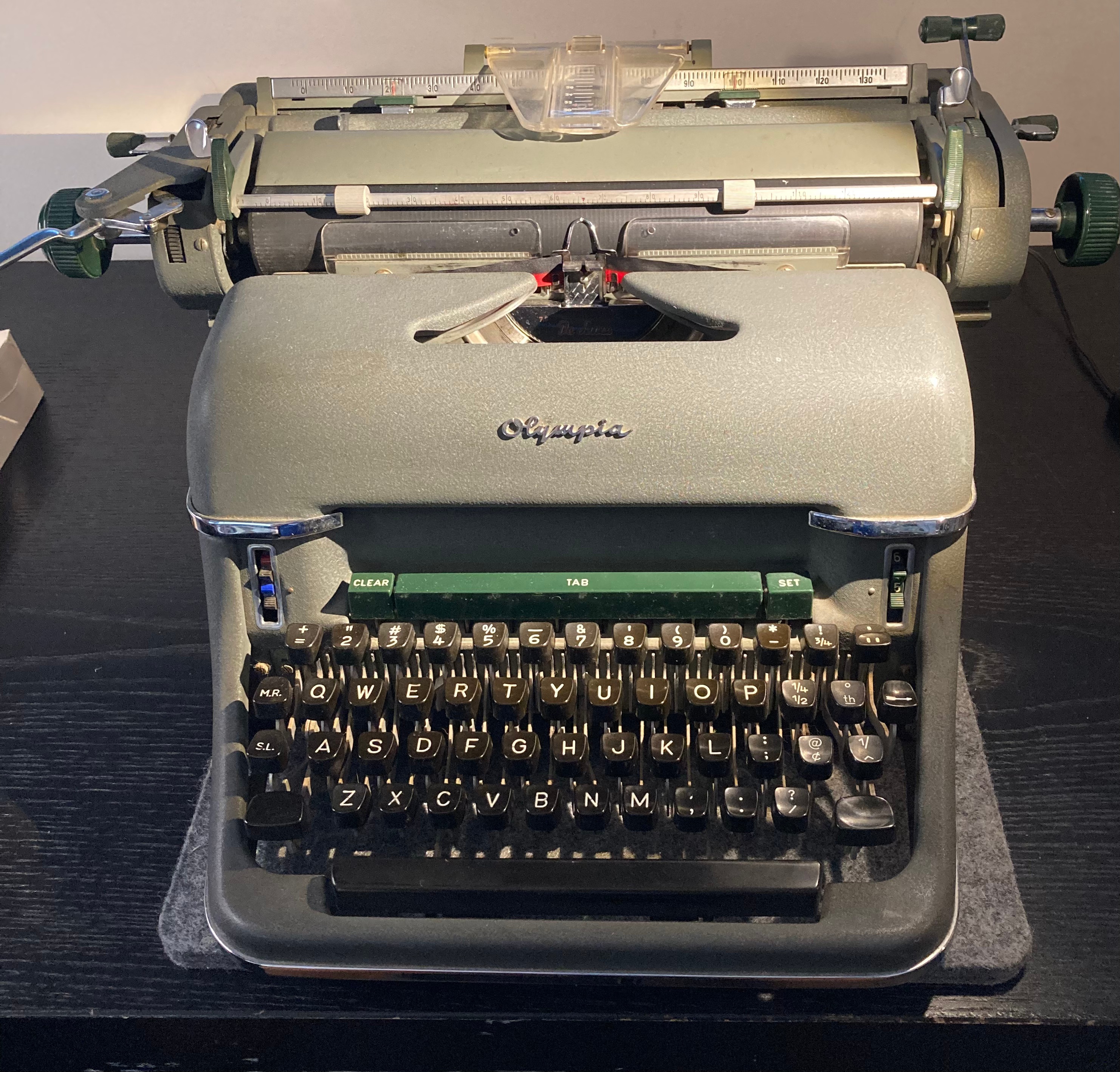
The offices of that magazine are imagined here as a large dining table with three high-end standard machines atop it on three sides. Two are easily identifiable as Olympia SG-1s, apparently brand new and perhaps purchased together for office use. The studio standard machine for people who write for a living, they are completely plausible presences here. First manufactured in 1953, they dominated the European and American markets. Mine is from 1960 and hulks on the table behind me right now.
The third is harder for me to make; it looks plastic and sloping, not exactly the Olivetti 82 but pretty close. We barely see it in the establishing shot of Godard, François Truffaut, and Jacques Rivette typing, and in a later shot of a brief speech by Roberto Rossellini to his assembled acolytes it is missing altogether. Perhaps it belonged to Rivette and he took it home? Pretty big machine–not for commuting! But it would make sense: another serious machine for forging a new age of film.
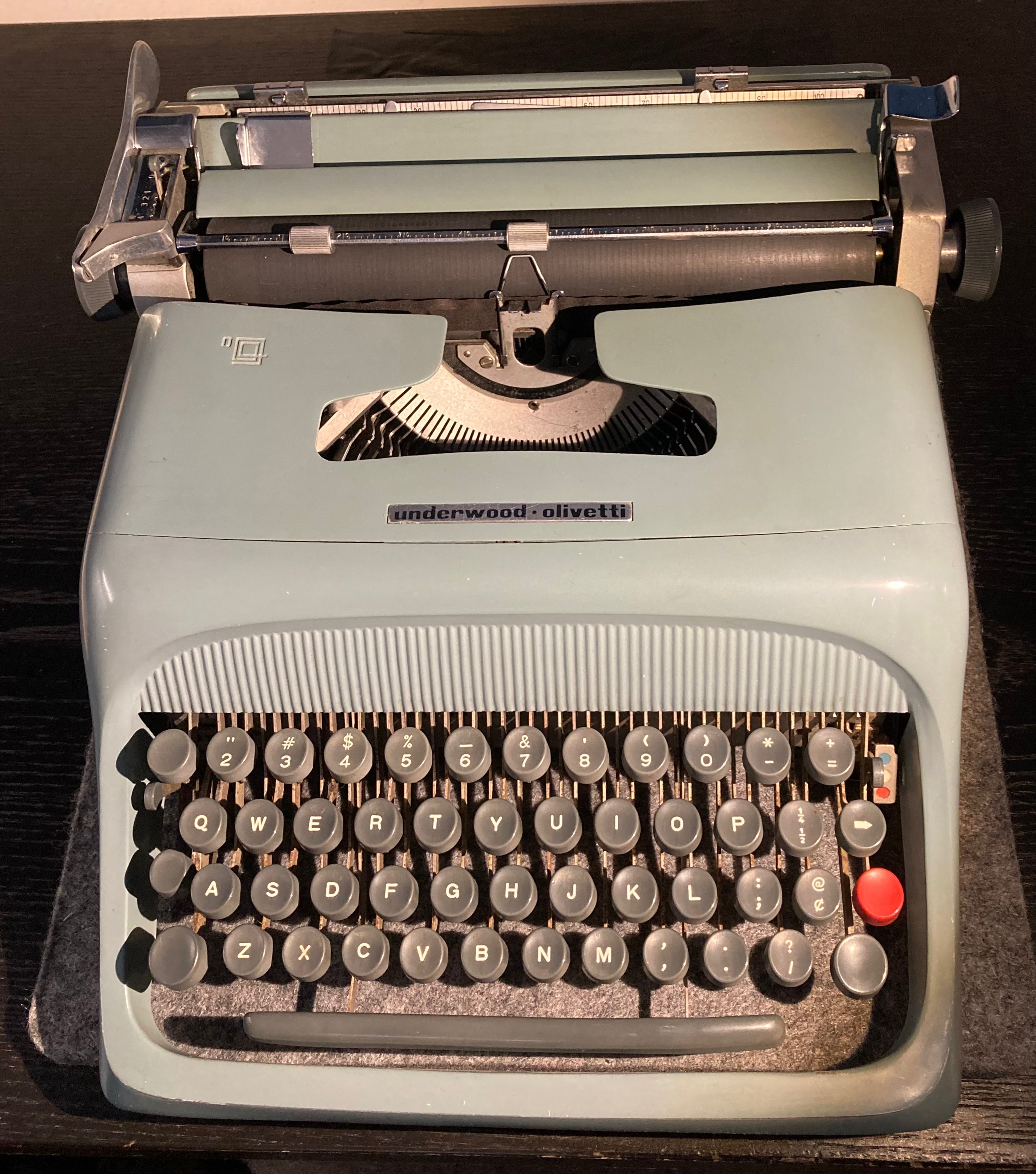
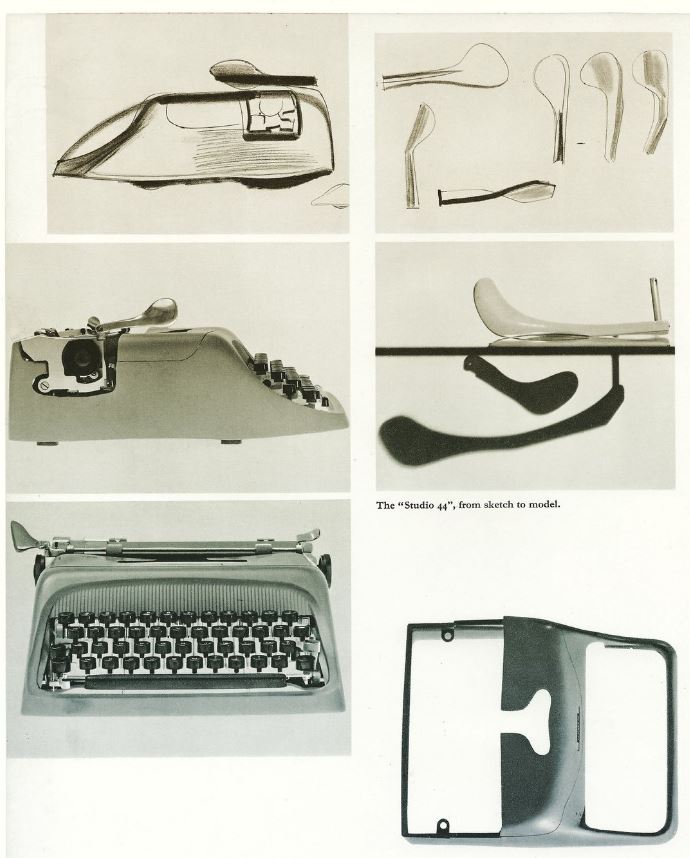
There’s also a lovely Olivetti Studio 44 in the presumed offices of the Breathless shoot itself, tucked into a corner behind Godard’s desk. I have one too, from 1961–though it began production in 1952.
He never touches it, or even acknowledges it is there; the light looks bad for serious typing on it, to me. The machine was style-forward in every conceivable way. Entirely reasonable that it would be the choice of one as presentation-conscious as Godard, so eager to make his mark in the vanguard.
Marcello Nizzoli’s sketches for the Studio 44. Cribbed gratefully from Oz Typewriter.
Whether he ever types anything on it is unclear–and improbable, as we shall see.
But the third typewriter scene is the most interesting to me. In Breathless‘s extended afternoon almost-tryst that Patricia and Michel enjoy in the tiniest hotel room in Paris, we glimpse a portable typewriter on a cluttered desk by the bed. It is Patricia’s, because this is her hotel room. We know she is aspires to be a journalist, despite mostly just selling the Herald-Tribune rather than writing for it, and she also notes that she will have to enroll at the Sorbonne in order to keep her financial support flowing from home in the United States. (From where in the US is unclear to me–though Jean Seberg was born in Iowa, as her flatly-accented French reveals whenever she opens her mouth.) These are all good reasons to have a neglected typewriter on your premises.
And the typewriter is the least interesting thing on that desk in the original film. There is paper in it, but it mostly serves as a flat surface for a hat to rest upon. Later it supports a radio that plays “music to work to”–and is promptly switched off, since its strident tones interrupt the afternoon-delight reverie each is enjoying on different terms.
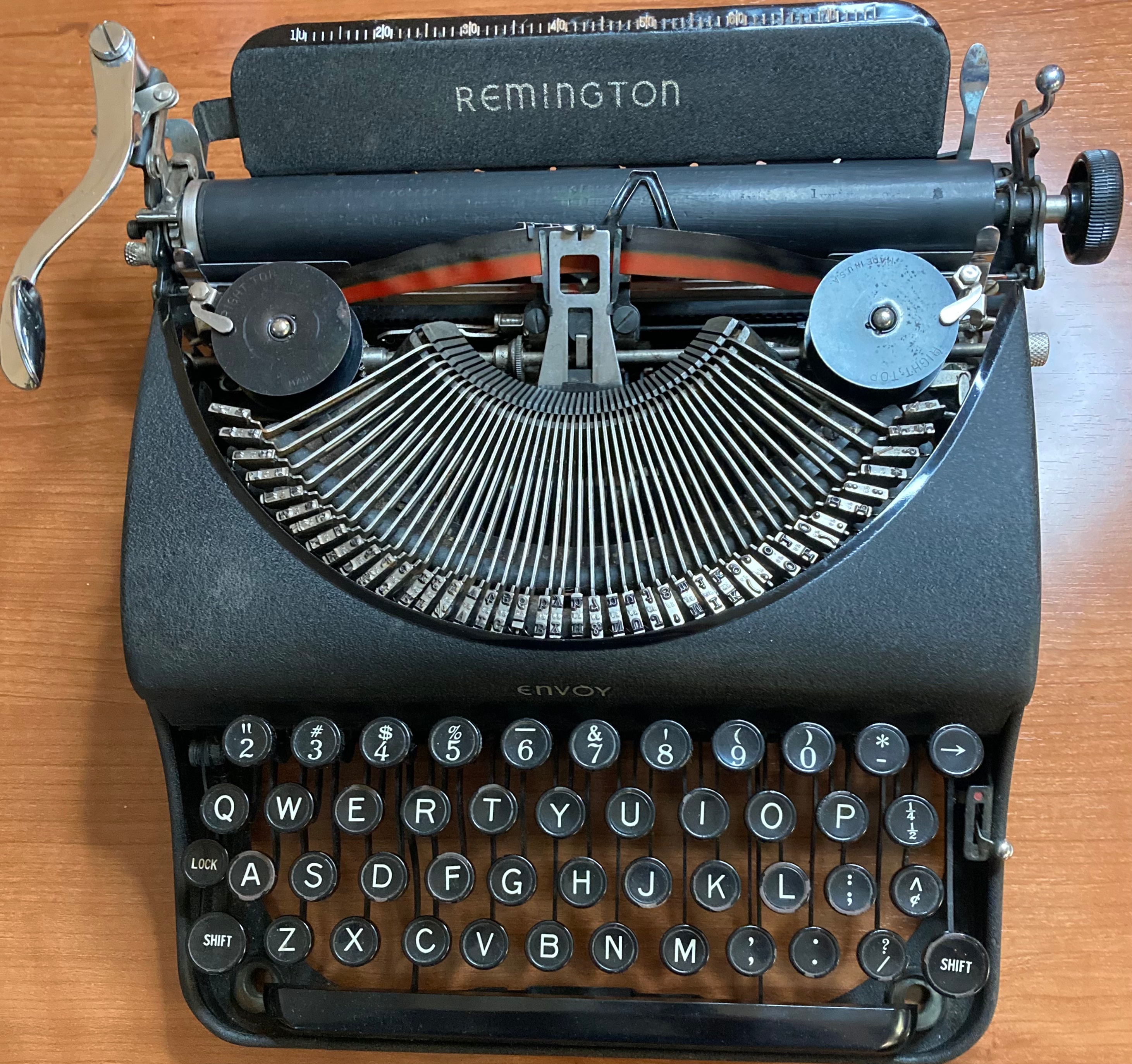
I would guess it is a Remington, by its round keys and distinctively-hooked carriage return lever. It could be an Envoy Type 2 like the beautiful one I own. Manufactured in 1941-42, and indestructible as a cockroach, it is a sensible machine for a budget-conscious gamine to be carting to Paris seventeen years later. So far so good.
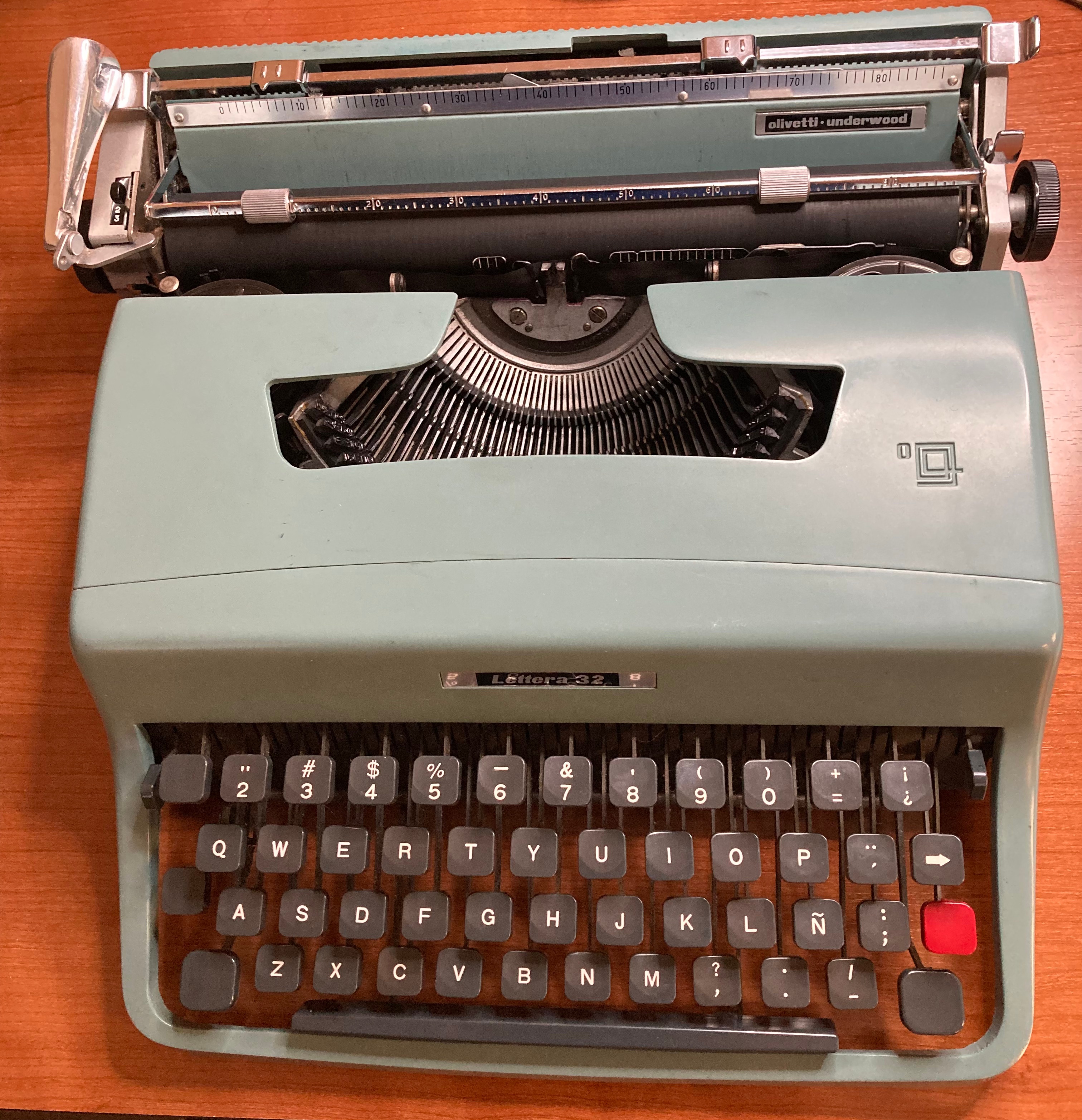
BUT: in the otherwise-fastidious recreation of that hotel room in Nouvelle Vague, the probably-Remington has unmistakably become…an Olivetti-Underwood Lettera 32. An anachronism, since Olivetti first made this machine in 1963—and the distinctive faceplate identifies it furthermore as a later iteration, probably from the late 60s. Catastrophe!
This machine is coded completely differently! Italian vs. American, stylish and sexy vs. boring and reliable. She might have even bought it in Paris.
Who even is Patricia, if this is her typewriter? Other than a time traveler?
Pour quoi?
In a lovingly-detailed recreation and invocation of a very specific time and place…why would Linklater get the typewriter wrong?
Well, maybe he missed it. As a cineaste friend of mine noted, “if I found out you knew more about mid-century typewriter manufacturing than Linklater’s production design team, I wouldn’t be shocked, exactly.”
But isn’t it more interesting if he didn’t? If it is on purpose? Consider.
Nouvelle Vague presents Godard as someone with a complicated relationship to writing. At best. A running theme of the story is that Breathless has no script. In pursuit of a purity of experience, a spontaneity, never before seen, he shot without one. The film used a camera that was too loud to allow synchronized sound, but did permit unique still-camera film that, spliced into long rolls, could capture natural light in extraordinary ways. That meant all the audio was dubbed later, and Godard could and did feed lines to the cast while filming…lines that he would read from scribbles in a series of Moleskin notebooks where he claimed to have the whole film plotted.
Which does not mean the Godard of Nouvelle Vague fears text: he begins each day at a cafe with a pile of paper upon which he makes notes in what Seberg calls “beautiful handwriting,” and sometimes communicates important info by passing those notes to those they concern.
What this Godard fears is committing to a text: to typing it up and saying, this is what it will be. The script manager helplessly flips a single page back and forth on her clipboard. The producer fumes at how this same spontaneous relationship to text extends to the relationship with time and budget: Godard won’t shoot if he is uninspired. Nothing on any of his private pages dictates how and when to make the film: they are just gaps of indeterminacy, as Wolfgang Iser says, that will lead to new possibilities yet unimagined.
The fungibility of printed text in the film also boggles the digital-era, backup-savvy viewer. Presumably, the treatments we do see bandied about are bare stacks of paper, without bindings or apparent copies. (Le mimeo is glimpsed once in the background of the office: it sits silent.) A single copy of the story itself is handed back and forth between Truffaut and Godard on a metro bench; the first assistant director carries a fistful of paper through a bar, responding to Godard’s insistence that he “show it to no one” by shoving the pages briefly into the face of an innocent customer with a smirk.
Where is the text? It is scribbled here, it is handed around there…it is none of these places.
There is no text for Breathless: the film is the text, and the film only seeks to capture the untrained and unplanned interactions that result from Godard’s willingness to commit fully to their pursuit.
At one point, Godard is frustrated with his two leads planning what they are about to do when camera rolls (Allez!)
“What are you filming?” asks a passer-by. (He is shooting on the street, with real people unknowingly serving as extras.)
In frustration, he snaps back, “A documentary about Jean-Paul Belmondo and Jean Seberg acting out a fiction.”
Everything he didn’t want: people planning to do things, which means they will not actually be doing things. (“Though a documentary would have sync sound,” Seberg grumbles.)
That is what Godard wanted, and got. Live action!
And that is what he inspired in those who followed, including Linklater: to seek out reality as best they can contrive to. Linklater, who played with time itself in Boyhood and the Before trilogy–synchronically daring, insisting on time shaping what appeared and what went on the film.
Because the text isn’t in the script, and it isn’t in the typewriter.
And if it isn’t in the typewriter…maybe it isn’t in the choice of typewriters, either.
Typewriters make dead fictions to be acted out, this out-of-time machine seems to say.
This is alive.
Even in this recreation, homage, impression, of what might have happened seventy-six years ago in the process of committing life to film…the choice seems to say: this is alive, too.
Allez!
*I wish I could figure out how to share screenshots from Kanopy and Netflix, but that stuff is locked down. Check out the films themselves! Get Kanopy from your library!
**I had pretensions of using some Roland Barthes in here somewhere but it’s probably in everybody’s best interest that I didn’t.
***The Olivetti Studio 44, by the way, also graces Susie Myerson’s office desk in The Marvelous Mrs. Maisel–which is incongruous, being way more of a home machine. Until you consider that the office is being operated on a shoestring mainly to book Midge: she must have loaned it from home.
I really have no time for blogging today, but I have to share Wikipedia’s “Signs of AI Writing” advice page that I stumbled across while not sleeping last night. It is sort of an internal white paper for those who edit that remarkable resource: not definitive, but trying really hard to be helpful.
I had no idea this existed. But it turns out to be the most explicit list of tells, bugaboos, and quirks of LLM output in fall 2025 I that have ever seen.
Last week I taught my doc seminar on scholarly writing, and was informed by my doc students that “em dashes mean AI wrote it.” A quick web search shows I am a few months behind this supposed wisdom, and it is included.
The first takeaways are pretty breathtaking. I will quote widely from the page (linked above) because no time to paraphrase.
[snip]
LLM writing often puffs up the importance of the subject matter by adding statements about how arbitrary aspects of the topic represent or contribute to a broader topic…Words to watch: stands as / serves as / is a testament/reminder, plays a vital/significant/crucial role, underscores/highlights its importance/significance, reflects broader, symbolizing its ongoing, contributing to, enduring/lasting impact, watershed moment, key turning point, deeply rooted, profound heritage, steadfast dedication, indelible mark, solidifies …
AI chatbots tend to insert superficial analysis of information, often in relation to its significance, recognition, or impact. This is often done by attaching a present participle (“-ing”) phrase at the end of sentences, sometimes with vague attributions to third parties…Words to watch: ensuring …, highlighting …, emphasizing …, reflecting …, underscoring …, showcasing …, aligns with…
LLMs have serious problems keeping a neutral tone, especially when writing about something that could be considered “cultural heritage”—in which case they will constantly remind the reader that it is cultural heritage…Words to watch: rich/vibrant cultural heritage/tapestry, boasts a, continues to captivate, groundbreaking, intricate, stunning natural beauty, enduring/lasting legacy, nestled, in the heart of …
LLMs often introduce their own interpretation, analysis, and opinions in their writing, even when they are asked to write neutrally, violating the policy No original research. Editorializing can appear through specific words or phrases or within broader sentence structures. This indicator often overlaps with other language and tone indicators in this list. Note that humans and especially new editors often make this mistake as well…Words to watch: it’s important to note/remember/consider, is worth mentioning …
[/snip]
It goes on and on; you should check it out.
We are of course beyond “gotcha” AI moments, at least in my institution. We are encouraged to “teach the controversy,” surely, and encourage students to begin to use these tools critically because job skills.
But if you are someone who cares about words, or was taught to, or make at least part of your life with words, I ask you: what do you notice about these “tells”?
That they are, and have always been, the hallmark of inexperienced writers trying to find their way into what they have to say.
When we who care about words say that AI output is “bad” I can begin to see now what we mean. It is vague; it pretends to perspective it does not have; it leans into gravity while being featherweight.
In other words: it is a lot like the papers many of our students would be writing on their own–if they were actually writing their papers.
So where’s the problem?
The problem is: until you write like this on your own, and get told you are writing like this and shown how to do better…you will continue to write like this.
Worse, you will be satisfied with this writing as “enough.” It looks “smart” and “authoritative,” so it must be.
And this is only the writing-skill part of the deeper issue, described in the lengthy quote from an associated page:
[snip]
LLMs are pattern completion programs: They generate text by outputting the words most likely to come after the previous ones. They learn these patterns from their training data, which includes a wide variety of content from the Internet and elsewhere, including works of fiction, low-effort forum posts, unstructured and low-quality content for search engine optimization (SEO), and so on. Because of this, LLMs will sometimes “draw conclusions” which, even if they seem superficially familiar, are not present in any single reliable source. They can also comply with prompts with absurd premises, like “The following is an article about the benefits of eating crushed glass”. Finally, LLMs can make things up, which is a statistically inevitable byproduct of their design, called “hallucination“…
As LLMs often output accurate statements, and since their outputs are typically plausible-sounding and given with an air of confidence, any time that they deliver a useful-seeming result, people may have difficulty detecting the above problems. An average user who believes that they are in possession of a useful tool, who maybe did a spot check for accuracy and “didn’t see any problems”, is biased to accept the output as provided; but it is highly likely that there are problems.
[/snip]
If you care about writing–or if you don’t care about writing, but do care about critical thinking, bias, or plausible-sounding and confidently-expressed things being accepted as true–well then, there is much to fear here.
Thoughts?
My typewriter sits in the corner and shakes its shaggy head at me…
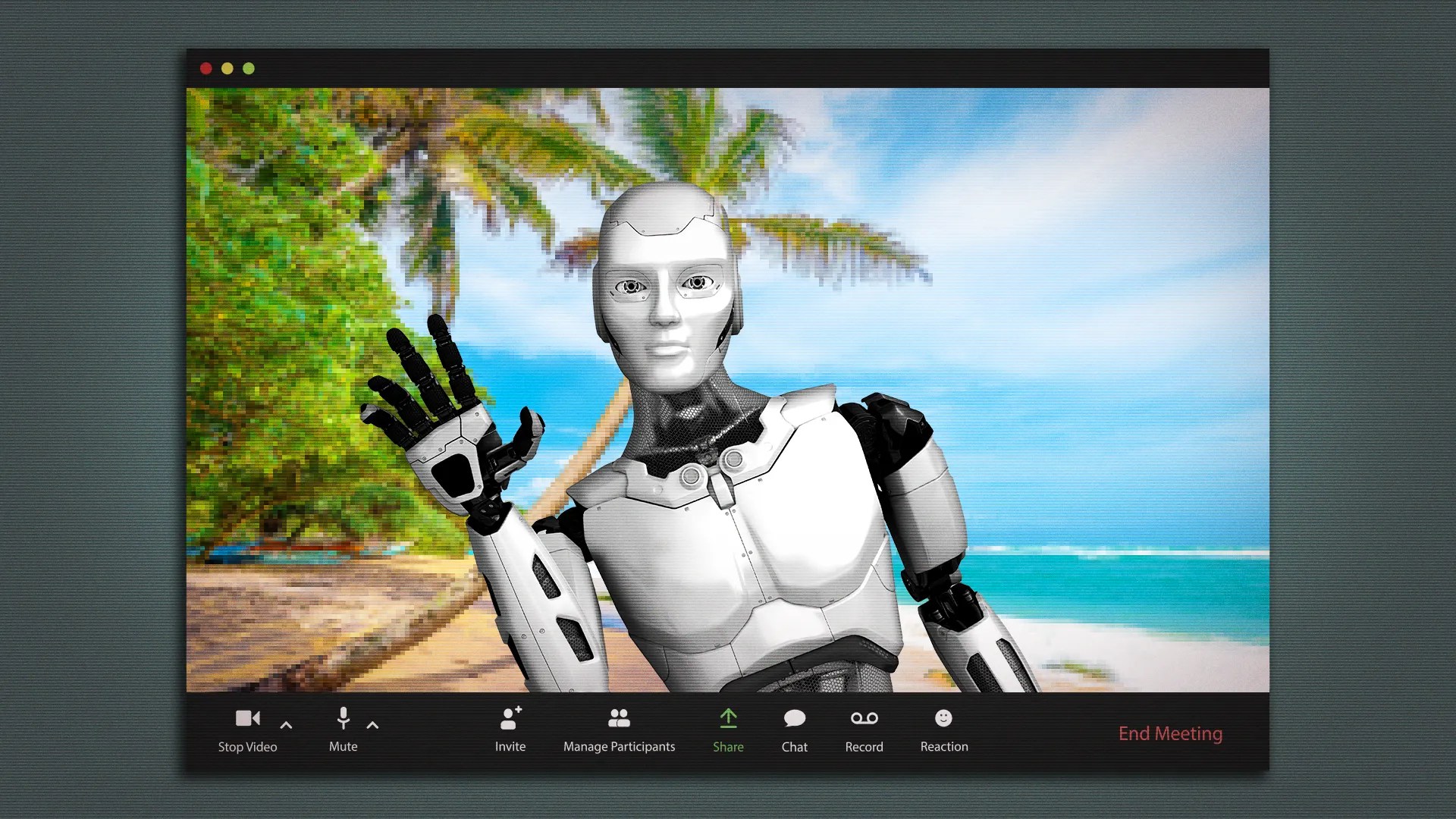
Image borrowed from this Axios story on the apparent currency of the term “clanker” for undesired and ineffective AI. Image possibly AI generated, who can know anymore ¯\_(ツ)_/¯.
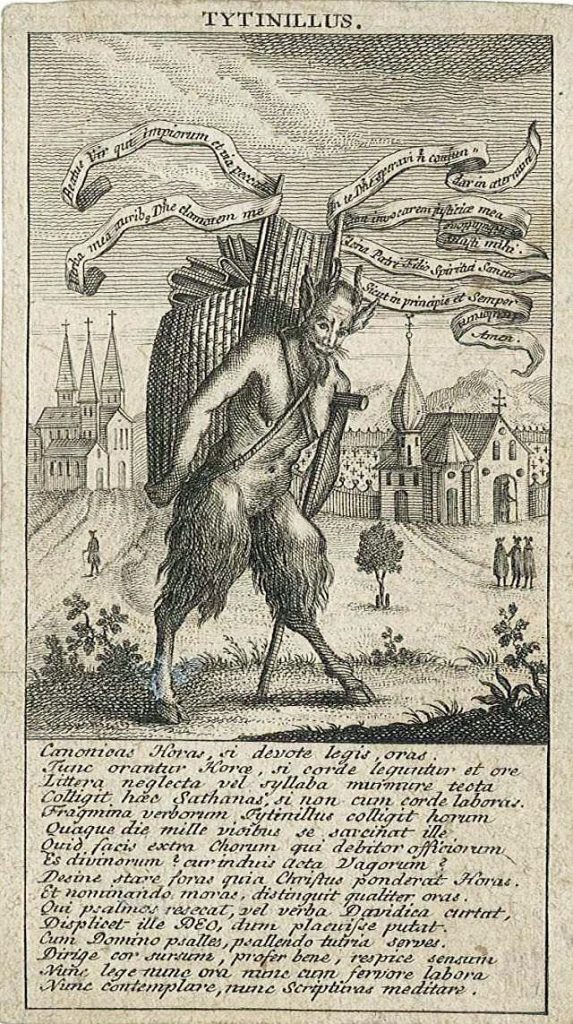
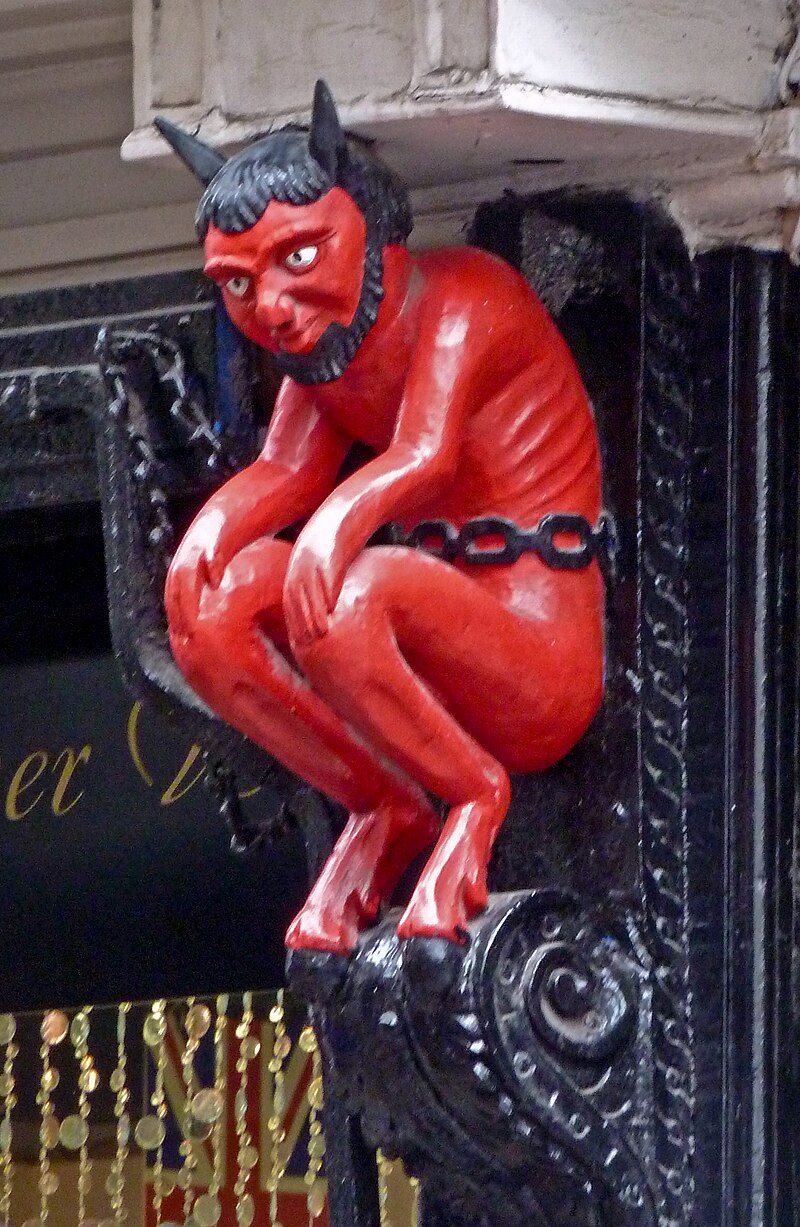
Here he is! You probably didn’t even know he existed.1 He messes up what you are trying to write. He introduced the errors that have grown like mushrooms in your draft since you last looked at it. His industry is your weakness. It’s not you–it’s him! The lord of all typos, the demon of scribes: meet Titivullus!2
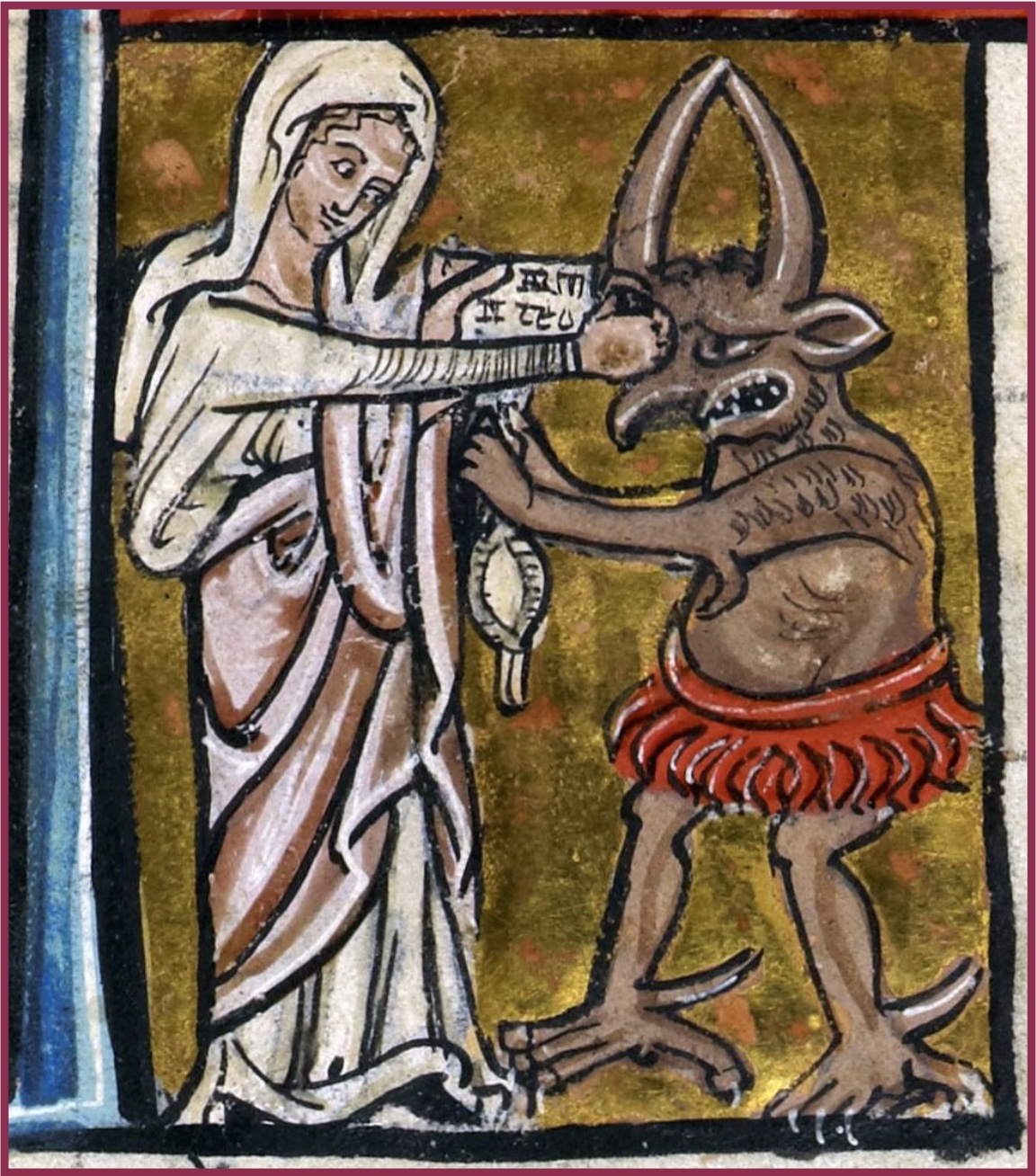
I understand he was originally two demons! One who gathered up all the poorly-spoken and mumbled sermons of the preachers and prayers of the laity in a big sack–the image above has him in this form, toiling toward his quota of a thousand per day (!). And a second who compiled and tallied them, to be held against the poor mumbler and lazy parishioner on the judgment day.
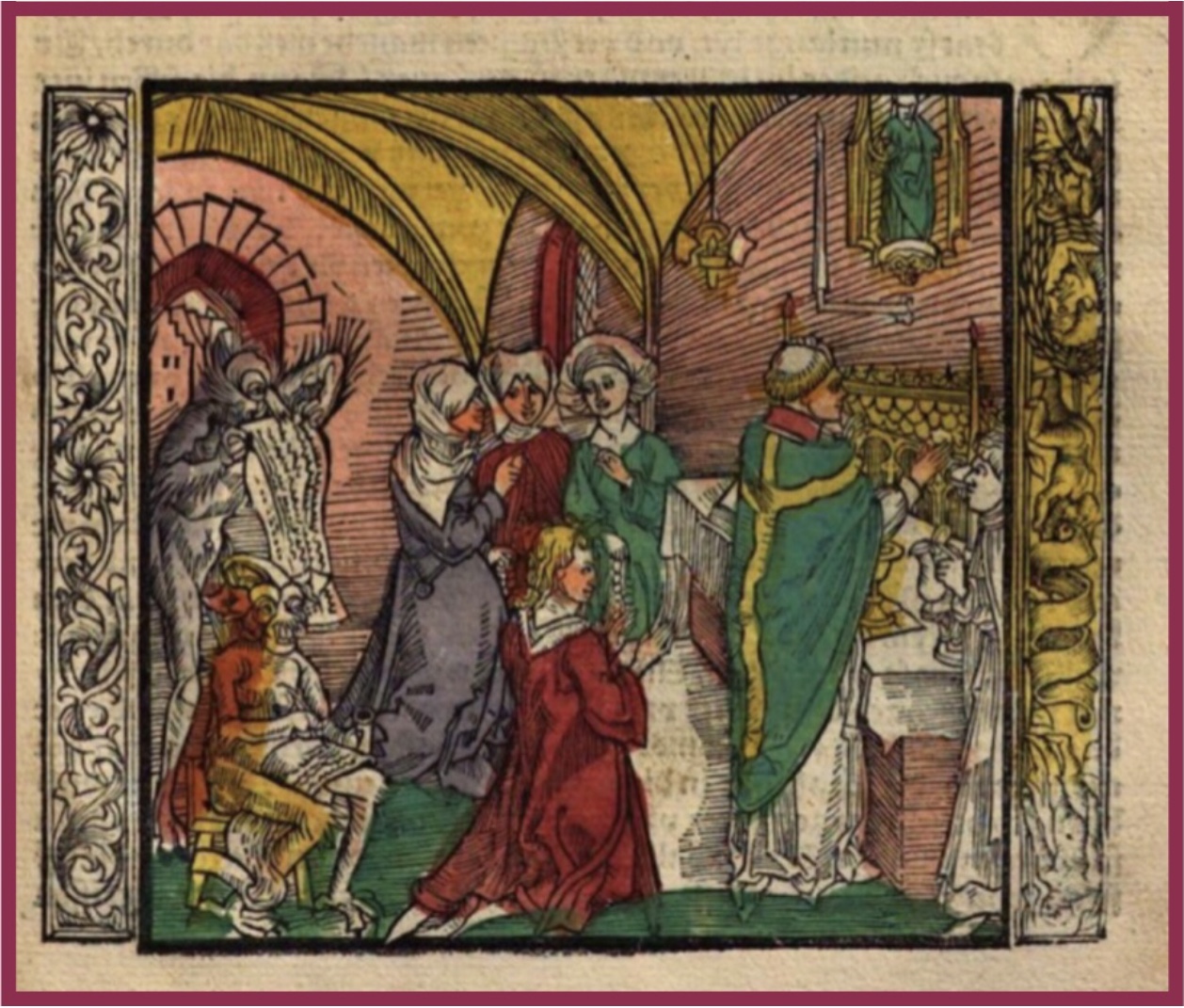
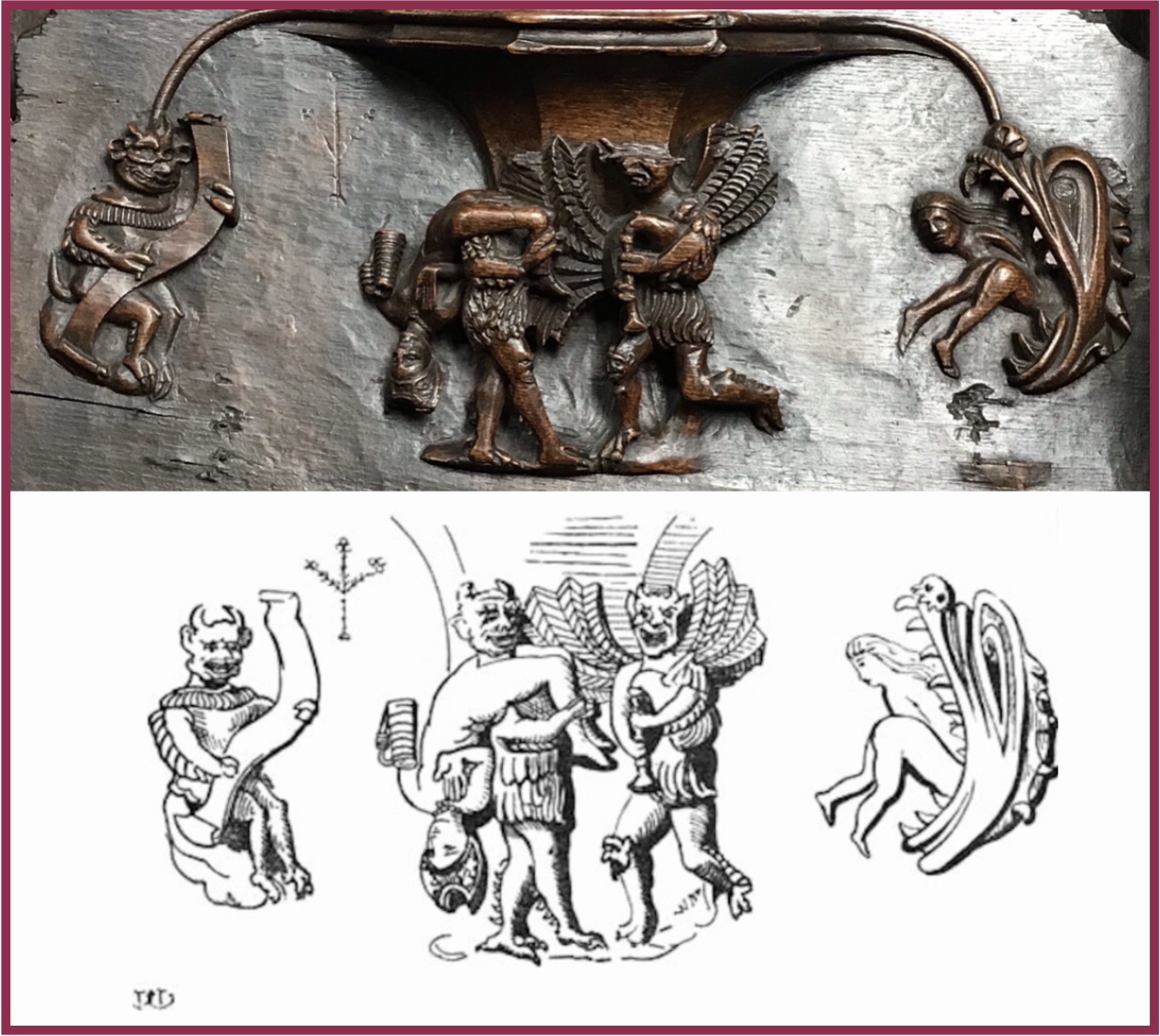
Most images from a terrific blog at Lost Art Press. You should just go read it!
Thus the medieval church installed a panoptic anxiety among the faithful.
In Margaret Jennings study of Titivillus she wrote the point of this Medieval demon was to remind clergy and laity of the danger of “spiritual sloth.” The litany of the service, each prayer and each song were to be unhurried, expressed clearly and with fervor.
To say or sing by rote and without care, to attend church, but not participate wholly was to open oneself to sin. Hence, visual reminders of a recording demon, as well as other devilish minions, were found on wood, walls and paper. In the hand-colored woodblock above three women gossip, one demon scribbles away and the second demon stretches a scroll with his teeth because they need more paper!
He sees you when you’re sleeping, he knows when you’re awake…and he knows if you have been phoning in your devotions, too. So look sharp, lest your imperfect words be held against you in the final tally and toss you into the jaws of hell (below, right).
Fate of a “dishonest alewife,” also given to loose talk. As above.
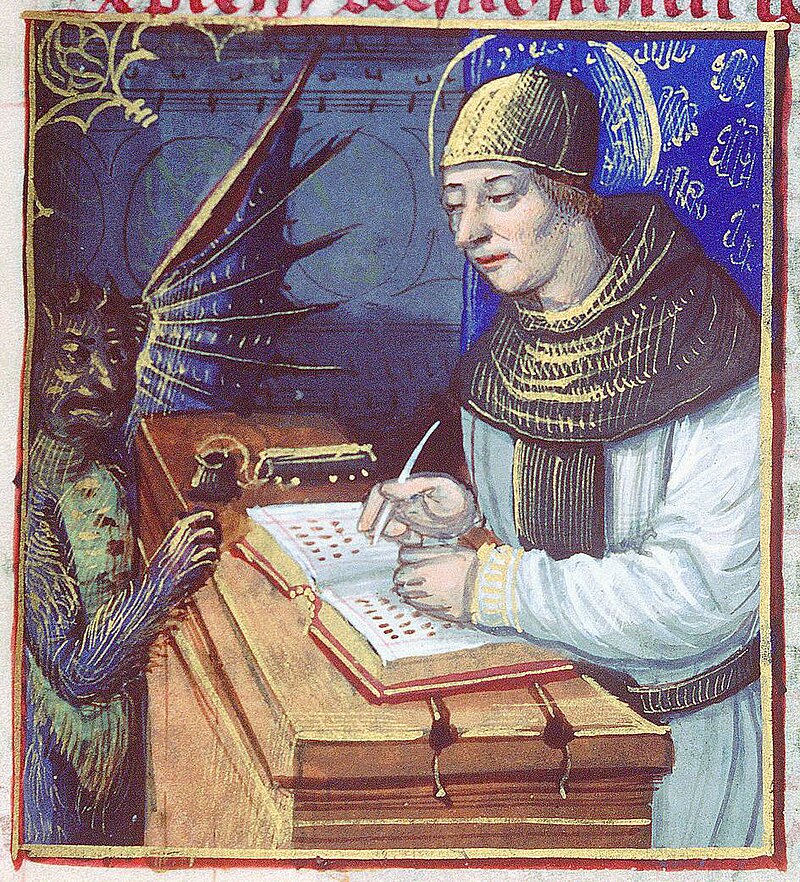
From the demon monitoring and keeping track of our language shortcomings, it was a small step to the demon actually interpolating such errors. Mischief not just recorded, but instigated. And thus T became the active cause of our imperfections, not just their registrar.
Titivullus’s relation to Ceiling Cat’s many forms is as yet undocumented, and awaits future research.
Fun fact: he is apparently the source of the “printer’s devil,” the name given to apprenticed boys who scurried around eighteenth- and nineteenth-century printshops pulling fresh pages out of the press and collecting errant type to melt down. Because their hands were blackened by ink; because they were underfoot; because they made mischief!
Holy cow! No wonder we are so averse to typos and other false steps in our writing. We liberal arts undergrads who sort-of remember our sort-of reading of Max Weber shake our woolly (or bald) heads and think, yes: sloth in all its forms does not compute with the rational pursuit of economic gain. So mis-writing is a crime against God, and also profit.
Are we still in thrall to Titivullus? Well…does this track?
Typos are sin! And must be stamped out, even (especially?) if doing so requires an internalized self-loathing that is activated whenever we make a mistake.
Whenever we read back what we just wrote and think, that is not what I meant at all. That sounds stupid, and I misspelled “stupud” too…that voice is the spirit of Titivullus, living for free in our heads!
And loading up the very fallible (but passionate) humanity that led us to write anything at all with…well, wow, with what?
Guilt?
Nagging sense of inadequacy?
Embarrassment at having thought we had anything to say in the first place?
Much safer to not write anything at all…
And If we are already primed to feel bad about our writing’s syntax inconsistencies, then the prevalence of effortless “typesetting” technologies will make us feel even worse.
We all know two spaces after a period in word processing is a tell that your author is a recalcitrant from the age of typewriters. Word processing automates the monospace of typewriting: just put in one space and let the rock that thinks figure it out.
And everything written should look perfect now, whether or not it is actually flawless. Canva is the tip of the spear, here; a friction-free tool that raises all our expectations that whatever we dare to inscribe should be Instagram-ready, should look cute on a Stanley cup or an Etsy t-shirt.
When you know about Titivullus, you see his minions everywhere. Making you feel bad about all the ways real human words are imperfect when they first come out of us.
And making you think that until they are perfect, they are wrong and unworthy. And maybe even evil: maybe even will be held against us in some final accounting that awaits us, and our wordmaking.
What bunk, friends!
Let’s embrace an enlightened perspective that we all make and consume our words exactly the best way we can and should, exactly as we are!
Especially when the demon’s AI great-great-great grandchildren are offering us the false promise that we need never feel bad about our words again–as long as we just let them write for us. (“It’s cheating, but I don’t think it’s, like, cheating.”)
Subtle temptor indeed.
Long live typos–because they affirm the real-world and real-person provenance of what you are reading!
Or “Tutivillus, Tytivillum, Tintillus, Tantillus, Tintinillus, Titivitilarius, Titivilitarius.” He is a demon of many names–perhaps more evidence of his craftiness. To believe Wikipedia, “for the past half-century every edition of The Oxford English Dictionary has listed an incorrect page reference for, of all things, a footnote on the earliest mention of Titivillus.” ↩︎
Written and not sent; that’s what a blog is for, right? Still deeply felt. Event is tonight: App folks who read this, I’ll see you there!
– c
I was raised in a conservative religious household, and recall the concern I inherited – absorbed through my skin, like oxygen – about the depravity of some art, literature, movies, and music. I remember how I felt in my deepest heart when reading something that seemed offensive to my values, a wounding that felt like I had betrayed my God and my people by even casting my eyes, let alone my mind, on such stuff. I remember that arguments for the literary, artistic, cultural value of a such a document were unconvincing to me. If anything, they affirmed that I was “in the world, but not of it;” that, as Matthew taught me, “ye cannot serve God and Mammon,” and any rationale that Mammon offered only deepened my resistance and my greater turning toward God.
I remember these powerful experiences of wounding and healing, acceptance and rejection, as I witness our community’s controversy about the teaching of Isabel Allende’s The House of the Spirits to tenth graders at Watauga High. Arguments against the book have turned on the unsuitability of its sexually explicit and violent passages for inclusion in curriculum. Defenses have included appeals to the work’s universally-recognized literary merit (even, in a letter to the county school board, by the author herself), character references of the teacher involved, and insistence that the book is approved for inclusion in the tenth grade curriculum and that an alternate was offered (so, really, why should anyone be upset)?
I am torn up about how this dialogue is unfolding: how closely it follows the narrative of so many controversies about curriculum. It seems initially to be about legality and literary quality, each side trying to educate the other about risks and benefits it apparently cannot conceive. But I am beginning to see that the core issue is actually the authority we give or withhold from the school to speak into deeply-held differences of our society. The Reagan-era school prayer flap was the first time I noticed the conflict. In our times it includes evolution/creationist science curricula, sex ed, political advocacy, The Pledge of Allegiance, Scouts in the cafeteria in the afternoon, and on and on. We are a deeply divided nation on many fronts, and the school is the brightest flashpoint as we work out our own anxieties through the presumably more manageable lives of our children. We don’t know what we want our schools to do for them (us), how uncomfortable we are willing to let school make them (us). So we fume and fret and grumble to those who agree with us about what the world is coming to as the other side drives us into the ditch.
My best response to this tension comes out of what happened to me after I left home. I attended a university with an unfailing commitment to supporting exploration of every controversy, and trusting that that the community, through respectful dialogue, would find its way. I encountered attitudes and values at school that were deeply different than mine, and as a result found my own changing: about culture, politics, gender, sexuality, and ultimately the nature of my faith. Through respectful – though sometimes heated – discussion and argument, and open-hearted listening to those who were not me (i.e., everyone), I came to understand just how different others were than me. And that my own values, however deeply held, simply could not serve as an index of what someone else knew and felt about the world.
This is perhaps the greatest possibility offered by public school, greater than basic skills training, job readiness, even Friday night football: the possibility to allow all who make up this community to see deeply into each other’s otherness – perhaps to realize, at core, that we are exactly the same in our passionate need to have our otherness understood and respected.
That’s why I support the teaching of The House of the Spirits, unequivocally, and the teacher who chooses to teach it. The book is an opportunity to have that kind of discussion, that kind of listening and understanding of each other. But I refuse to support teaching the book by making those who oppose it into cartoons of intransigence and closed-mindedness. (After all, it’s only a matter of time before this controversy makes national news, and the rest of the country remains completely willing to retell that story about who we are in the High Country. Can’t we be better to each other?) I believe that school is where our students should – must – respectfully encounter, engage with, and come to understand points of view that differ profoundly from their own. And our larger community must be a place where we can do the same with each other. If I presume to have the only clear vision of what is valuable, I am as blind as my worst caricature of those who disagree with me.
I plan to attend the community-wide read-in and teach-in of The House of the Spirits ( 7:00 p.m. to 8:30 p.m. Dec. 3 in Belk Library, Room 114, on ASU’s campus), and I hope you will too. I would be happy to organize another one in the common room of our excellent Public Library. I hope these events will be a chance for all of us to share the book and make our own judgment; share our own experience of reading and encounter of ourselves and each other. May we all go back to school, as we focus the energy this controversy has ignited. Focus it toward hearing, seeing, reading each other fully, perhaps for the first time.





 Chris Osmond PhD