I am just back from the annual professional meeting of folks around the country who run programs like mine.
Like nearly all academic meetings, it took place in a big city, in a hotel that is also a conference center. The action went down in one big ballroom and an assortment of smaller meeting rooms spread around wide central spaces, where coffee and food intermittently appeared and then was cleared away.
It was furnished to be “nice” twenty years ago but, like all such spaces, showed the constant wear and tear of hosting one such event after another. A spot of ripped upholstery here, a missing light switch fixture there, the scuffs on the walls that inscribe a story of people constantly coming and going, presenters moving chairs and tables in an effort to make their session more collaborative, or less.
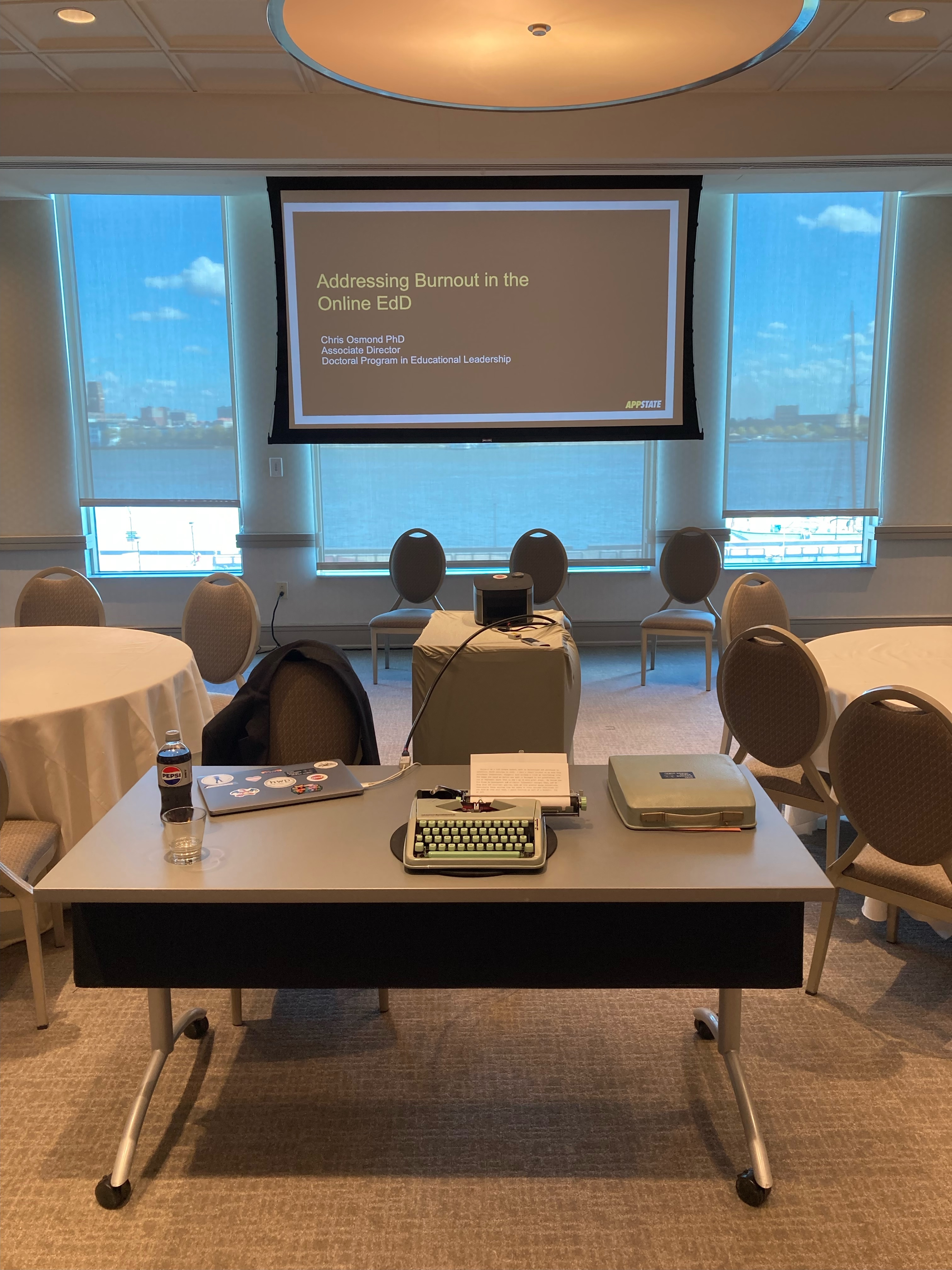
I brought a typewriter with me, as above: my bulletproof 1965 Hermes Rocket, which has traveled with me to Hawaii and Ireland and many places in-between. My session was on manual typewriters in 2025 as an interpretive lens to understand the nature of educator burnout and find new ways through it. (Also the topic of the book I have coming out very soon with Loose Dog Press: watch this space!)
So I got to bring the Rocket with me, and invite participants to take it for a spin. Maybe one of the latent powers of a manual typewriter in 2025 is that it is always exactly what it is, where it is. After all, it is the only object in this photo of my session that is really its own, singular thing: the tables and chairs are anonymous, and even the “slides” aren’t real.
In every session we found ourselves sitting with strangers at a round wedding-reception-type table covered by two massive industrial tablecloths and were asked to interact, to break ice, to discuss, to synthesize, to report out, above all to network. The incongruity of the importance of the work we are striving to do at these meetings, juxtaposed with its trade show surroundings, always jars me and creates an anomie in my soul so consistent I have learned to brace for it.
I remember attending my industry’s biggest meeting twenty years ago in San Francisco and standing on one of those terrible banquet chairs to see one of my mentors receive the organization’s highest honor, a lifetime achievement award. A deeply moving moment, thousands of lives changed for the better, world-shifting impact on education—taking place in a corner of the Moscone Center that would probably feature a refrigerator display in two days.
My local district in opening a new elementary school on Monday, years after accepting the fact that the historic WPA-constructed building was too close to a flood-prone river to possibly be reclaimed, Hurricane Helene displaced the kids from it anyway; they have been meeting for a year in donated halls, and so having a home at last is a major achievement. But of course, as one of my sons (a former student of the school) commented upon viewing an online video tour, it looks like a Hampton Inn inside.
I have not seen the video but do not need to. I know what educational “nice” looks like. I know exactly what he means. Indestructible carpet with fierce patterns overlaying neutral texture that will hide stains and wear for two decades. Ranks of plastic tables and chairs that can be rolled around and reconfigured, but never really fit together. Indirect lighting that will still make everything cold and sallow.
(I also read that the university building where I was so splendidly taught by that grad school mentor just re-opened after a comprehensive refresh. In the photos, I see the Hampton Inn aesthetic, filtered through a lot more money.)
I am grateful to the designers and the builders and everyone for a new building, don’t get me wrong. I just want to note that any public institutional space has to meet its contemporary demands to look “nice,” to accommodate hundreds, and to last for fifty years.
Spaces that tick all those boxes will never be humane spaces. They will never build in the evidence of human existence that so many of us find comforting in older, lived-in educational spaces. Worn spots on terrazzo floors where three generations of chairs have been scraped. Formica tabletops with the edges worn from students leaning over books, then laptops, late into the night. Chalkboards from the 60s peeking out around the edges of whiteboards from the 90s that were mounted right on top of them, to not leave divots in the drywall.
My favorite educational meeting has always happened in the same physical place, and has since the late 70s. It’s a Catholic retreat center near Dayton. I am not Catholic, but I read in its low-slung brick and monastic rooms and stained-glass chapel a strong presence of the liberation theology of fifty years ago. Ecumenical, peacenik, a little woozy, earth-tone woodcuts of venerated elders and saints painted on burlap. The rooms redolent of thousands of urns of coffee and the adequate but unpretentious on-site dining service. Brick and coffee and just a little warm damp: a terrarium, nearly, for people who seek to care for other people.
Overwhelmingly human and cozy, Feels like home to me, anyway, who is old enough to remember Air Force Base chapels built in the same vibe. Feels like room to sit and rest, room to hole up and read, room to make a new friend. The meeting itself the historic home of the last educational moment, IMHO, when we took seriously the interpersonal, the autobiographical, the human becoming of our work. The last moments before Reagan and measure-to-manage became commonsensical, before the ground opened and swallowed it all up in a conflagration of accountability that now feels like the only way to do school. (But isn’t.)
Of course, the real kicker is that every educational space that feels humane now was just “nice” when it opened, according to whatever “nice” meant at the time. The modernist / Brutalist cement and chrome piles I remember fondly from undergrad were built in the 60s as interruptions of the previous century’s brownstones. They only feel human to me because I was a human in them. (Oh look, one of those just got torn down and replaced too.)
Maybe the real point of this reverie on human living in inhumane spaces is that only by living in them do cold spaces warm up. Places where we do sacred work become sanctified. Churches and schools. Why does an empty classroom feel different than an empty hospital ward, than an empty prison cell? Exactly.
Maybe one of my deepest disquiets about online Zoom classes is that Zoom will never feel lived-in. A Zoom meeting is always the same, because a Zoom meeting is not a place. Evening class in Zoom can never feel different than every other meeting you have had in Zoom that day. It is the same not-space, and unless we who teach there make a real effort to make it otherwise, what is conveyed therein will just be more content to be consumed and optimized and turned into deliverables and accountabilities.
(And easily 1/3 of the sessions at my meeting were about incorporating AI into the teaching, writing, and mentoring work we do: another irreality that is changing the scope of what we can imagine doing with our students. For another day.)
We need real places to feel ourselves as real people undertaking real experiences. A sentence even John Dewey, that Lorax of experience, could not have imagined uttering in his day.
Don’t know how to end this. Maybe with the suggestion that we all notice and value what the real spaces we live in do for us. Whether welcoming and accommodating or brutal and indifferent, we make ourselves and each other as we share those spaces and work toward our shared intentions.
What do we want them to feel like? What can we do to make them more so?
Whatever they start out as, they end up…ours.
This whole blog SHOULD be about my amazing encounter this week with Bryan Kravitz of Philly Typewriter. What a shop, what a project! Typewriter Valhalla! More to come!
 Chris Osmond PhD