On June 23,1868, in Milwaukee, Christopher Latham Sholes patented the design that informed nearly all typewriters that followed. So today we mark the creation of one of the greatest human word-making devices of all time. To all who observe: Happy National Typewriter Day!
I am not expert in the history, but Richard Polt is, and he notes that this patent introduced the four-bank QWERTY layout that is still on nearly every keyboard you will touch today. However, it was an “understrike” machine, meaning that the typist could not see their copy without lifting up the carriage. Underwood began to saturate the market in the late nineteenth century with their “visible” typewriter, and that became the norm: “By the 1920s, virtually all typewriters were “look-alikes”: frontstroke, QWERTY, typebar machines printing through a ribbon, using one shift key and four banks of keys.”
This design limitation would have completely undone me. I remain a mediocre typist, despite my obsession with the machines. I cannot type without looking at the keys, so I would have been hopeless at the task you needed to accomplish professionally as a typist for most of the twentieth century: creating fresh drafts from notes, shorthand, or recordings.
I took typing class when I was in high school, during the summer in order to clear the semester’s time for academics. Too bad for me: I barely paid attention, and slacked off on practice, so I settled into a hobbled three-finger and one thumb style that barely does what I need it to in my writing life. When you have a typewriter with you, as I usually do, strangers stop to tell you their typewriter stories. Many of them center on the stresses and successes experienced in classes like that, and a common theme is having to achieve X words per minute with something over your hands. Not me! I was allowed to look, and now here I am muddling through, too old to relearn.
I feel like this technical weakness, though, actually makes typewriting a uniquely effective reflective practice. I am actually looking back and forth between my fingers and the page, every few seconds, which makes the experience actively engaging of both hands as well as active eyes. I imagine there is something centering or settling about this ilk of bilateral engagement. My basic understanding of EMDR therapy, and how it works by interrupting distressing perceptual memories and reducing psychophysiological responses, seems to align with this.
I definitely feel calmer when I am thinking by typing. I do! It creates a low-stakes, comprehensive physical engagement with the world. Coupled with the existence of what I am typing as physical lines on the page, rather than a cartoon of words on a screen that will contain something else in a moment, typing soothes and heals me. Typing corrects virtuality’s disorientation.
How to observe National Typewriter Day? Well, until you have the experience of using a fine manual mid-twentieth-century machine as an early twenty-first-century digital refugee, you probably can’t imagine why you would want to.
All I can do is recommend that you acquire your own manual typewriter, get it back into fighting trim, and find out for yourself.
There’s lots of online guides to finding and using your first typewriter! This one is pretty good–especially on how much happier you will be with a machine from the 50s, 60s, or early 70s, when economies of scale meant that great quality stuff was being manufactured by the millions, rather than with a “new one” made today to much lower standards. Though I disagree with looking on Etsy. Too much there is too expensive, IMHO. Better to stick to Facebook (I know, yuck) Marketplace, or shopgoodwill.com.
And the number-one question I am asked: do they still make ribbons? Oh do they! My preferred vendor is this mom and pop place in Maryland. (Yes, you can buy ribbons a little cheaper on Amazon; no, they are not very good.)
Here is my highly-subjective (but most would agree) list of top-five, well-tuned and high-quality machines to seek out! Probably in ascending order of price.
Smith-Corona “5 Series”–often in uninspiring dirt and mud colors (except when they are not!), but indestructible and beautifully-designed. Appears under other model names due to varying features and price points: Silent! Super! Silent Super! Clipper! Sterling! The mind reels. The typewriter that launched a million recipe books and church bulletins!
Royal Quiet De Luxe–another American-made family workhorse typewriter. Marketed to students especially; its gentle touch is legendary. They made this machine for decades, from Hemingwayesque black curvys to 50s Chevy-fin pastel colors. Iconic!1
Olympia SM9–if S-C and Royal are the Chevy and Ford of the typewriter world, then Olympia is the Mercedes: West German-made, highest quality, and priced to match. “SM” just means “midsize typewriter” in German, and there are lovely older ones too–but the 9 is from the mid 60s when the design and build quality really peaked.
Olivetti Lettera 32–in this (tortured?) car analogy, Olivetti is the Fiat, or maybe the Ferrari: Italian, design-forward, shapely, stylish. The Lettera 32 is favored by many writers, and is small and easily portable. I also love both the Studio 44 and 45 models, thought they are a bit larger if that is an issue. Che bella!
Hermes 3000–Swiss-made, so the car analogy collapses. Maybe Hermes is the Saab of typewriters? Highly-desired and collectible, so prices tend to be steep–but it is something special if you can find one. Worth cruising estate sales for. Also watch for the smaller Hermes, called the Rocket or Baby! Delightful and fun-sized!
Underwood Champions, and most Remingtons, will also be good bets, but I don’t have as much personal experience with those lines. And do not sleep on the Japanese-made Brother machines! In typewriters as in many things, Japanese precision manufacturing began underselling American models in the 70s, and these are plentiful, cheap, and tend to work great.
I come not to bury typewriters, but to praise them. However: I would strongly recommend against the Smith-Corona Corsair, and its many iterations under different names. I know it is super-cute, but it is notoriously janky and poorly-balanced and terrible in nearly every way a typewriter can be terrible: the Suzuki Samurai of typewriters. Regret and pain await its next owners.
Once you acquire a machine, perhaps sight-unseen, some cleaning (most “broken” typewriters just need to be cleaned well) and minor upkeep may be necessary. This page is a great start for these tasks! As are all of the videos posted by Dwayne at Phoenix Typewriter’s YouTube page.
Beyond cleaning, the next most-urgent need is usually drawband reattachment, which I would rate a “5”on the difficulty scale; here is a great hack for pulling that off. And I have encountered maybe three broken mainsprings in my journey thus far: more like a “7,” and requires a Dremel, but also eminently doable!
And a word to those skittish about undertaking what looks and feels at first like small engine repair: I do not consider myself particularly handy, and I have figured out how to get many typewriters working again. Like playing drums and juggling: there is no secret to fixing a typewriter. It is exactly what it looks like. And if you look at it hard enough, you can usually figure out what should be happening that isn’t.
And that is why we need typewriters in our lives again. In a moment when all of my other tech is inscrutable to me, a closed box that I cannot fix except by restarting it and praying, a typewriter is a human-sized, human-scaled, and human-fixable device. Making a typewriter work again is healing for our digitally-addled souls.
I would even say that repairing a broken mainspring, reattaching a new drawband, and hearing a typewriter find its voice again after decades in someone’s attic is nearly miraculous.
So the best way I can think to observe National Typewriter Day…is to get your hands on one, tune it up, and have yourself a type! Let me know how it goes!
One of my favorite typewriter-as-subtext moments in the movies takes place in The Wolf Hour, starring Naomi Watts as a blocked writer. Her first bestseller was apparently written on a humble QDL, which we see abandoned in a corner in the opening credits; she has since traded up to an Olivetti-Underwood Studio 44, flashier and more expensive. And that is perhaps where her troubles began… ↩︎
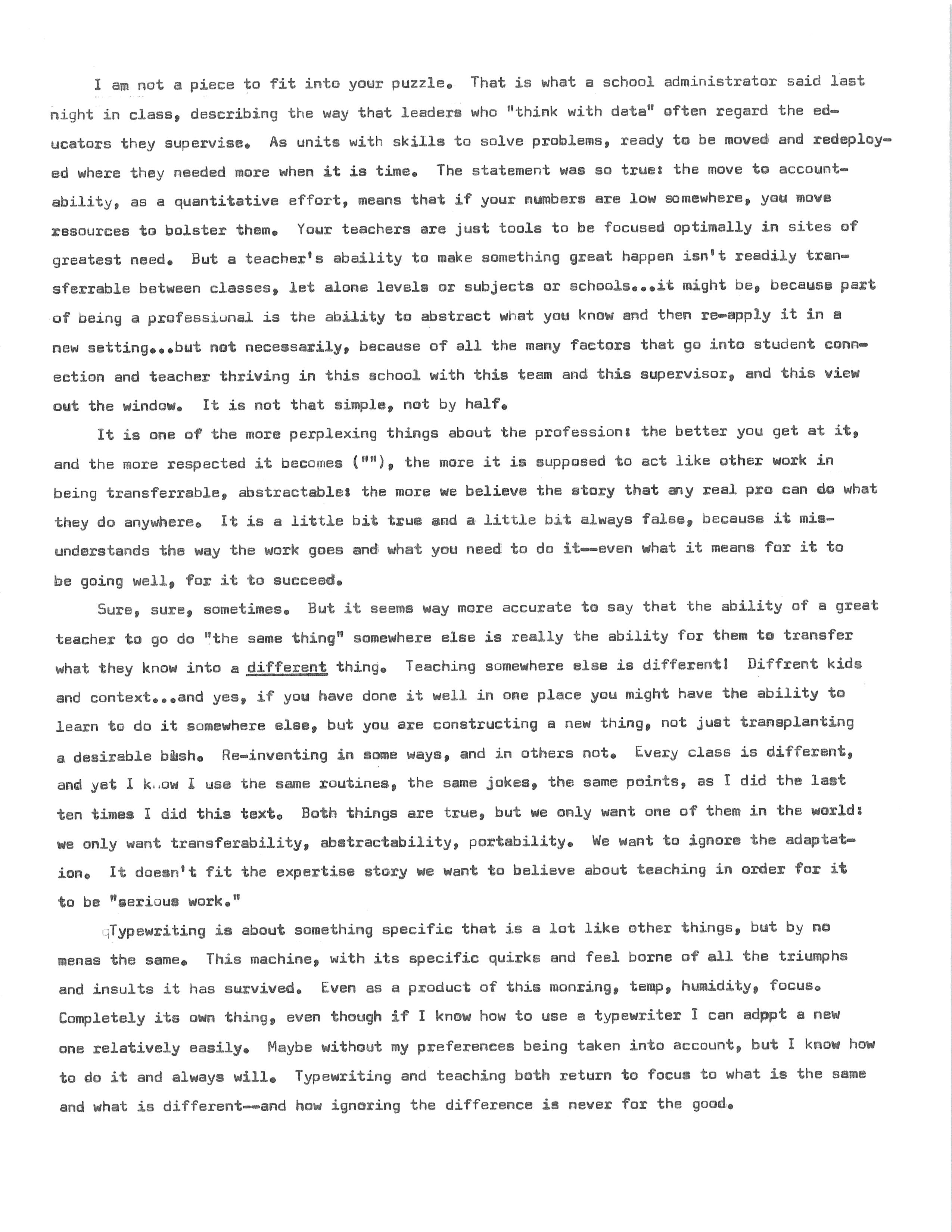
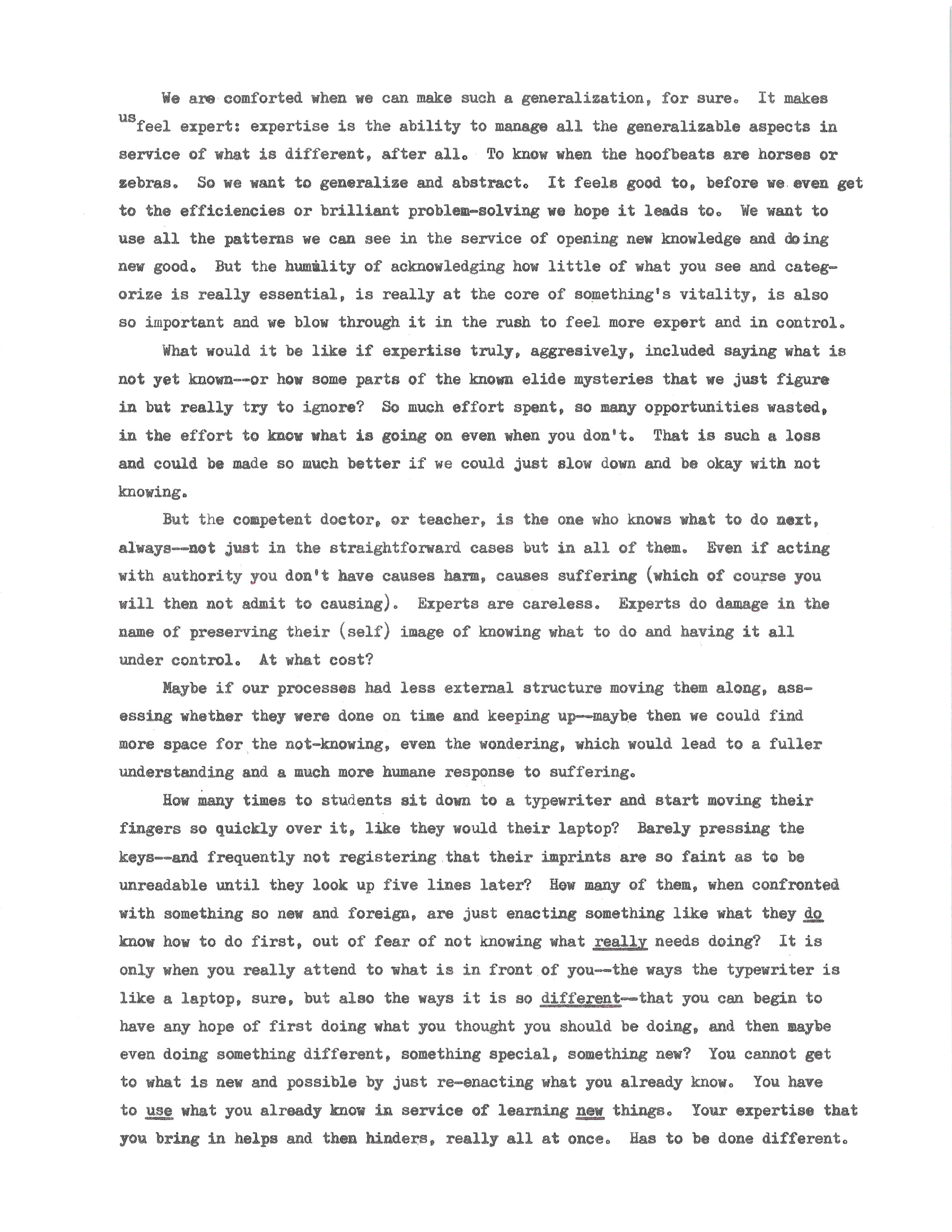
Here are a couple of pages I typed this morning on my ’67 Hermes 3000.
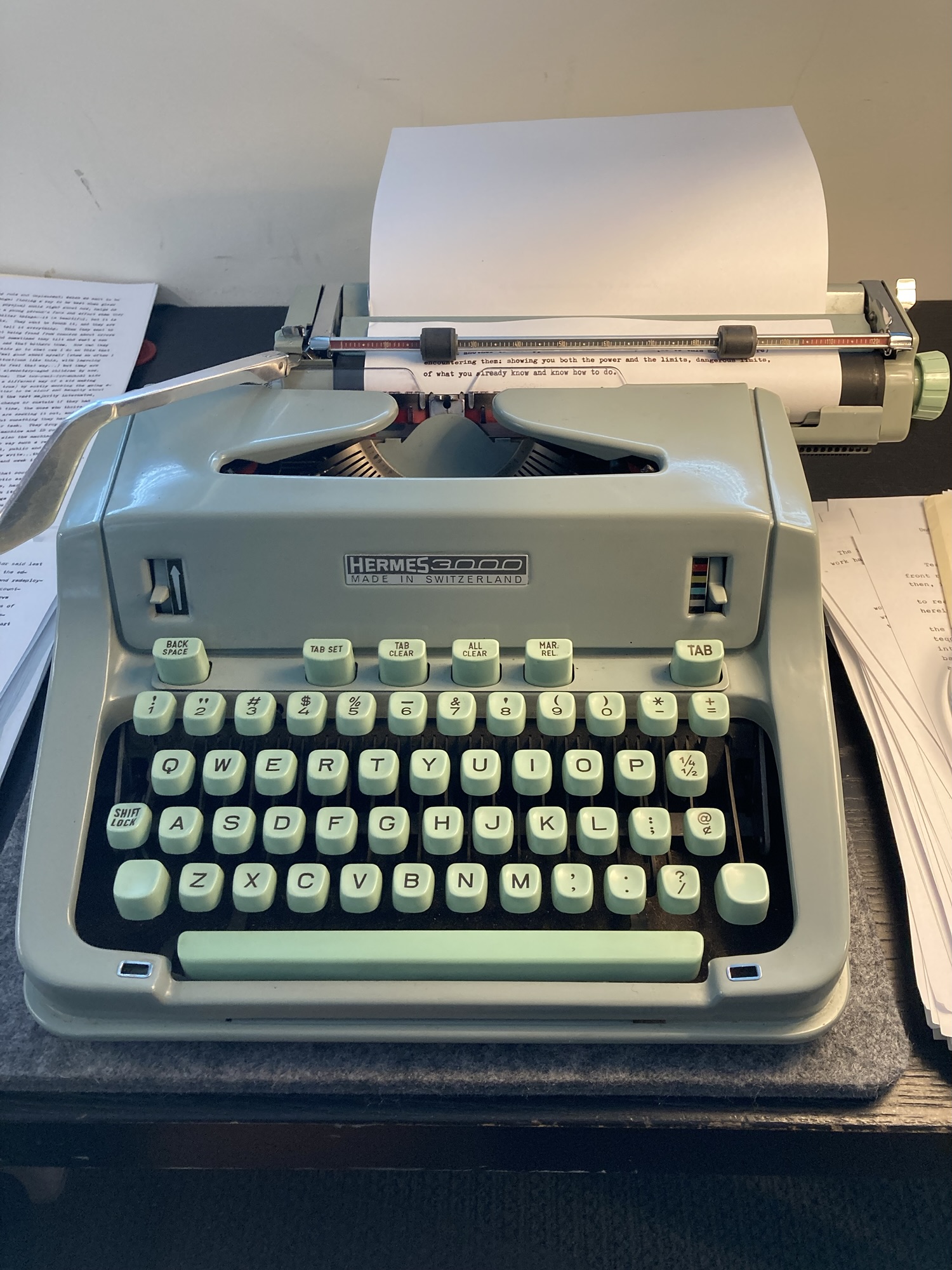
Well: first, here is the ’67 Hermes 3000 in question. My ten year-old named all my typewriters when he was in my office last month, but I have mixed up the placards. This is either “Smith” or “Inigo Montoya.” It will probably answer to either.
I am in love with the wonderful ease with which a typewriter like this calls you in to think something through. There is nothing else to do but decide what comes next on a typewriter like this. Nothing else to do but find out what comes next. Can you stay with it long enough to see?
(Oops–astute readers will note that I changed typewriters halfway through, from the ’63. Still Hermes though.)
URGENT QUESTION, for me:
Is the first-draft typing, as above, “the writing”?
Or is it only “writing” if it gets revised, marked-up, turned into a second draft, then read and marked up again incorporating feedback? Round and round until it gets codified and published, somehow–the final version erasing memory (and if digitally edited, existence) of everything that went before?
I am convinced that our appetite for revised, polished, perfect prose is pretty much sated. Especially because machines can make perfect prose now. Boring and predictable prose, to be sure, but free of syntax error and misspellings.
Polished and perfect is easy now, and (feels) free (though isn’t).
First-draft prose, on the other hand, is now reinvented as human words, verifiably one imperfect-but-motivated human having their say to another, or many others–who might even have human words to share back.
We became allergic to typos over the decades because perfect prose was the ultimate respect for the reader. And the capacity to make that perfect prose was the ultimate sign of writing expertise. I honor you enough to conform to your expectations of how this will be put together, our careful proofreading said: I care enough to remove any obstacles that get between you and my meaning, intimation, implication.
Awesome–but now, can we respect our readers enough to show that we are actually people like them? Having false starts and repetitions, and misplaced fingers and smudgy ribbons–or sometimes catching fire for a page or two and producing a unitary thought that hangs together in its (im)perfect but alive way?
Can we respect our readers enough to share the real heat of what we think, rather than run the risk of homogenizing it through rewrites, or Grammarly, or god forbid ChatGPT? Is imperfect authenticity on the way as the new quality we want to find in what we read?
And if so…won’t it change how we read? Won’t we who benefited from excellent reading and writing educations, whose work was pored over with a red pen and corrected and corrected until we could correct ourselves–won’t we need to UNLEARN a lot of that? Since it has become a dead expertise, one that a machine can do better?
Won’t we want to read with a different calculus of quality: one that can’t be fooled by a machine? At least not yet?
Of course, I agree that there will always be a hunger for well-formed prose, made and revised and perfected by humans, using whatever human-throttled technology we prefer.
And there will always be those among us capable of making such prose, evolving along with the tools and holding onto their voices and our rapt attention despite tech’s incursions. I watched the Joan Didion documentary on Netflix, astounded to watch her move seamlessly from tiny portable typewriter in and after college (writing her first novel: “I sat on one of my apartment’s two chairs and set the Olivetti on the other and wrote myself a California river”) through big desktop typewriter to more expensive and better big desktop typewriter to hideous-but-state-of-the-art IBM Wheelwriter and finally, in her last years, to cowering before a massive Retina display like the rest of us.1 That’s a writer, babe. Oh yes.
And I, many of us, will always love that art. But I think we will evolve to love the first draft too. Awash in perfect, meaningless robot prose, we will learn to crave any sign of life–and what is more alive than a first draft? If it is typewritten, it might even be legible.
(Meta-moment: if you are still reading, did you scroll past the typewritten pages and jump down here to the more congenial-looking, fit-to-your-screen digital stuff? What would it take for us to WANT to read the stuff that doesn’t leap into our eyeballs most easily? If that is really where the life is?)
Will you love imperfect writing differently, in the next months and years? Writing that is different, and shows traces of its provenance in its imperfections?
As surely as a handworked quilt with uneven stitches is a precious heirloom, while a mass-produced comforter from Wal Mart is disposable?
What do you think?
(Title from what is apparently emphatically NOT a Lao Tzu quote, but I like it anyway. “If you want to become whole, let yourself be partial.” Beauty’s where you find it.)
Just one footnote: Didion on how the word processor impacted her work. “Before I started working on a computer, writing a piece would be like making something up every day, taking the material and never quite knowing where you were going to go next with the material. With a computer it was less like painting and more like sculpture, where you start with a block of something and then start shaping it. . . . You get one paragraph partly right, and then you’ll go back and work on the other part. It’s a different thing.” Yes it is. ↩︎