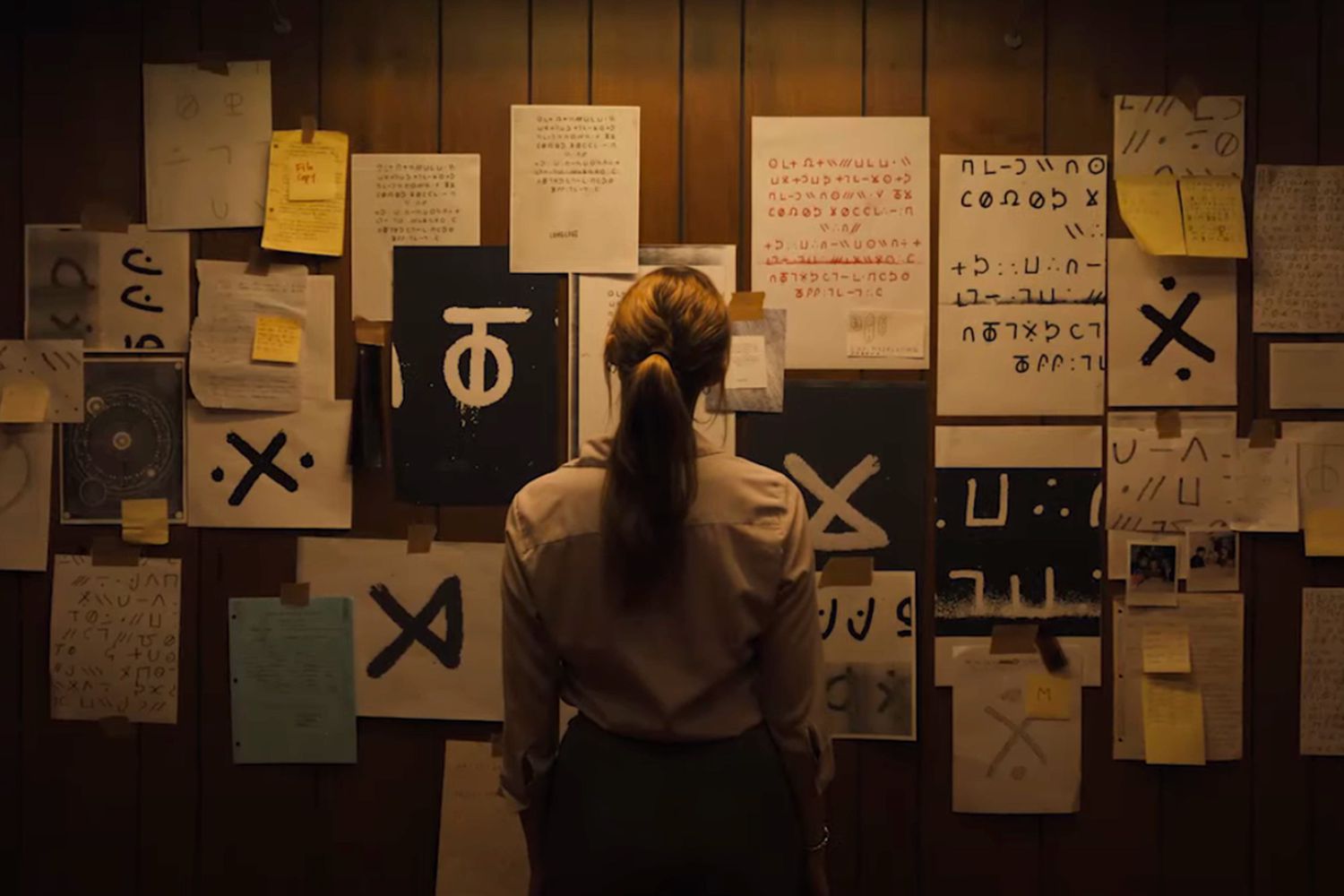
Rewatched a terrific Oz Perkins film last night, on my small personal screen. Longlegs. (And if you haven’t seen it yet, obviously spoilers abound in what follows.)
I made a point of first seeing it in a nearly-empty theater when it was released fourteen months ago, and am glad I did. The forced perspectives work best when there is nowhere else to look but down the tunnels he builds, over and over again. When there is nowhere else to go.
But this time I had the comfort of pause and rewind, and subtitles to make what on first viewing is terrifying mumbling into words. I am not sure which experience I prefer.
Those perspectives regularly give you a long view of an outside or household landscape, with everything focused and static–then refuse to tell you where to look. Like the conceit of Paranormal Activity, you do not know what is about to happen or where the threat will emerge.
But unlike that excellent but still-lesser film, the payoffs do not always come. A second viewing allows you to cheat, of course. To mash the “rewind ten seconds” button over and over and see how Perkins’ craft shifted something so, so subtly, just enough to decenter you from where you are looking. This is a well-worn tool of horror, but I have not seen it used so deftly since Let the Right One In‘s blend of uncanny and quotidian.
What is worth noticing, remembering, reading, adding to your churning internal complex of “making sense”? Maybe the central question of the film, and mostly unremarked in reviews I have read.
Maika Monroe’s Lee Harker experiences the world differently than the barely-sketched normies around her–and why is left pretty open until the very end. Is it intuition, or psychic power? Is she on the spectrum? All we know is she can attend more closely to real things that others do not even see; grok what others do not even know is there to be grokked. She is in reality: just a different one than everyone else knows. The film actually makes refreshingly-short work of the usual business of trying to understand why she knows stuff: in the last third, a massive manhunt is begun based only on her saying, this is guy we have to find.
The 90s milieu of the film is signaled only by a looming official portrait of Bill Clinton in an FBI office, and the unmentioned nondigital surfaces where the story lives. This is how we lived before our smartphones, the film says over and over: there was nothing to note about it, because it was just living. The cars have radios, the libraries have microfilm readers, and all the macguffins that move the film’s grim business along are hand-crafted and hand-deployed: dolls, birthday notes, shotguns.
And the “built environment” of the film is warmly lit, but grimy on top of ersatz. The net effect is queasily human and alien both. The FBI office’s walls are paneled in the faux-grain dark wood all children of the eighties know well, from rec rooms and dens where Godzilla films on TV were watched on long Sunday afternoons and unsupervised Boggle games went inexplicably awry.
Institutional spaces are massive and cluttered at once, and the people who sit and stand in them are oblivious to how the strangely-shaped doors and oddly-placed windows in turn shape and place them according to obscure intentions. The exception is Lee’s childhood home, a handsome arts-and-crafts farmhouse that we first see in her pre-blight childhood. In the present, though, it has been taken over by malevolence that weaponizes reality against its sole occupant: hoarding, but hoarding as slow encroachment and engulfment. The fast-cut images of snakes writhing bear out this sense of being surrounded and consumed (kudos to Perkins for recasting this imagery to his own vision, after Nine Inch Nails’ era-defining Hurt).
There is a single manual typewriter in this film, that I could find: an unremarkable 70s era Smith-Corona we see abandoned on Lee’s childhood desk, surrounded by a time-capsule child’s bedroom. Here like in so many films, it is a shorthand way for a filmmaker to evoke the beforetimes. As surely as the stack of Polaroid instant photos Lee finds in the same scene, which hasten the story to its conclusion. In a film with so much realia, it fades into the background as yet another artifact piled up over time against an implacable invading force.
But there is so much time to stack up, in this movie. Scene after scene seems to move at 1/3 speed, until sudden violence is delivered at its own slow pace. We fall with Lee into reverie after reverie: on our knees with her as she spreads out photos and reports on a dark red carpet, at her desk at home as she decodes satanic code with her well-thumbed Bible open beside her.
Fans of Perkins’ The Blackcoat’s Daughter and Gretel and Hansel will recognize this insistence upon letting things unfold the way they actually do. Upon refusing to make even the most absorbing life pass more “narratively” than it actually does. Upon refusing to tell you what is going to matter later that right now is just another object on a desk, another shadow in the corner of the frame.
My own time is moving fast, and I need to get ready for class. But I will always be ready for another plunge with Perkins into a world of real things and places that seem like what you think until they are not. This one is a real dilly.
As a nine year-old girl asks in a quiet moment: Is it scary being a lady FBI agent?
And the answer: Yeah. Yeah, it is.
(Image from EW.)

