How to be a great adult rock star? Rock and roll being primarily an art of and for the young. Just showing up at all as a grown-up with any credibility seems like it’s most of the battle.
What to wear? Youth and volume + leather and swagger are the the original classic thing, from Elvis to The Ramones to Bono to The Strokes. But that gets tougher to pull off as you either soften or get stringy. If you somehow manage to survive your 27th birthday, and fail to die before you get old, what will you wear to your 50th birthday party, or your 60th, or 70th–or beyond?
You could retread the Johnny Depp pirate look you invented, like Keith Richards. Or go for jumpsuited Devo-core, like D. Byrne. Basic black with good kicks works for Jack White more often than not.
Or will you look sharp?
And holy cow: what to play?
Reanimated roots rock is always respectable (with or without AI de-aging, like the Stones in their new video). So is furthering the genre you invented, like David Byrne again, with sidepeople and stage crew not yet born when you made your bones. Or like Jack White, you can remain the daemon you have always been, and slay with another surprise record of noise and edge coming out this summer.
Or you can push on into…something quite else.
Hello cruel world, I’m not going away
So I might as well have my say
For all the damns that I never gave
And for every damn whale that I failed to save
For every little fad I didn’t chase
And every little fool who just didn’t like my face
I know that you like it
I know that you want it
I know that you need it
Leave it alone because I’m not gonna say it
I’m not sorry
I’m not sorry at all
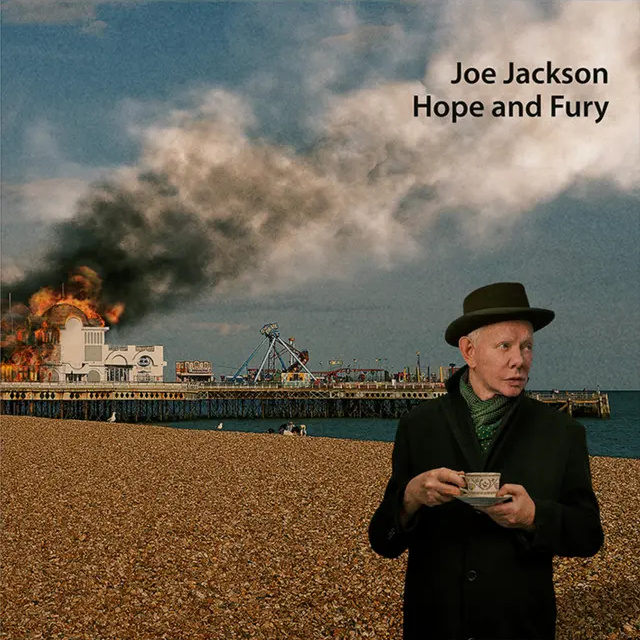
I found Joe Jackson’s new album Hope and Fury almost unlistenable the first time through. Then I read the words and listened again, and again. I learned from it how to hear it.
And now it is my favorite release of the year. It is a sign of life in a dead time: a blast of grownup-ness in an age of deliberate puerility, especially from our supposed betters. And it is therefore more precious than ever.
You remember Joe Jackson, if only casually, o Gen X American former radio listener. You do! The angry young man who got signed in the wake of Elvis Costello’s late 70s fame, and broke through on the radio with smartypants songs like “Is She Really Going Out With Him” and “Sunday Papers” from his first album.
His second record I’m the Man was rushed out within the year, same formula; the title track was joyfully covered by Silversun Pickups in the season three opener of The Lincoln Lawyer, which cover put him back on my own personal screen. The song there does the work his early music always does: cue intelligent mania, cue passionate people who put the stick in their own spokes. He’s the patron saint on these records of the guy who yearns and hustles and is denied but gets back up again.
Then wow, do things get interesting: he makes two records that mostly amuse himself, one full of British reggae dub (featuring bassist-for-life Graham Maby) and one of Louis Jordan jump blues stuff–but not much attention results. He repairs to NYC in the early 80s and soaks in the Latin vibe of the street music he finds there, metabolizing it with the composition training he had gained at the Royal Academy of Music. And the resulting album, Night and Day, gives him his biggest hit (thanks to nascent MTV, which spins it heavy in the absence of much else on offer).
He is among the masters of English songwriting that yearn for connection, from the juvenalia of “Happy Loving Couples” through the early-midlife trainwreck of “My House” and “Stranger Than Fiction.”
And no-one since Eddie Palmieri understands better the sting of a lit montuno (well, guajeo, strictly, I think). Those piano figures burn through his fiercest work, from Night and Day’s “Cancer” to Body and Soul‘s “Cha Cha Loco” to Hope and Fury’s acid cancel-diss “I’m Not Sorry.”
He could be done, is my point. After so much music, he has certainly earned it. He is 71 years old. Those who love him have plenty to keep loving.
But he isn’t done. So here’s Hope and Fury.
Maybe he needed a reason to get back to touring. He has been a tireless road warrior throughout, and that’s the only place for any musician to really earn in the age of essentially-free streaming. These songs seem like they took time–at least one references Covid–but who can tell? Someone this prolific must have another hundred tunes shored up for future releases.
Though he is not superhuman, and admits to a multi-year creative block after the commercial underperformance of 1991’s impeccable Laughter and Lust, which still seems to perplex him. He worked so hard on it, even did market research with the new tunes live to see what the kids liked…and it wails, even now, thirty-five years on. But it didn’t sell. Heartbreaking.
Hope and Fury is an album about efforts and plans going wrong, sure. But the scars are sublimated, so familiar they are not mentioned so much as whiffed ambiently as the songs hurtle by.
JJ songs have always taught tough lessons–even as they didn’t care whether or not you learned them–about the ease and impossibility of connection between and among the sexes especially. His didactic bent is funny and sad in his first decade. “It’s Different For Girls” is a swirling gender studies disquisition ten years before we start laboring through Judith Butler in grad school.
But “Made God Laugh” isn’t about a lesson learned, so much as a reporting of the reality of the weather in your head when your head has been pushing you to succeed your whole life. If you don’t already know that you “made God laugh when you told him your plans,” you are not going to learn it here. But if life has taught you that truest truth, well, here’s your affirmation, and company for the daily commute to the latest site where it’s happening to you.
It’s also a record about coming home after fleeing home for most of your life. JJ is an ambivalent Englishman, and says as much. He started as a pub rocker, but his long time in NYC softened both his accent and his tolerance for the gray and the old. This record is about how he both hates and loves it back home. Now he leans into the Portsmouth accent sometimes, for effect–but he lives in Berlin now, mostly.
And I think the offputting chorus of distorted growling groaning voices that appears intermittently on the record is Britannia, that mother, that minx. It performs an important libretto role on the album as the voice of tradition, both the stuffy and terrifying bits and the comforting bits. His most complex feelings are given to it: the monster-rap opener, about how hideous and beautiful “Burning-by-Sea” is; the self-doubt and self-criticism in “The Face”; the chorus of “The End of the Pier” turns into a comforting pub singalong.
What’s more grown-up than accepting you’ll always feel some kind of way about your origins, and letting all the conflicting feelings stay conflicted?
“Fabulous People” slyly returns to the distinctive glockenspiel voicings of his biggest hit, 1982’s “Stepping Out” (pun intended) for a complicated take on queer identity. It’s a bracing Pride month listen, for sure. He weaves a tale of a shlubby straight guy who has tried “being himself, but no one cared.” And so decides to embrace the “fabulous” LGBTQ ways promised by the “rainbow” he sees everywhere: on “the shopping mall / city hall / glitter ball.”
Turns out it’s not for him. He is going to have to find his own way to be “always fun, and never scared”…which of course no one can ever be.
So much cascades through this song! It makes me remember the dryest New Yorker cartoon ever, about how Pride is supposed to invite all ways to be while honoring mostly one. This June has had more than its share of thinkpieces about queer identity in a season of erasure and violence. In this moment, the song lands as an insistence on complexity and iconoclasm, even now, forever.
(Remember he gave us “Real Men” in 1982 as well, a song in the darkest days of AIDS that swung for more than even that pathos. In any decade, his message is clear: you are going to have to go your own way.)
You know what a grown-up rock star does? He delivers exactly what he has to give, as blunt and abrasive and contradictory as it may be. He’s not here to settle your hash about who he is–or much less, who you are.
He’s not demo-ing new songs anymore to see if you like them. He’s putting out what he’s got, and if you don’t like it, then sod off.
He’s straining for some notes; the cracks in his voice are part of the landscape now, and why would he fix them in post?
And he’s got a grown-up band too, it goes without saying. Doug Yowell’s supple feel on “After All This Time” is nearly everything I hope my drums sound like, Keith Carlock without the metronome. And trading fours on piano with Teddy Kumpel’s guitar on “The Face” is just enough to remind you he’s got the chops…but he doesn’t need to impress you anymore, so back to the bridge he goes. The song’s the thing.
His tour plays Charlotte tomorrow night. I feel too old and tired to make the two-hour drive down the mountain that late, frankly–a sentiment I fancy he would support.
But I hope my small celebration here sends him the sentiment I have always wished him. Gratitude for his wicked craft, and fellow-feeling for his insistence on being utterly himself.
Don’t listen to the dopey critics, who begrudge him growing up. Just listen to the record.
Then came the smoke, then came the flames
And no more jokes, no video games
Who’s left to cry, who’s left to cheer
For the end of the pier

