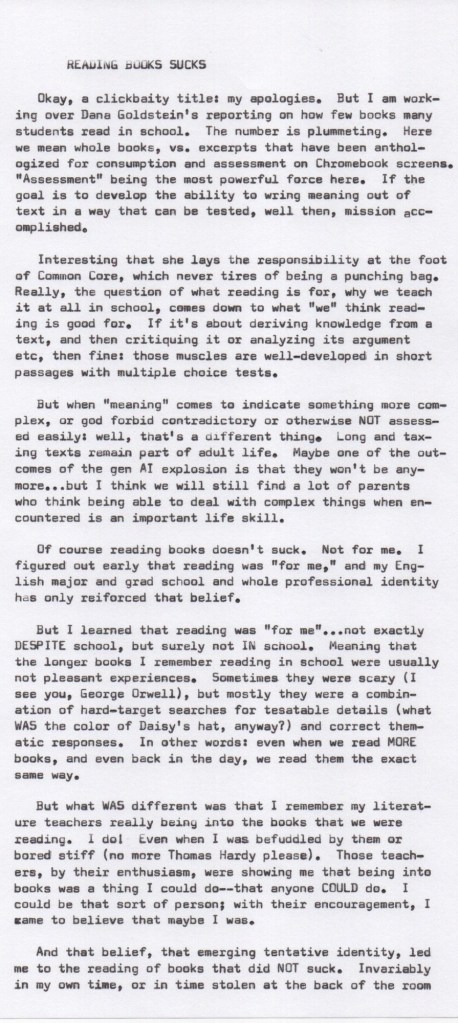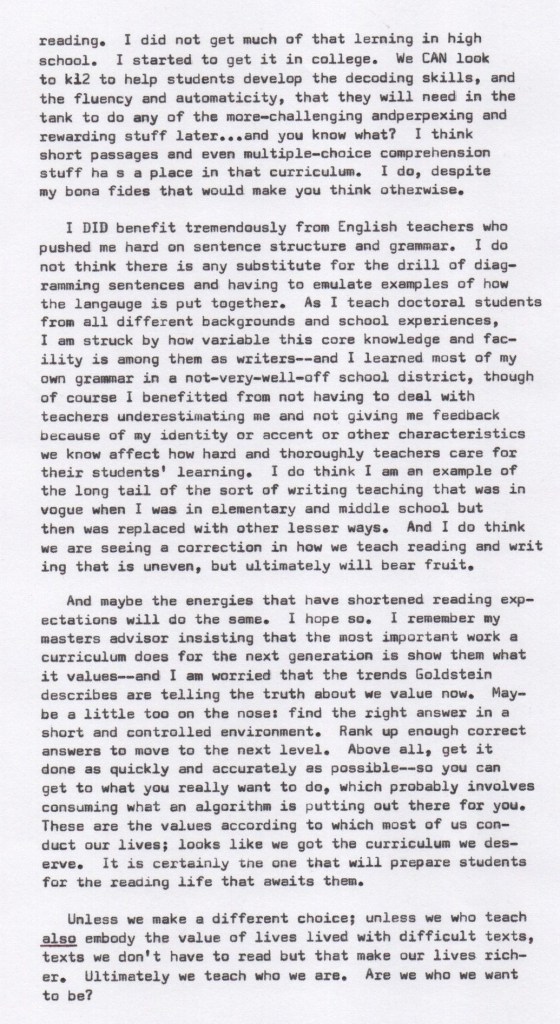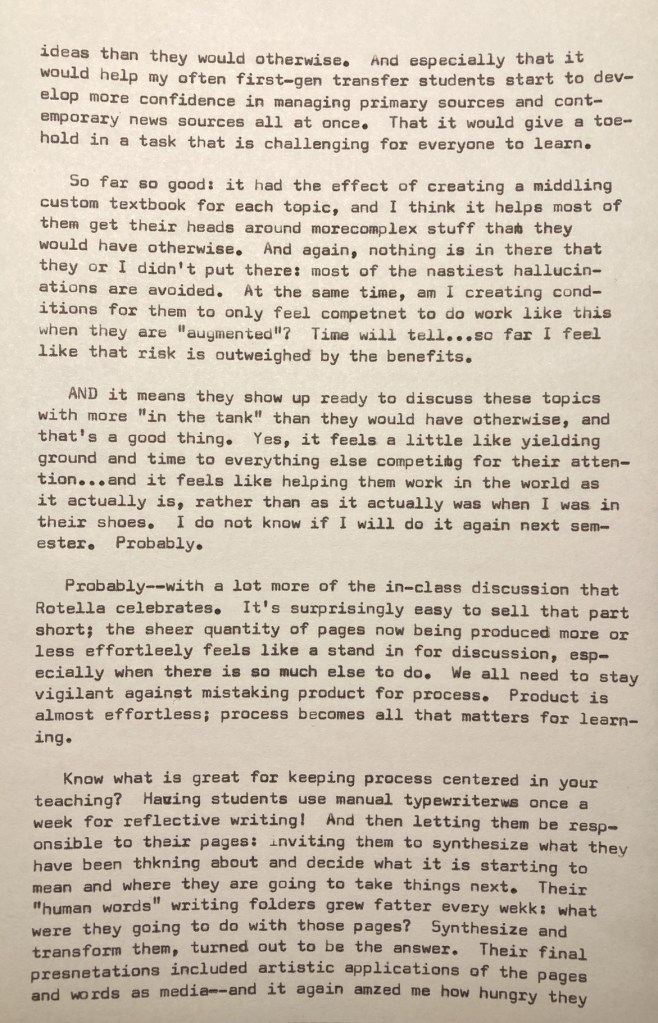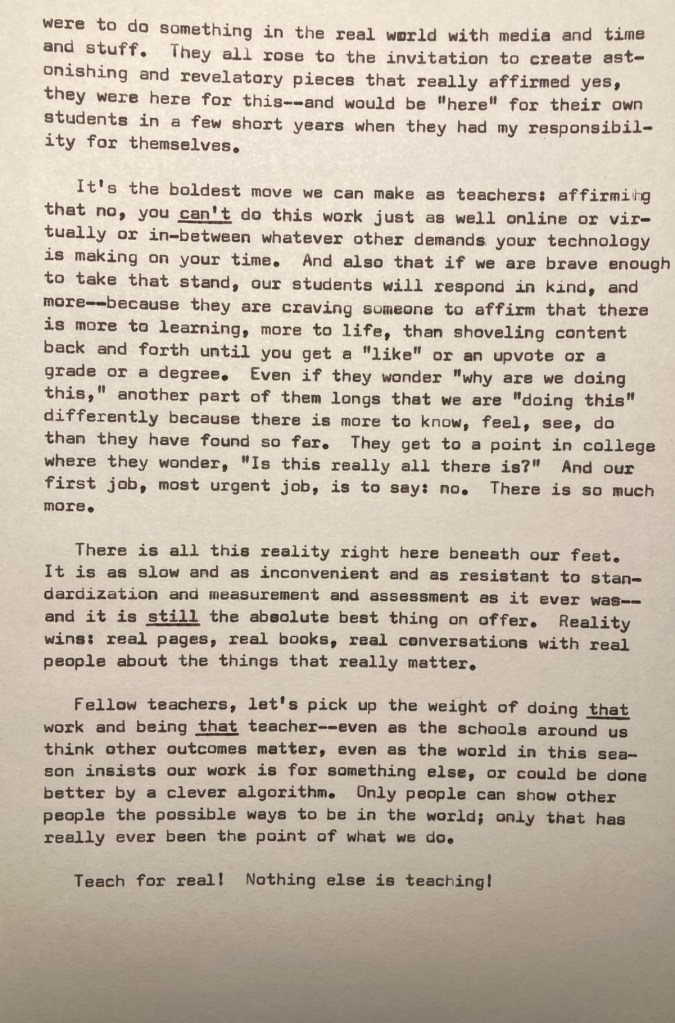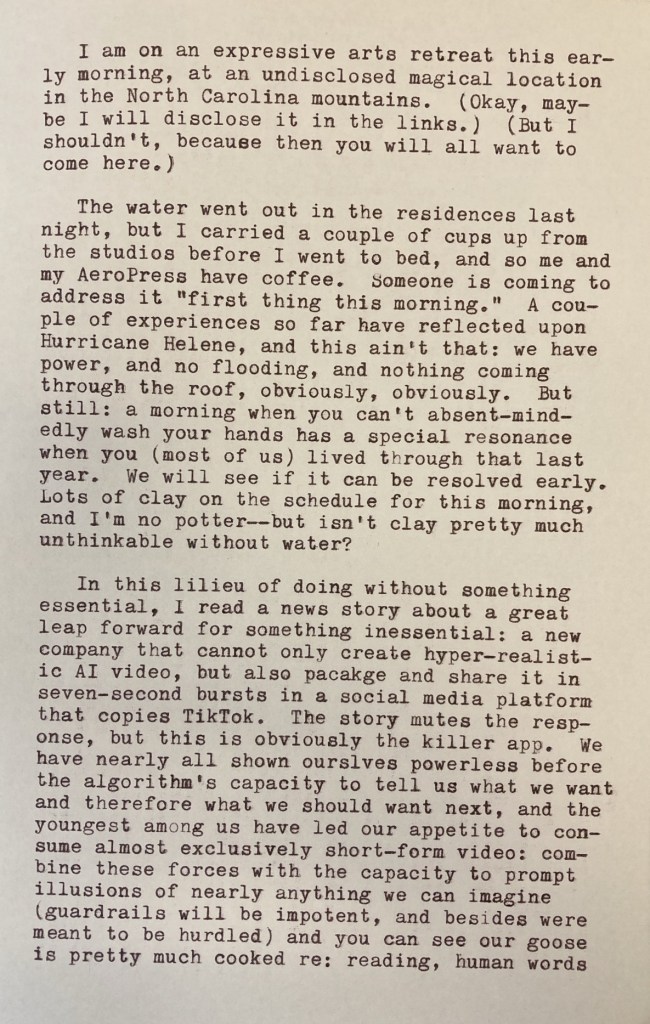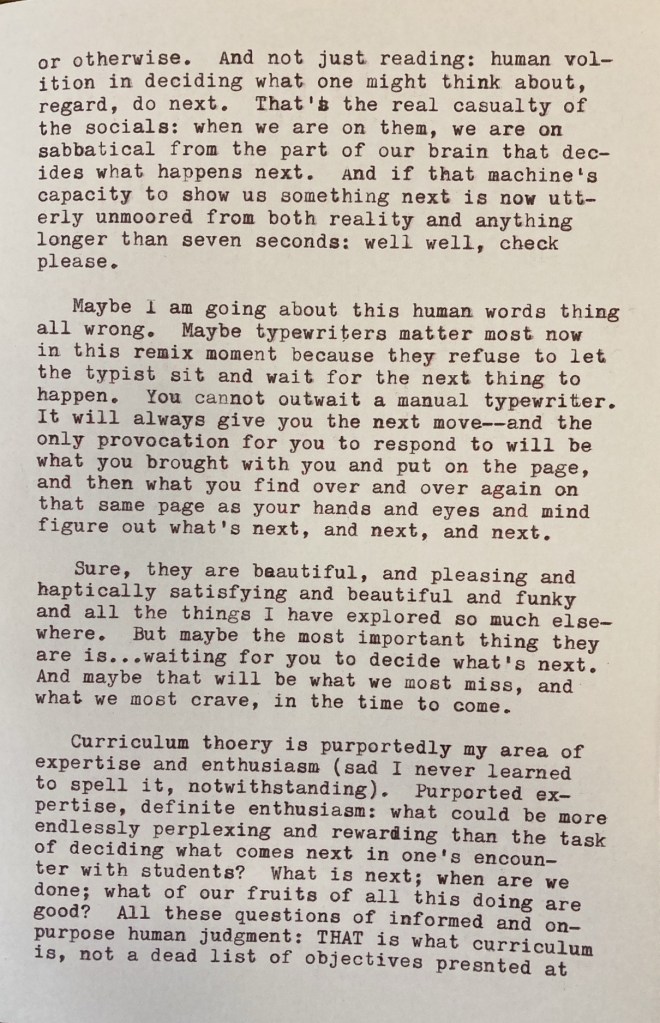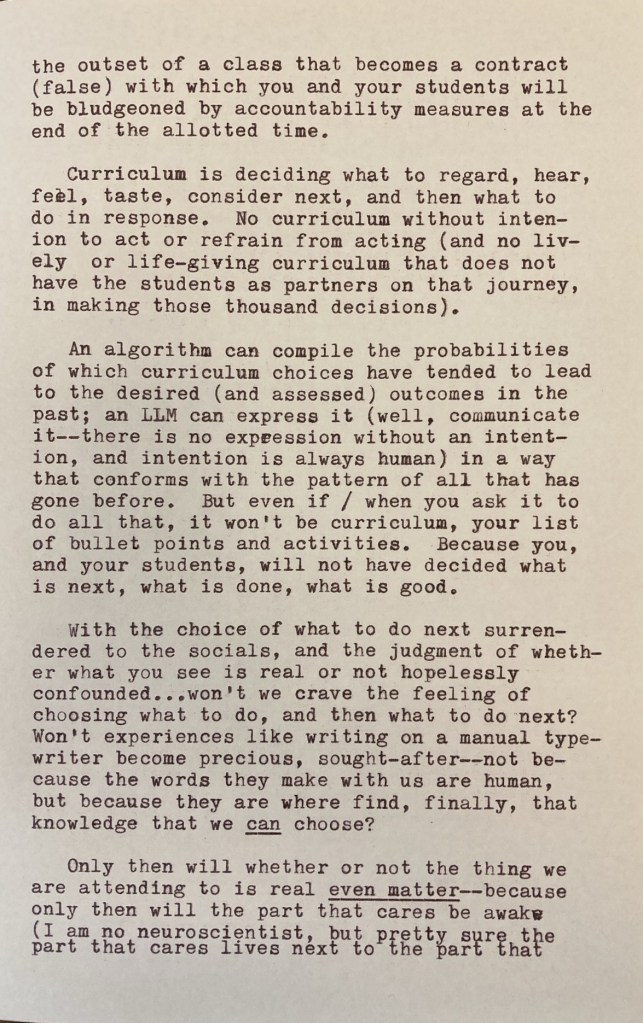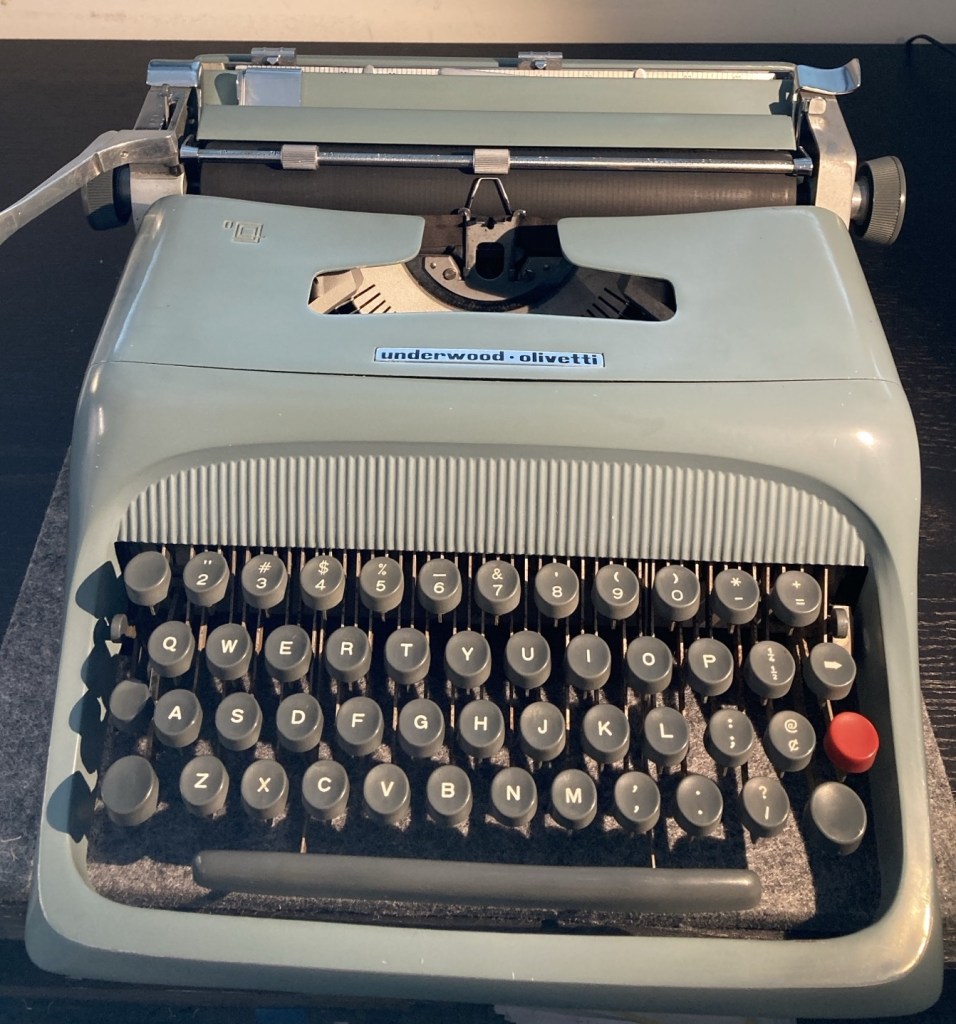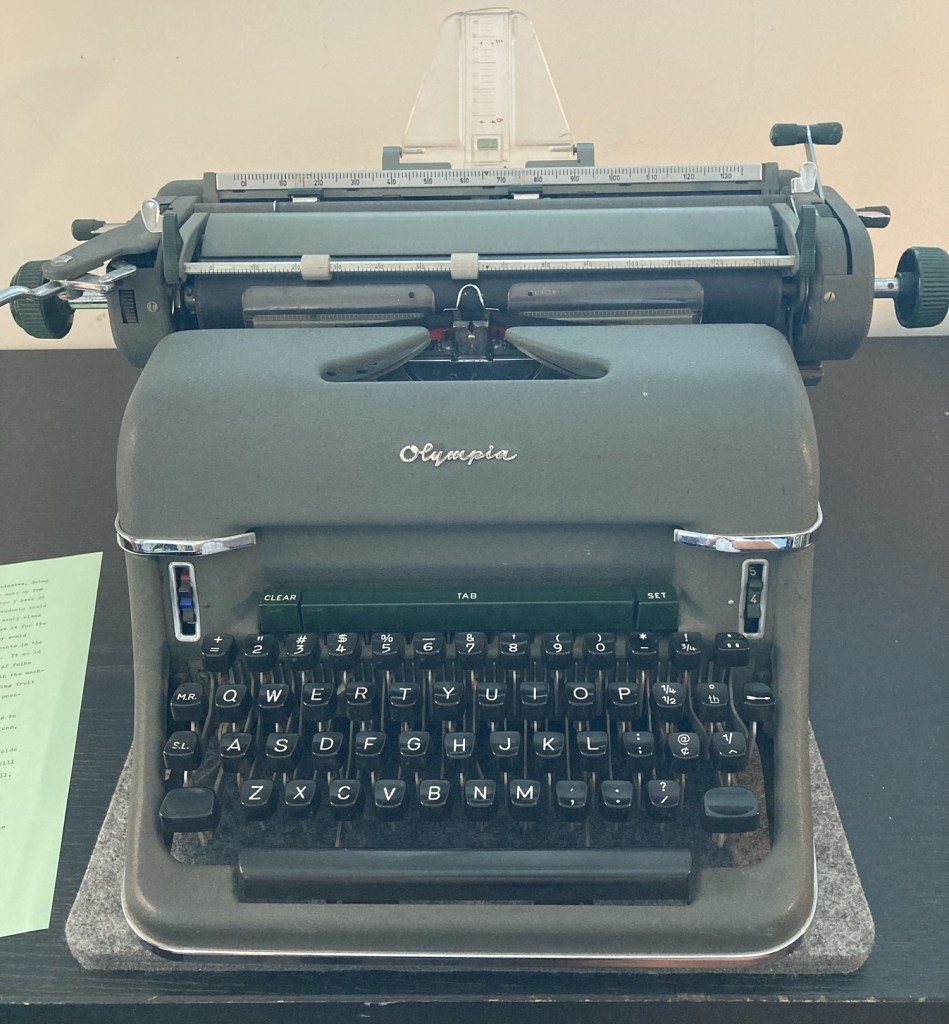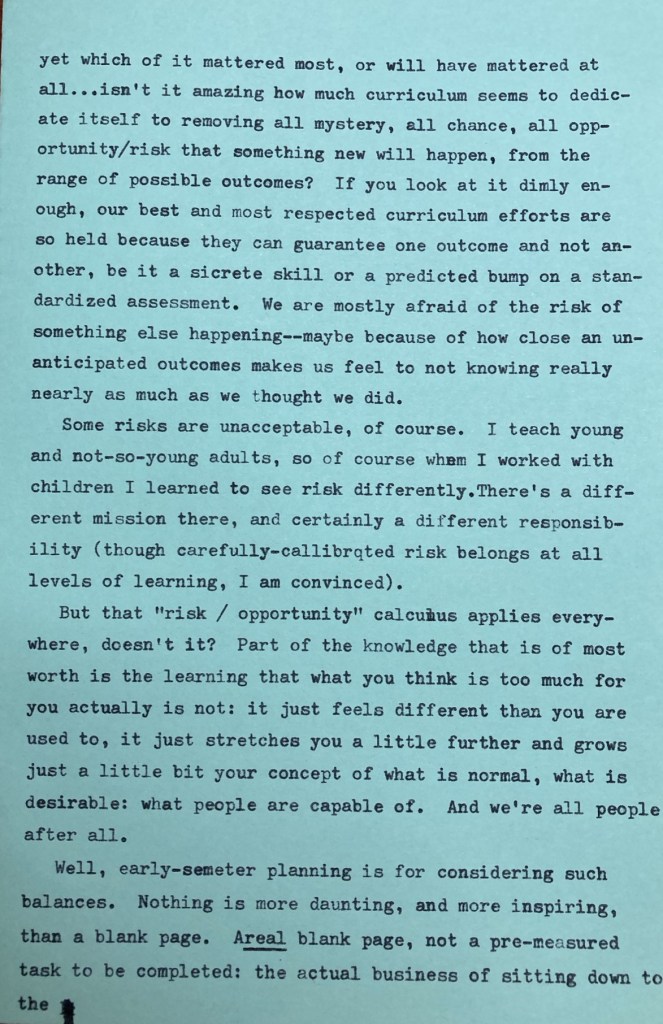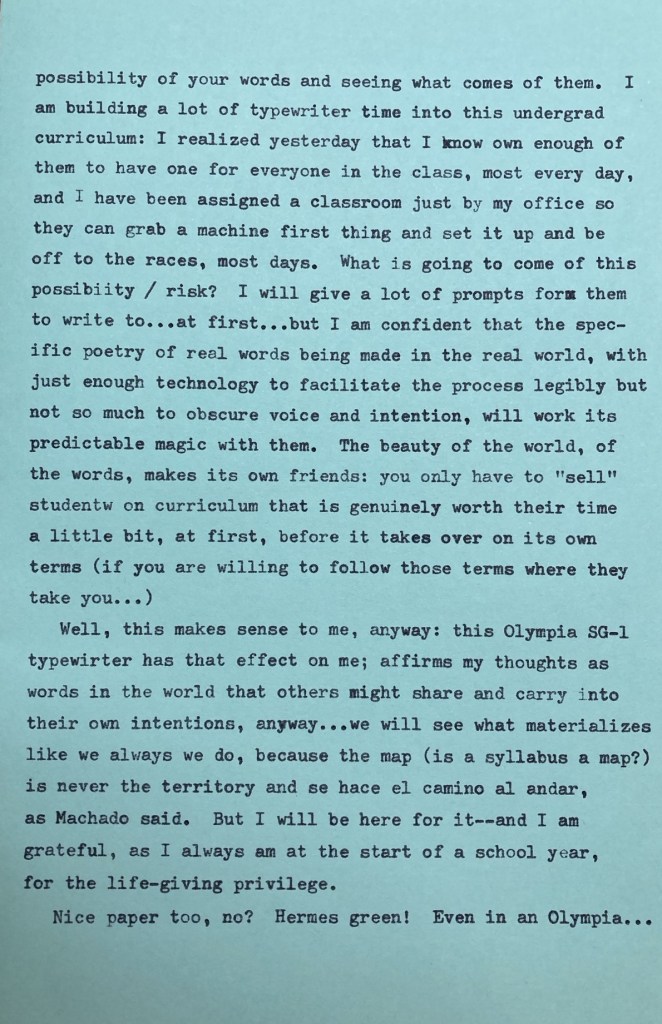
Excited to try a new scanning process to make my typed human words more legible and accessible! I am still with the charming ’63 Hermes 3000. We’re developing a serious long-term relationship. It really gets me…
I have no rights to the B&B image, which is the cover of an out-of-print anthology, but hope Mike Judge would consider it fair use. FWIW, you can buy it here.
First I have to share a note the great jazz pianist Bill Evans wrote to his composition teacher, Gretchen Magee, at Southeastern Louisiana University.
I have always admired your teaching as that rare and amazing combination – exceptional knowledge combined with the ability to bring that same knowledge, that lies deep within the student, to life. You were certainly my biggest inspiration in college, and the seeds of the insights that you have sown, have in practice borne fruit many times over.
This week I am listening to one song on repeat in the car, every day: “Way Back Home,” featuring Ronnie Cuber on baritone saxophone, from Steve Gadd and Friends’ 2010 album Live at Voce.
Saxophone is, I guess, a hard thing to love now? Two NYT pieces in the last week say sax is suss: a hot take on the current preponderance of the instrument at weddings, and “5 Minutes That Will Make You Love Alto Saxophone” (because if it can’t be done in 5 minutes, it can’t be worth doing). It is certainly the instrument that never sounds like anything else. You can mute a trumpet, you can prepare a piano, and if you amplify anything you can run it through yards of effects—but sax is sax.
I have been on a guided saxophone tour for the last few weeks, led by my youngest son. I was spinning Getz / Giberto in the car at pickup one afternoon, and he had questions. So I explained the three primary sax variants one finds in the wild. The alto: the intellectual’s horn, that of our first alchemist Charlie Parker and later technicians like Paul Desmond. The tenor: the alto’s soulful uncle, who can’t hold down a job but is out wailing on the bridge every night. Sonny Rollins, Wayne Shorter, Coltrane and of course Mt. Getz. (The fraught history of the soprano is excused for another day.)
And the baritone…well, no bari player came to mind. So I asked Spotify for one, and it coughed up this record. Thanks, algorithm! What a gem! (Also a favorite of Donald Fagen, according to the YouTube link above: my excellent taste is affirmed.)
Against its better-pedigreed colleagues, the bari sax always sounds like your sketchy friend leaning across the table to tell a dirty joke. The bari knows it is here for its personality, and leans into it. Perhaps the bari is the trombone of the woodwinds: it eludes its reputation only by occasionally embracing it.
I do not know anything about Ronnie Cuber other than his long long resume on Wikipedia, and the fact that he played in the SNL band. I think I recognize his tone from bumper music in the years when you had to be up at midnight to hear it. He would probably be considered a very accessible player. “Way Back Home” has no arch bebop changes, is not “out” in the slightest. It is boogie music, feel-good music. A two-chord vamp that only goes to the third when you cannot take the pressure anymore; puts me in mind of Joe Zawinul’s “Mercy Mercy Mercy”, which despite Cannonball Adderley’s intro about persevering through adversity has always been a joyous song to me. Here to move your booty, not push you through the doorways of perception.
And that tone! The growl and the hum and the whine. I have seen one photo of this hulking man and am put in mind of Mingus with his double bass: parity between player and instrument, clash of the heavyweights. I am pretending I know everything I need to know about him from that Wikipedia page, and I like every single bit of it. I am not looking up any more: I do not want to know if he treated his collaborators like garbage or sold his horn for smack. I want to just climb inside that tone and spend a long, lazy weekend sliding down the surface. He enjoys the lowest honks of the horn and is not afraid to let you love them too. He knows his instrument is ridiculous on the way to being sublime: that the two are inseparable.
And he knows he can do anything he wants on it, and a big part of the joy of listening to him is the physical feat he is pulling off. Because that is the other thing about bari sax that can’t be ignored: its size. Its weight. I am finding curiously variable numbers online, and do not have one handy to check. Does it weigh twenty pounds? The neck strap introduces a whole new problem in the long term I bet. Posture implications. More than the weight, though, is the distance your air column has to traverse. All the way down to those lower notes, with the big clanging pads, is four feet at least. Bari is a physical commitment.
I played bari for a couple of years in my high school jazz band. I was a competent clarinetist, and my indulgent band director told me I was welcome to audition if I could learn the bari. If I could hang, maybe there would be a clarinet feature in the future. Jazz band practiced at 7:15 in the morning twice a week, is my memory: you had to want to be there. I had to muscle that metal into submission almost before I was awake.
I learned it well enough to honk along with the real saxophonists. Sax is nominally simpler than clarinet, thanks to Adolphe’s ingenious design that makes the same fingerings work for the same notes all up and down its range, vs. the clarinet, which puts you off a fifth in between octaves. And I did hang! True to his word, we did “Woodchopper’s Ball” passably, and I made an absolute wreck of Jobim’s “Wave” at a festival once.
But the real long-term benefit for me was getting to spend hours up close and personal with a horn that big. Cuber does not seem to notice the heft of the thing. His dexterity and speed is improbable, unimaginable. Especially when you have also tried to wrestle with it and been bested. I love his playing because I know how much work it is.
I got out my alto* this week, inspired by Cuber’s deftness and tone, and was immediately reminded how you either are married to your instrument or struggle with it.
And I struggle on sax! Twenty years ago, I joined a band in Chapel Hill for a few months on that alto. They were named, gloriously, “The Guns of Navarone.” A serious montunos-for-miles cubop piano player, an upright bassist, a traps drummer, and a conga player. And somehow me. I knew by the second rehearsal that I was way outclassed by this project, but they kept me on, so I stayed. We worked up two sets–“Caravan,” some Horace Silver maybe?–and I played one gig in a dim weeknight room on Rosemary Street. I remember the piano player glaring at my honking, keening tone all night, waiting for my to materialize into the player of his dreams but remaining the same mess I had been in rehearsal. I quit the next day, and went back to being a well-satisfied drummer ever since.
But I am going to keep up my honking and keening regardless. My saxophone-remembering has every place on this blog, because music-making will always be a physical act. Most of the music I love comes from real people and objects working at each other and finding harmony, or at least detente.
And computers can now emulate nearly any sound with alarming fidelity. In my last DC band we would haul an actual Rhodes stage piano up and down stairs into second-floor clubs, cursing its weight and size all the way. Now my friend who played that Rhodes gets all its sounds and more (Hammond organ!) out of a tiny Nord that weighs less than my cymbal bag, and I am sure his back thanks him for it.
The music I most love lets you hear a person and an instrument working it out together. I love John Bonham’s drumming because I can hear his right foot on that (squeaky) Ludwig Speed-King, can hear the lightness and the thunder exactly where he put it before you could quantize a tempo. I love Wynton Marsalis on “Jig’s Jig” because I can hear his breath easing over the top of his figures, his conservatory nimbleness trying to ooze into something looser. I love Steve Williams’ (oops, Billy Hart’s) quarter-note ride behind Shirley Horn because his swing is implied, is in the air around the notes. I love music that is people with things in the world.
And I love Ronnie Cuber’s peace with his horn and the world he makes in it. Check it out–and then go play some yourself today, how about? Go ahead: get out your horn from high school, if it has survived the moves and yard sales, and see what you got today. I bet you’ll care less about getting it right, about being “good,” than you once did—because those are the concerns of children, aren’t they? Whether you sound “good enough”?
Well, the concerns of children and pros like Cuber, and thank god for them. But the rest of us just get to play today, if we want. Go play in the world; go be part of it. It is still there–both the music, and the world–and it is yours for the making.
*My alto sax was a gift from my band director, a saxophonist himself. It was his marching horn when he was a student at the University of Georgia. A splendid Noblet “Serie Maville,” it is in great shape, no leaky pads. If I could just get my embouchure in step with my horn, I would be flying high! So grateful to have his horn here, and so grateful to that man—and his co-director, and their extraordinary public school band program–that made my musical life so satisfying and durable. Go Dawgs, B.C.!
I am just back from the annual professional meeting of folks around the country who run programs like mine.
Like nearly all academic meetings, it took place in a big city, in a hotel that is also a conference center. The action went down in one big ballroom and an assortment of smaller meeting rooms spread around wide central spaces, where coffee and food intermittently appeared and then was cleared away.
It was furnished to be “nice” twenty years ago but, like all such spaces, showed the constant wear and tear of hosting one such event after another. A spot of ripped upholstery here, a missing light switch fixture there, the scuffs on the walls that inscribe a story of people constantly coming and going, presenters moving chairs and tables in an effort to make their session more collaborative, or less.
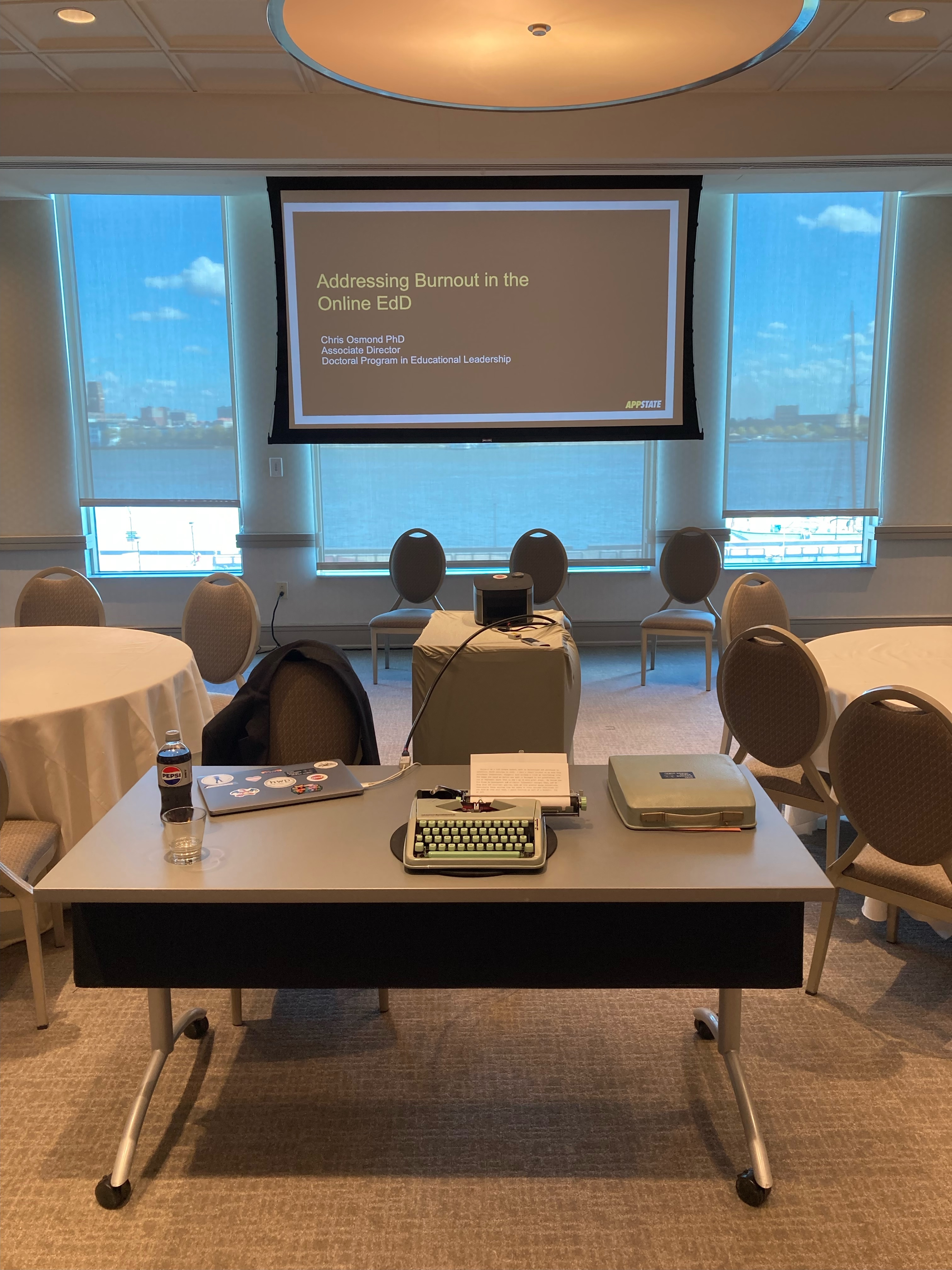
I brought a typewriter with me, as above: my bulletproof 1965 Hermes Rocket, which has traveled with me to Hawaii and Ireland and many places in-between. My session was on manual typewriters in 2025 as an interpretive lens to understand the nature of educator burnout and find new ways through it. (Also the topic of the book I have coming out very soon with Loose Dog Press: watch this space!)
So I got to bring the Rocket with me, and invite participants to take it for a spin. Maybe one of the latent powers of a manual typewriter in 2025 is that it is always exactly what it is, where it is. After all, it is the only object in this photo of my session that is really its own, singular thing: the tables and chairs are anonymous, and even the “slides” aren’t real.
In every session we found ourselves sitting with strangers at a round wedding-reception-type table covered by two massive industrial tablecloths and were asked to interact, to break ice, to discuss, to synthesize, to report out, above all to network. The incongruity of the importance of the work we are striving to do at these meetings, juxtaposed with its trade show surroundings, always jars me and creates an anomie in my soul so consistent I have learned to brace for it.
I remember attending my industry’s biggest meeting twenty years ago in San Francisco and standing on one of those terrible banquet chairs to see one of my mentors receive the organization’s highest honor, a lifetime achievement award. A deeply moving moment, thousands of lives changed for the better, world-shifting impact on education—taking place in a corner of the Moscone Center that would probably feature a refrigerator display in two days.
My local district in opening a new elementary school on Monday, years after accepting the fact that the historic WPA-constructed building was too close to a flood-prone river to possibly be reclaimed, Hurricane Helene displaced the kids from it anyway; they have been meeting for a year in donated halls, and so having a home at last is a major achievement. But of course, as one of my sons (a former student of the school) commented upon viewing an online video tour, it looks like a Hampton Inn inside.
I have not seen the video but do not need to. I know what educational “nice” looks like. I know exactly what he means. Indestructible carpet with fierce patterns overlaying neutral texture that will hide stains and wear for two decades. Ranks of plastic tables and chairs that can be rolled around and reconfigured, but never really fit together. Indirect lighting that will still make everything cold and sallow.
(I also read that the university building where I was so splendidly taught by that grad school mentor just re-opened after a comprehensive refresh. In the photos, I see the Hampton Inn aesthetic, filtered through a lot more money.)
I am grateful to the designers and the builders and everyone for a new building, don’t get me wrong. I just want to note that any public institutional space has to meet its contemporary demands to look “nice,” to accommodate hundreds, and to last for fifty years.
Spaces that tick all those boxes will never be humane spaces. They will never build in the evidence of human existence that so many of us find comforting in older, lived-in educational spaces. Worn spots on terrazzo floors where three generations of chairs have been scraped. Formica tabletops with the edges worn from students leaning over books, then laptops, late into the night. Chalkboards from the 60s peeking out around the edges of whiteboards from the 90s that were mounted right on top of them, to not leave divots in the drywall.
My favorite educational meeting has always happened in the same physical place, and has since the late 70s. It’s a Catholic retreat center near Dayton. I am not Catholic, but I read in its low-slung brick and monastic rooms and stained-glass chapel a strong presence of the liberation theology of fifty years ago. Ecumenical, peacenik, a little woozy, earth-tone woodcuts of venerated elders and saints painted on burlap. The rooms redolent of thousands of urns of coffee and the adequate but unpretentious on-site dining service. Brick and coffee and just a little warm damp: a terrarium, nearly, for people who seek to care for other people.
Overwhelmingly human and cozy, Feels like home to me, anyway, who is old enough to remember Air Force Base chapels built in the same vibe. Feels like room to sit and rest, room to hole up and read, room to make a new friend. The meeting itself the historic home of the last educational moment, IMHO, when we took seriously the interpersonal, the autobiographical, the human becoming of our work. The last moments before Reagan and measure-to-manage became commonsensical, before the ground opened and swallowed it all up in a conflagration of accountability that now feels like the only way to do school. (But isn’t.)
Of course, the real kicker is that every educational space that feels humane now was just “nice” when it opened, according to whatever “nice” meant at the time. The modernist / Brutalist cement and chrome piles I remember fondly from undergrad were built in the 60s as interruptions of the previous century’s brownstones. They only feel human to me because I was a human in them. (Oh look, one of those just got torn down and replaced too.)
Maybe the real point of this reverie on human living in inhumane spaces is that only by living in them do cold spaces warm up. Places where we do sacred work become sanctified. Churches and schools. Why does an empty classroom feel different than an empty hospital ward, than an empty prison cell? Exactly.
Maybe one of my deepest disquiets about online Zoom classes is that Zoom will never feel lived-in. A Zoom meeting is always the same, because a Zoom meeting is not a place. Evening class in Zoom can never feel different than every other meeting you have had in Zoom that day. It is the same not-space, and unless we who teach there make a real effort to make it otherwise, what is conveyed therein will just be more content to be consumed and optimized and turned into deliverables and accountabilities.
(And easily 1/3 of the sessions at my meeting were about incorporating AI into the teaching, writing, and mentoring work we do: another irreality that is changing the scope of what we can imagine doing with our students. For another day.)
We need real places to feel ourselves as real people undertaking real experiences. A sentence even John Dewey, that Lorax of experience, could not have imagined uttering in his day.
Don’t know how to end this. Maybe with the suggestion that we all notice and value what the real spaces we live in do for us. Whether welcoming and accommodating or brutal and indifferent, we make ourselves and each other as we share those spaces and work toward our shared intentions.
What do we want them to feel like? What can we do to make them more so?
Whatever they start out as, they end up…ours.
This whole blog SHOULD be about my amazing encounter this week with Bryan Kravitz of Philly Typewriter. What a shop, what a project! Typewriter Valhalla! More to come!
I really have no time for blogging today, but I have to share Wikipedia’s “Signs of AI Writing” advice page that I stumbled across while not sleeping last night. It is sort of an internal white paper for those who edit that remarkable resource: not definitive, but trying really hard to be helpful.
I had no idea this existed. But it turns out to be the most explicit list of tells, bugaboos, and quirks of LLM output in fall 2025 I that have ever seen.
Last week I taught my doc seminar on scholarly writing, and was informed by my doc students that “em dashes mean AI wrote it.” A quick web search shows I am a few months behind this supposed wisdom, and it is included.
The first takeaways are pretty breathtaking. I will quote widely from the page (linked above) because no time to paraphrase.
[snip]
LLM writing often puffs up the importance of the subject matter by adding statements about how arbitrary aspects of the topic represent or contribute to a broader topic…Words to watch: stands as / serves as / is a testament/reminder, plays a vital/significant/crucial role, underscores/highlights its importance/significance, reflects broader, symbolizing its ongoing, contributing to, enduring/lasting impact, watershed moment, key turning point, deeply rooted, profound heritage, steadfast dedication, indelible mark, solidifies …
AI chatbots tend to insert superficial analysis of information, often in relation to its significance, recognition, or impact. This is often done by attaching a present participle (“-ing”) phrase at the end of sentences, sometimes with vague attributions to third parties…Words to watch: ensuring …, highlighting …, emphasizing …, reflecting …, underscoring …, showcasing …, aligns with…
LLMs have serious problems keeping a neutral tone, especially when writing about something that could be considered “cultural heritage”—in which case they will constantly remind the reader that it is cultural heritage…Words to watch: rich/vibrant cultural heritage/tapestry, boasts a, continues to captivate, groundbreaking, intricate, stunning natural beauty, enduring/lasting legacy, nestled, in the heart of …
LLMs often introduce their own interpretation, analysis, and opinions in their writing, even when they are asked to write neutrally, violating the policy No original research. Editorializing can appear through specific words or phrases or within broader sentence structures. This indicator often overlaps with other language and tone indicators in this list. Note that humans and especially new editors often make this mistake as well…Words to watch: it’s important to note/remember/consider, is worth mentioning …
[/snip]
It goes on and on; you should check it out.
We are of course beyond “gotcha” AI moments, at least in my institution. We are encouraged to “teach the controversy,” surely, and encourage students to begin to use these tools critically because job skills.
But if you are someone who cares about words, or was taught to, or make at least part of your life with words, I ask you: what do you notice about these “tells”?
That they are, and have always been, the hallmark of inexperienced writers trying to find their way into what they have to say.
When we who care about words say that AI output is “bad” I can begin to see now what we mean. It is vague; it pretends to perspective it does not have; it leans into gravity while being featherweight.
In other words: it is a lot like the papers many of our students would be writing on their own–if they were actually writing their papers.
So where’s the problem?
The problem is: until you write like this on your own, and get told you are writing like this and shown how to do better…you will continue to write like this.
Worse, you will be satisfied with this writing as “enough.” It looks “smart” and “authoritative,” so it must be.
And this is only the writing-skill part of the deeper issue, described in the lengthy quote from an associated page:
[snip]
LLMs are pattern completion programs: They generate text by outputting the words most likely to come after the previous ones. They learn these patterns from their training data, which includes a wide variety of content from the Internet and elsewhere, including works of fiction, low-effort forum posts, unstructured and low-quality content for search engine optimization (SEO), and so on. Because of this, LLMs will sometimes “draw conclusions” which, even if they seem superficially familiar, are not present in any single reliable source. They can also comply with prompts with absurd premises, like “The following is an article about the benefits of eating crushed glass”. Finally, LLMs can make things up, which is a statistically inevitable byproduct of their design, called “hallucination“…
As LLMs often output accurate statements, and since their outputs are typically plausible-sounding and given with an air of confidence, any time that they deliver a useful-seeming result, people may have difficulty detecting the above problems. An average user who believes that they are in possession of a useful tool, who maybe did a spot check for accuracy and “didn’t see any problems”, is biased to accept the output as provided; but it is highly likely that there are problems.
[/snip]
If you care about writing–or if you don’t care about writing, but do care about critical thinking, bias, or plausible-sounding and confidently-expressed things being accepted as true–well then, there is much to fear here.
Thoughts?
My typewriter sits in the corner and shakes its shaggy head at me…
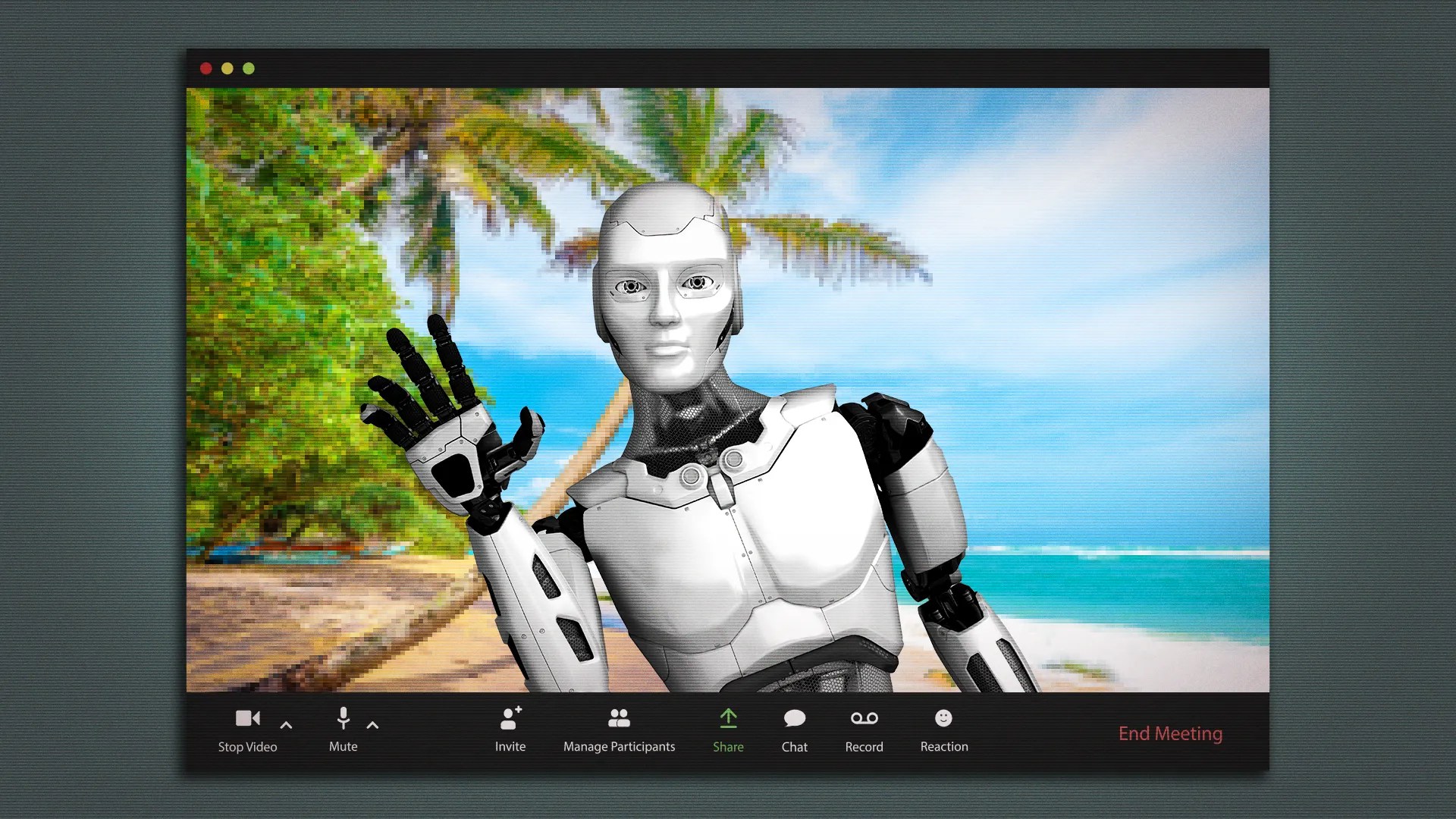
Image borrowed from this Axios story on the apparent currency of the term “clanker” for undesired and ineffective AI. Image possibly AI generated, who can know anymore ¯\_(ツ)_/¯.
*I am not really a Pavement fan, though “Slanted and and Enchanted” was pressed upon me by the hippest guy I know. See? I have no strong feelings about Nickelback, but I wish them well.
**That whole last bit is Wendell Berry—sure ain’t me, but I love it. See the page “Typewriter Agonistes” for link.
It details the thrill of Tom Mullaney, an obsessive history professor (I thought I had it bad) searching out, finding, and saving the only extant example of this machine from oblivion.
I have never seen any Asian language typewriter in person, but the gorgeous photos here really give a sense of the engineering feat accomplished in this protoype.
Imagine!
Any two keystrokes, representing pieces of characters, moved gears within the machine. In a central window, which Mr. Lin (YuTang, the inventor) called the Magic Eye, up to eight different characters containing those pieces then appeared, and the typist could select the right one.
Mr. Lin had made it possible to type tens of thousands of characters using 72 keys. It was almost as if, Dr. Mullaney said, Mr. Lin had invented a keyboard with a single key capable of typing the entire Roman alphabet.
He named his machine MingKwai, which roughly translates to “clear and fast.”
Ibid.
It was never manufactured. Lin had a single prototype made in the 30s at his own enormous expense, and tried to sell it to Remington, the General Motors of the era’s American typewriter industry. It failed during the demo; he went bankrupt; the machine was stashed at his job, then moved here, then there, and was presumed lost.
“Gone the way of most obsolete technology…had most likely ended up on a scrapheap. The right person hadn’t been there to save it, to tell its story.”
What is worth saving?
I think typewriters tend to be! My typewriter collection does not enter Dr Mullaney’s rare air, for sure. All of my machines were made in the hundreds of thousands, if not more, and none could be considered truly scarce. Though some, like the 1967 Hermes Ambassador that tops my blog, are definitely scarcer than others.
But the course of the Ambassador is exemplary of the path I think once-precious things often take when they become outmoded. It got stashed in the back of a dry closet, under a cheap plastic cover someone had the presence of mind to replace before forgetting about it for decades. And that afterthought by some anonymous someone is why it surfaced in an estate sale, perfectly functional, when so many others that were left uncovered in damp basements or attics do not. (Cover your typewriters, children!)
I think so many manual typewriters are still around because they were so expensive. They were workaday tools–well, some were more stylish than others, and they had different price points, so maybe they were more like automobiles than tools–but they were dear to acquire, about the price of a laptop today. So even when they were no longer needed, and were replaced by an electric or a desktop computer, folks couldn’t imagine tossing them out.
That cover wasn’t an afterthought. The Ambassador was a luxury model! I like to imagine that it was the owner’s child, or grandchild, that finally made the choice to store it safely. Maybe because they had been told over and over that it wasn’t a toy. You can’t play with it. It’s precious. Treat it like something precious. And that someone–or their child–did.
So maybe that’s why one generation’s expensive stuff tends to still be around for future generations to rediscover, reassess, and decide if it has anything new to offer in a present-day recontextualization. The kids get told to take care of it–and they do.
But…what about the true ephemera of our daily lives? Will we miss any of it when it is gone?
Cruise FB Marketplace’s “free stuff” section in a college town right around the end of July, when all the student apartments are turning over, and wonder. Will anyone ever miss flatpack furniture? Entry-level vacuum cleaners? Futons? (So many futons.)
So much hideousness. Here in my personal college town, our sustainability-branded university students used to collect all the discarded stuff, spend a few weeks cleaning and sorting it, and then sell it back to the incoming frosh in “The Big Sale” that happened at Legends, proceeds to scholarships. A one-day Black Friday delirious feeding frenzy of plastic and upholstery and area rugs. It was a gas.
Unimaginable with social distancing, “The Big Sale” got cancelled during COVID…then, like so many things, just quietly never started up again.1 I have a mediocre electric fan from the last one in 2019. It cools nothing, but reminds me of stomping around the bedlam of that sunny hot morning in a packed Legends with my then six-year-old in wide-eyed tow. Glorious memory.
You miss the ephemeral stuff if you have reason to miss it; you miss stuff if it has a reason to matter. It was from the last “Sale.” I didn’t know it was the last sale, any more than Lin knew the typewriter would be the only one ever made. The meaning got loaded into it after.
And of course you can’t save everything just in case it matters later–because that is the high road to hoarding. If you never throw anything out, how will anything ever be precious?
You have to miss something for anything to matter. Like Sheryl Crow sang, “there ain’t nothin’ like regret / to remind you you’re alive.” Better to lose too much and make space for the new, run the risk of having tossed something you long for, than be hemmed in by stacks of everything in case some of it happens to matter to you again…
Right?
So: save some of it, I guess?
Maybe that is how to honor a past you were part of–and, eventually, as you grow older and more judicious about what is beautiful, a past you weren’t part of too.
But also, let the world have its way with ephemera, which of course is most everything. Burn through stuff made to be burned through.
What matters will become clear later…and we will have the delectable chance then to rediscover what once we could not even see, and treasure it up in our new world for the preciousness it brings us from the old.
Ibid.
Besides, Legends was torn down this week. Victim of Helene, supposedly–but also was hard to program the last few years, and nothing that doesn’t fill up right with value stays as-is on this campus. Will it be missed? Maybe if you saw Hank Williams Jr there, or Dave Matthews, or A Tribe Called Quest…some hyperlocal cred to be collected if you did. I saw a great band there once featuring students I taught in middle school twenty years earlier. That is enough for me to miss it–especially because it will almost certainly be replaced with some “nice”, institutional building with all the soul of a Holiday Inn Express. ↩︎
Here he is! You probably didn’t even know he existed.1 He messes up what you are trying to write. He introduced the errors that have grown like mushrooms in your draft since you last looked at it. His industry is your weakness. It’s not you–it’s him! The lord of all typos, the demon of scribes: meet Titivullus!2
I understand he was originally two demons! One who gathered up all the poorly-spoken and mumbled sermons of the preachers and prayers of the laity in a big sack–the image above has him in this form, toiling toward his quota of a thousand per day (!). And a second who compiled and tallied them, to be held against the poor mumbler and lazy parishioner on the judgment day.
Most images from a terrific blog at Lost Art Press. You should just go read it!
Thus the medieval church installed a panoptic anxiety among the faithful.
In Margaret Jennings study of Titivillus she wrote the point of this Medieval demon was to remind clergy and laity of the danger of “spiritual sloth.” The litany of the service, each prayer and each song were to be unhurried, expressed clearly and with fervor.
To say or sing by rote and without care, to attend church, but not participate wholly was to open oneself to sin. Hence, visual reminders of a recording demon, as well as other devilish minions, were found on wood, walls and paper. In the hand-colored woodblock above three women gossip, one demon scribbles away and the second demon stretches a scroll with his teeth because they need more paper!
He sees you when you’re sleeping, he knows when you’re awake…and he knows if you have been phoning in your devotions, too. So look sharp, lest your imperfect words be held against you in the final tally and toss you into the jaws of hell (below, right).
Fate of a “dishonest alewife,” also given to loose talk. As above.
From the demon monitoring and keeping track of our language shortcomings, it was a small step to the demon actually interpolating such errors. Mischief not just recorded, but instigated. And thus T became the active cause of our imperfections, not just their registrar.
Titivullus’s relation to Ceiling Cat’s many forms is as yet undocumented, and awaits future research.
Fun fact: he is apparently the source of the “printer’s devil,” the name given to apprenticed boys who scurried around eighteenth- and nineteenth-century printshops pulling fresh pages out of the press and collecting errant type to melt down. Because their hands were blackened by ink; because they were underfoot; because they made mischief!
Holy cow! No wonder we are so averse to typos and other false steps in our writing. We liberal arts undergrads who sort-of remember our sort-of reading of Max Weber shake our woolly (or bald) heads and think, yes: sloth in all its forms does not compute with the rational pursuit of economic gain. So mis-writing is a crime against God, and also profit.
Are we still in thrall to Titivullus? Well…does this track?
Typos are sin! And must be stamped out, even (especially?) if doing so requires an internalized self-loathing that is activated whenever we make a mistake.
Whenever we read back what we just wrote and think, that is not what I meant at all. That sounds stupid, and I misspelled “stupud” too…that voice is the spirit of Titivullus, living for free in our heads!
And loading up the very fallible (but passionate) humanity that led us to write anything at all with…well, wow, with what?
Guilt?
Nagging sense of inadequacy?
Embarrassment at having thought we had anything to say in the first place?
Much safer to not write anything at all…
And If we are already primed to feel bad about our writing’s syntax inconsistencies, then the prevalence of effortless “typesetting” technologies will make us feel even worse.
We all know two spaces after a period in word processing is a tell that your author is a recalcitrant from the age of typewriters. Word processing automates the monospace of typewriting: just put in one space and let the rock that thinks figure it out.
And everything written should look perfect now, whether or not it is actually flawless. Canva is the tip of the spear, here; a friction-free tool that raises all our expectations that whatever we dare to inscribe should be Instagram-ready, should look cute on a Stanley cup or an Etsy t-shirt.
When you know about Titivullus, you see his minions everywhere. Making you feel bad about all the ways real human words are imperfect when they first come out of us.
And making you think that until they are perfect, they are wrong and unworthy. And maybe even evil: maybe even will be held against us in some final accounting that awaits us, and our wordmaking.
What bunk, friends!
Let’s embrace an enlightened perspective that we all make and consume our words exactly the best way we can and should, exactly as we are!
Especially when the demon’s AI great-great-great grandchildren are offering us the false promise that we need never feel bad about our words again–as long as we just let them write for us. (“It’s cheating, but I don’t think it’s, like, cheating.”)
Subtle temptor indeed.
Long live typos–because they affirm the real-world and real-person provenance of what you are reading!
Or “Tutivillus, Tytivillum, Tintillus, Tantillus, Tintinillus, Titivitilarius, Titivilitarius.” He is a demon of many names–perhaps more evidence of his craftiness. To believe Wikipedia, “for the past half-century every edition of The Oxford English Dictionary has listed an incorrect page reference for, of all things, a footnote on the earliest mention of Titivillus.” ↩︎