“Of all the vices, I find books to be the least dangerous…I think it’s possible his landlord might have their priorities misplaced, or might not understand him. If you’re not steeped in his culture, maybe his library does look chaotic. But I’d argue it only looks like a mess. I’ll bet he can tell you where every single book is in his apartment.”
That’s bookseller Israel Mizrahi on Mendel Uminer’s collection of thousands of books, and his resultant eviction from his Upper East Side apartment. Here’s a picture of only some of them.
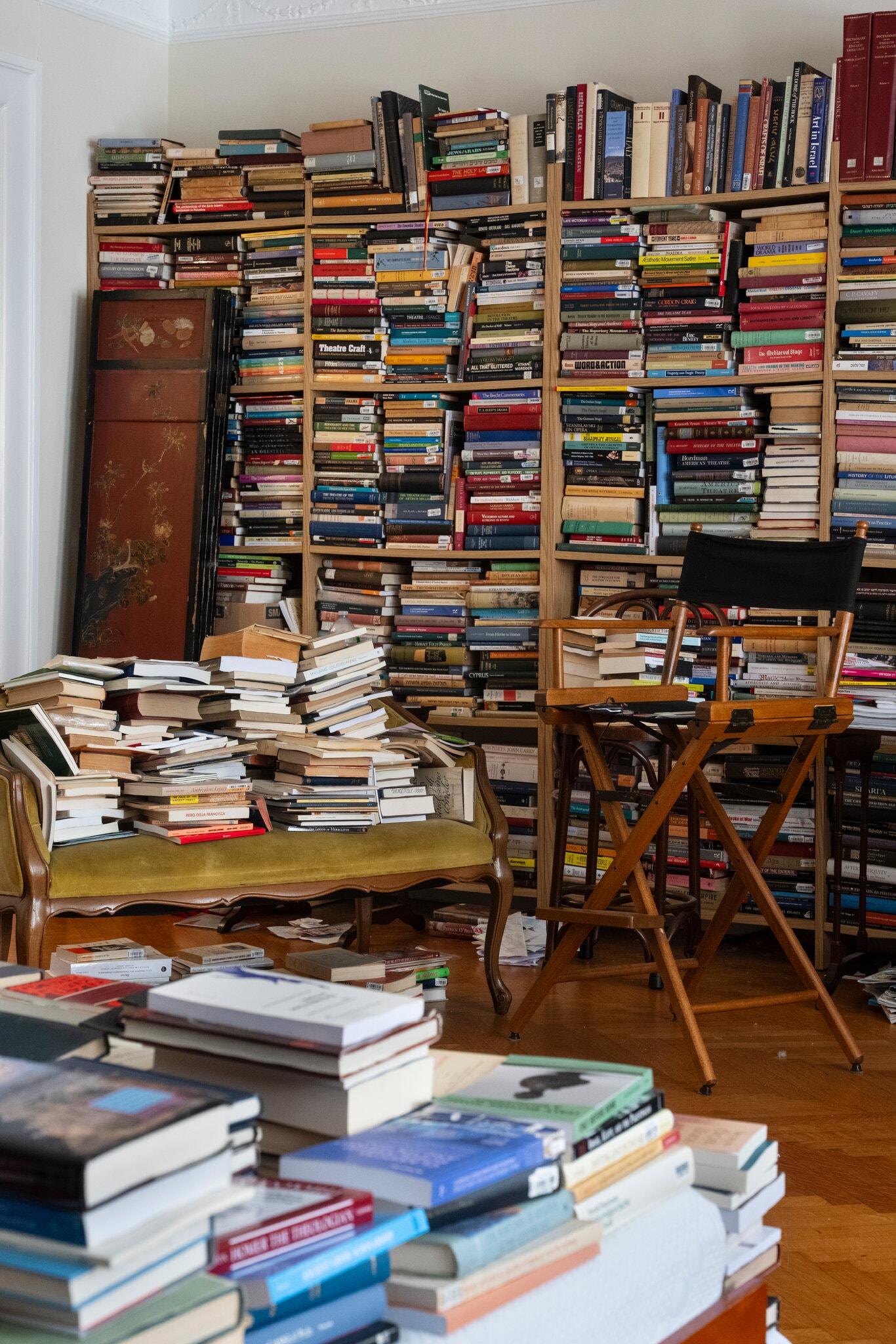
According to yesterday’s NYT piece, the stated grounds are fire hazard–but, as becomes clear in the article, his true infraction is unseemly eccentricity. Too many books!
We have a word for people whose relationship with their stuff doesn’t track with the sleek, beige, gentrified, laptop-and-tablet-and-phone lifestyle promoted on the socials: “hoarder.”
Like so many words borrowed from clinical psychology, its casual use dishonors the suffering caused by its authentic manifestation. It feels edgy, using words about real pathology to describe behaviors that are a little outside the norm–feels knowing and hip. It’s also kind of stupid, since it blunts an edge that can be so helpful to so many. We should do it less.
But in this case it mostly serves to reveal a high cultural antibody titer…against stuff. The manufactured challenge that so many of us feel: too much stuff in our lives, and not enough room for it.
Why can’t our spaces look as curated and spare as the ones we see in the media, in the ads that sells us the storage and cleaning technologies we “need” to so appear? Uncluttered space=clear mind, we are told to believe, and so we are supposed to discard what doesn’t spark joy. Or, if our nerves fail us, hide it in the garage.
I am maybe a little sensitive about my stuff right now! I am in the middle of an office move, from one end of my College’s massive building to the other. And while it will not involve an elevator or staircase, it is still a physical and emotional heavy lift.
I have been in my present space for eight years. And the vagaries of summer schedules mean I am moved “out” of my present space as of three days ago–but will not be “in” my next space for a couple of weeks, after its present occupant has time to clear it.
This means that all of my stuff, at present, is stashed in two corners of the big seminar room of the Program I have helped run for eight years. It is out of the way, functionally; the truth is we rarely use the space for student events anymore anyway, since the entire Program moved online in 2019.
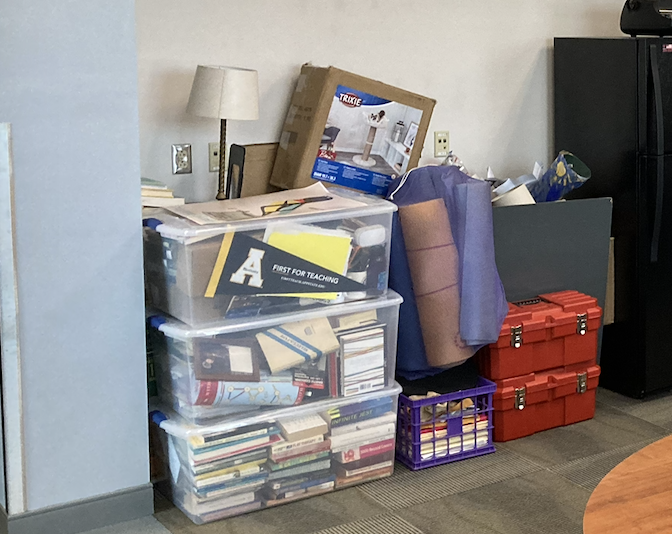
One wall is stacked with liquor boxes of books and files and papers and pictures and lamps and all the crockery and trophies and such that didn’t fit at home, and so found their way to work.
And the opposite corner is stuffed with my working collection of 40 +/- typewriters, and the shelves that have archived them and will again in a couple of weeks.
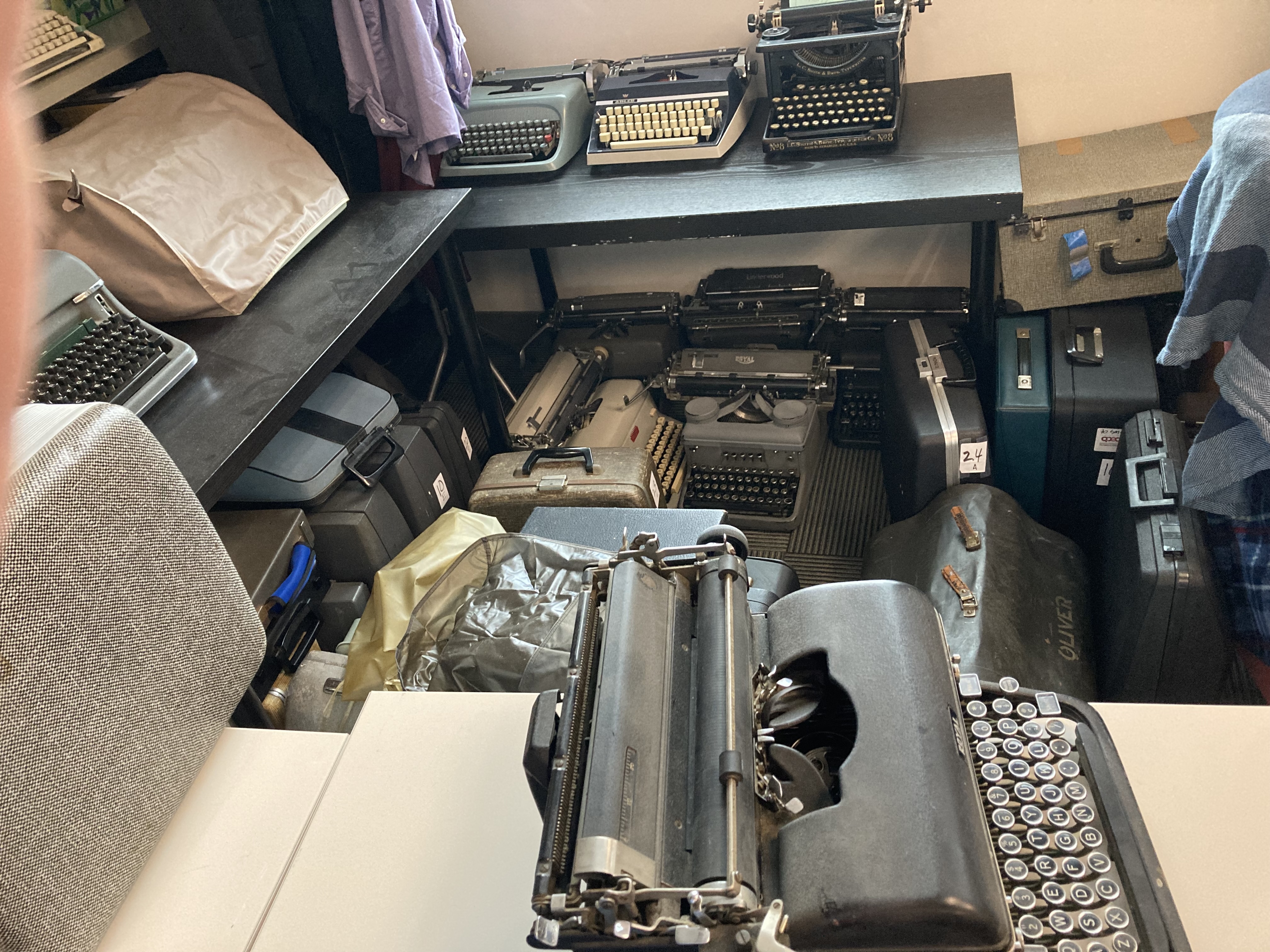
It’s a jumble, it’s a mess. And it invites inevitable feelings of reproach.
Why do I have so much stuff, when of course I can run 95% of my professional life off this laptop?
Why do I have so many books, when so much of their contents is available digitally via the University library?
And dear heavens: what of the typewriters?
Constant readers of this blog will know that my typewriters are in heavy service during the school year. (I wrote a book about it!)
They are the core of my undergraduate teaching, which asks students to retrieve a machine from my office at the start of one class session a week and use it to create a few pages of “human words” in response to a few prompts I provide. The prompts ask for reflection and consolidation of the themes in the readings we are handling that week–but also provoke about medium and technology, about attention and memory. About how the stubborn reality of the anachronistic tech in front of them refuses to let things feel normal, and what that discomfort could allow to happen next for them.
The majority of the machines I use for this teaching are “portable,” in the way that word in the 50s and 60s conveyed a machine with a case and a handle that conceivably could be carried from one writing site to the next.
But “portable,” in 2026, means something a lot lighter than the 20+ lbs of each of these machines. So their weight is a constant topic with my Gen Z students at the start of the semester: how schlepping a typewriter from my office to the classroom and back again isn’t effortless.
And of course, the new office location will require baroque calculations on my part about classroom location, changing floors, timing, frustration tolerance…learning spent with reality is rarely convenient, but the inconvenience is often the point.
Portable-but-heavy, it turns out, is an auspicious combination, if your goal is to invite students to notice stuff they haven’t before. It’s all curriculum.
And it is a nice characterization of the books in the article. Look at them! No one book is too much to manage, but taken together they are quite a phenomenon. There they sit, spines toward you for easy selection and delectation, tumble-bumble on shelves and tables and stacked along walls. Redeemed, somehow, in the opening quote, by the insistence that there is an organization to their stacking: you just don’t understand it. (If there’s a method, it’s not a mess.)
But also behold the boxes of books, so like mine. See their progress as the article unfolds: loaded up, with friends’ help, into almost-carryable batches. Hauled down beautiful but tortuous old stairways. Bunged into open minivans, in the rain of course–and finally stacked ignominiously in his parents’ apartment, in the middle of the floor, awaiting whatever is next, whatever can be allowed.
Somewhere along the line I learned, from a striving realtor probably, that the risk of many books in a home is not primarily fire: it is weight. Books are usually stacked in shelves along the edges of rooms. That concentrated weight at the borders, vs. the much-lighter foot traffic through the middle, over decades will lead to warped floorboards, settling, even foundation issues. Get rid of your books, I remember one realtor telling me. They will hurt your home’s value. Shed the weight.
But books as weighty signifiers of value, of seriousness and taste on the part of those who display them, is also nothing new.
Your books “say something” about you, we are told! You can curate them by the yard, “by color, theme, or size,” for your study decor.
You can place them strategically (or images of them) for your Zoom flex.
You can even dial them up on AI for unfathomable reasons. (No, wait–they’re real. Real fakes. Try to keep up.)
Have books, the big world seems to say, or simulacra of books: just make them tidy and hep. And for heaven’s sake, don’t make them towering ziggurats of Strand cutouts. That is not cute.
What does a wall of typewriters in a faculty office “say”?
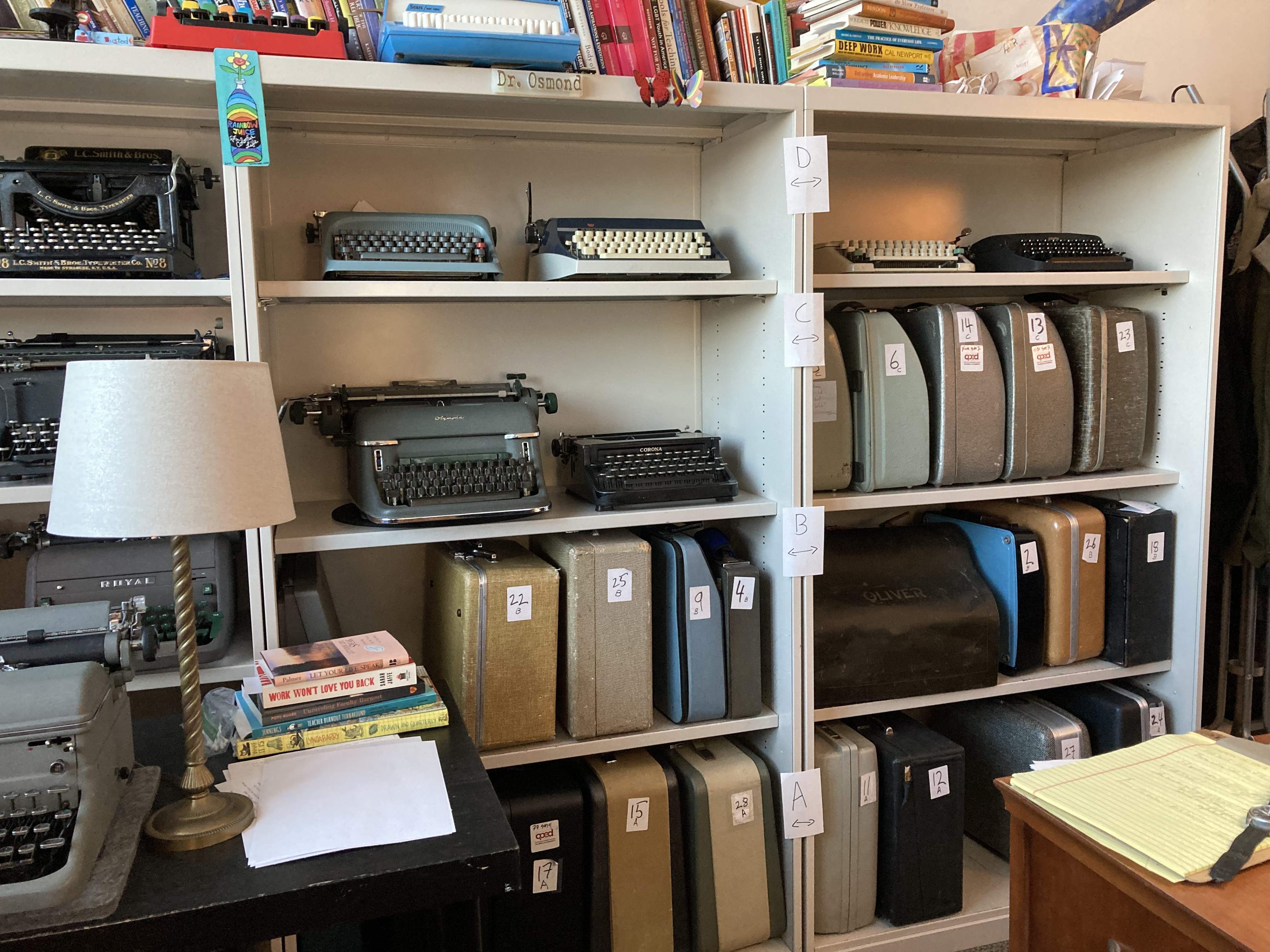
Other than giving one less floor space to maneuver through, and the comforting eau-de-typewriter-ribbon and whiff-of-mold that greets me every morning?
Well, I suppose it also communicates an eccentricity. a willingness to commit to something unusual and unwieldy, for reasons that will soon become clear if you can stay with me long enough to find out what it is.
I think teaching with typewriters is just a physical manifestation of an emotional dynamic that pervades every classroom:
-the teacher is convinced that something new should be attended to;
-the students are not so sure;
-the teacher’s first job is to make the case that a new enthusiasm is warranted;
-the teacher lends their own enthusiasm, generously, until the students’ own can be unearthed and engaged.
And a reliable way to concentrate that enthusiasm and pique that interest is to present a puzzle, an artifact, a curiosity, a weirdness. Any provocation that heightens engagement, and therefore attention, just enough for what students actually care about to run parallel to what the curriculum hopes they will start to care about. Just long enough to catch fire, like a fresh match set alongside a lit one.
Typewriters are great for that, whatever else they become over fifteen weeks of living with one.
And my wall of typewriters also gives a sense of history: a heightened sense of being in this moment by acknowledging that other moments have happened too.
This is surely a core reason why I am comforted by antique stores, especially the ones that are more rummage sale than curated display. These things all mattered once, those places say, for people who are not here anymore but were, just as you and I are here. We will eventually matter probably no more than they did, but certainly no less. Our now can be imbued with meaning by the artifacts of their now. Whether or not we take any of their stuff home, hanging out for a spell with their stuff makes our stuff–and our lives–more real.
I cannot tell you where every single book is in my boxes right now. (I also doubt Mendel can, and don’t need him to in order to have them.) I will not pretend otherwise.
But: I am definitely keeping it all. All the books, all the files, and definitely all the typewriters. (Most of the crockery.) It is all going into the new room at such time that the new room is available. I will not be culling the stacks much more than I already have, though I will probably continue to insist I intend to.
Because here’s the thing: an empty room is exciting, inspiring, bracing in its possibility. Isn’t it?
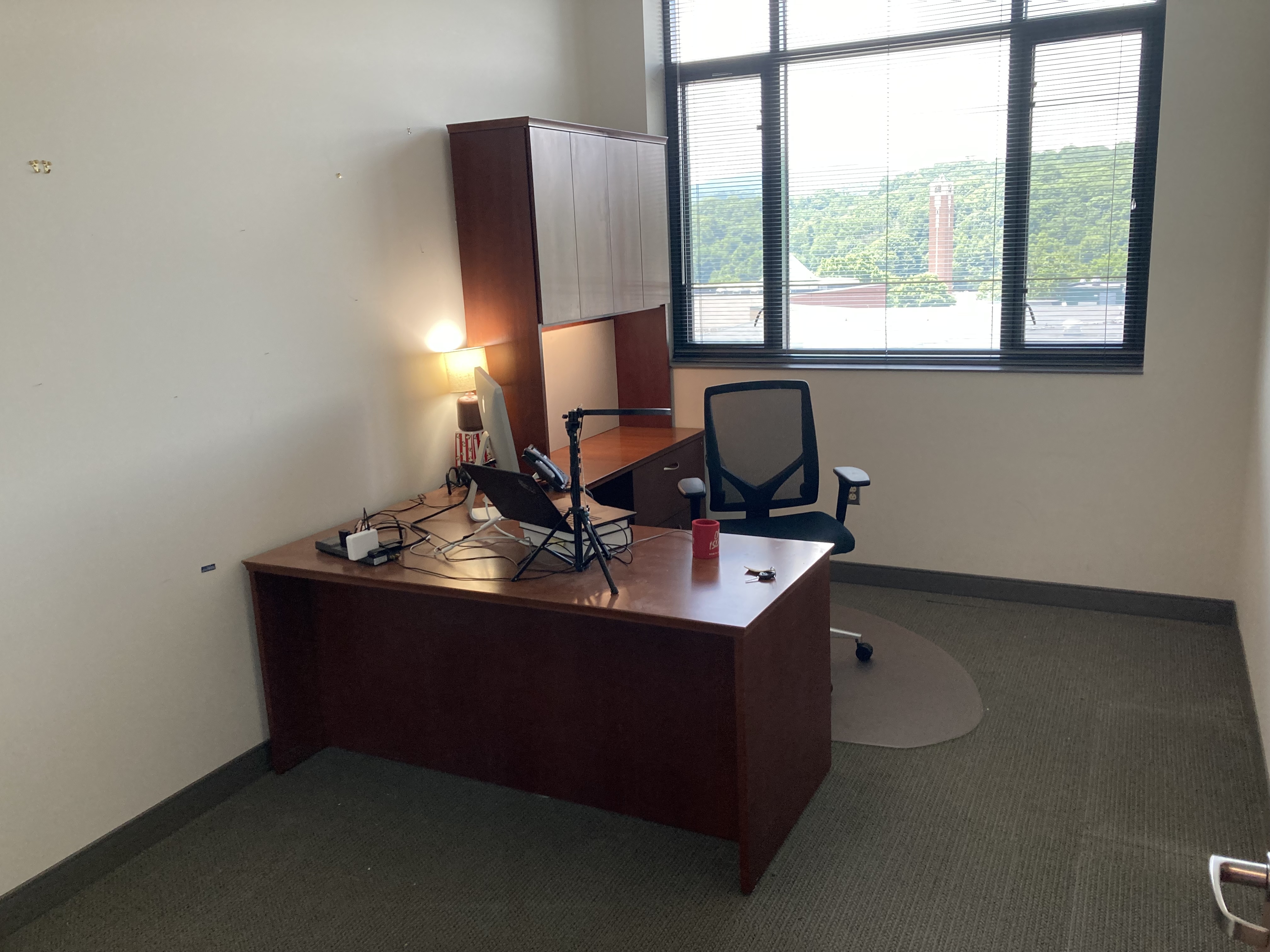
As I have worked in my now-empty office for the last couple of days, I have wondered: why do I not keep my office this empty all the time? So much space and aether; so little to hook onto from the past when I cast my eyes around it looking for the next sentence to write.
But empty rooms aren’t the ones we live in.
And they sure aren’t the ones we learn in.
And they aren’t the ones we stash the tokens and memories of the things we do that matter to us in.
You know, surgical suites are nearly-empty rooms. So are those interfaith chapels you can still find in airports. No specific tokens there to comfort or enrage; bring your own, or do without, for your devotions. Passing-through places are usually empty places.
But empty is not good for dwelling–except in someone else’s Instagram pic of how you should dwell.
Empty is not good for living–except according to someone else’s rules about how you should live.
We real humans live with our stuff: with our books, with our stacks, with our typewriters, with our ephemera that becomes less ephemeral the longer we keep it around. And sure, we can become prisoners of our stuff–but before things go that far, consider who we become when we let ourselves be owned by our stuff.
“It makes sense to me that Mendel, a Brooklyn yeshiva kid, would come to the Upper East Side and make this world for himself here, only to get rejected from it…There’s a New York now, keyed into professionalism and uniformity, that sees a guy like him and thinks something must be wrong. There’s an element to the city now that’s hostile to the life of the mind, to the eccentricity that might produce it.”
I hope you can find your own personal way to push back today against the forces of uniformity. The hostility to living one’s own life that is sure to come at you, in ways great and small, every time you ask the monoculture for input on how you should live.
After all, we are way harder to market to when we don’t like the things we are supposed to.
We are way harder to control when we don’t share our every word and image with the algorithms.
We are way harder to pathologize and shame into buying stuff we don’t need if we won’t be who we are told to be.
So blow up your TV, like John Prine told us fifty-five years ago. Delete your account, we would say now.
And go buy a used book, or an antique typewriter, and put it right in the middle of the table, right where it doesn’t belong.
Then get another one. And another.
Top image by James Estrin, from Alex Vadukul’s linked NYT story and reproduced here with thanks. All other images my own.

